Showing posts with label Greenshank Common. Show all posts

Monday, 14 May 2018

A few breeding plumage waders

I've only managed to get out to Heurajima once this spring; an uneventful trip before better weather brought some decent birds. Since then I've either been too busy or the ferry hasn't sailed so last weekend I decided to content myself with a trip to Mie to check out the wader passage.


The forecast predicted a 90% chance of rain from about 6am onwards but as luck would have it the rain held off till 1pm and didn't come down in road flooding torrents until 2pm. One benefit of dull, heavily overcast weather is Green Pheasants are suddenly everywhere, I stopped counting at 10 roadside birds. They can be next to impossible to find on clear days and trying to find them for visitors can prove a real time waster.


The downside of being easy to find to wet weather is they lack the vivid iridescence that makes them so striking.


But this post is supposed to be about breeding plumage waders, isn't it? There were about 300 red Red-necked Stints on the mudflats but you can't be everywhere at the right time and none of the Stints were close when I was at any of the three estuaries holding large numbers. Ponds and beaches were better for reasonable views of birds and for me a couple of Spotted Redshanks were the most attractive waders of the day.


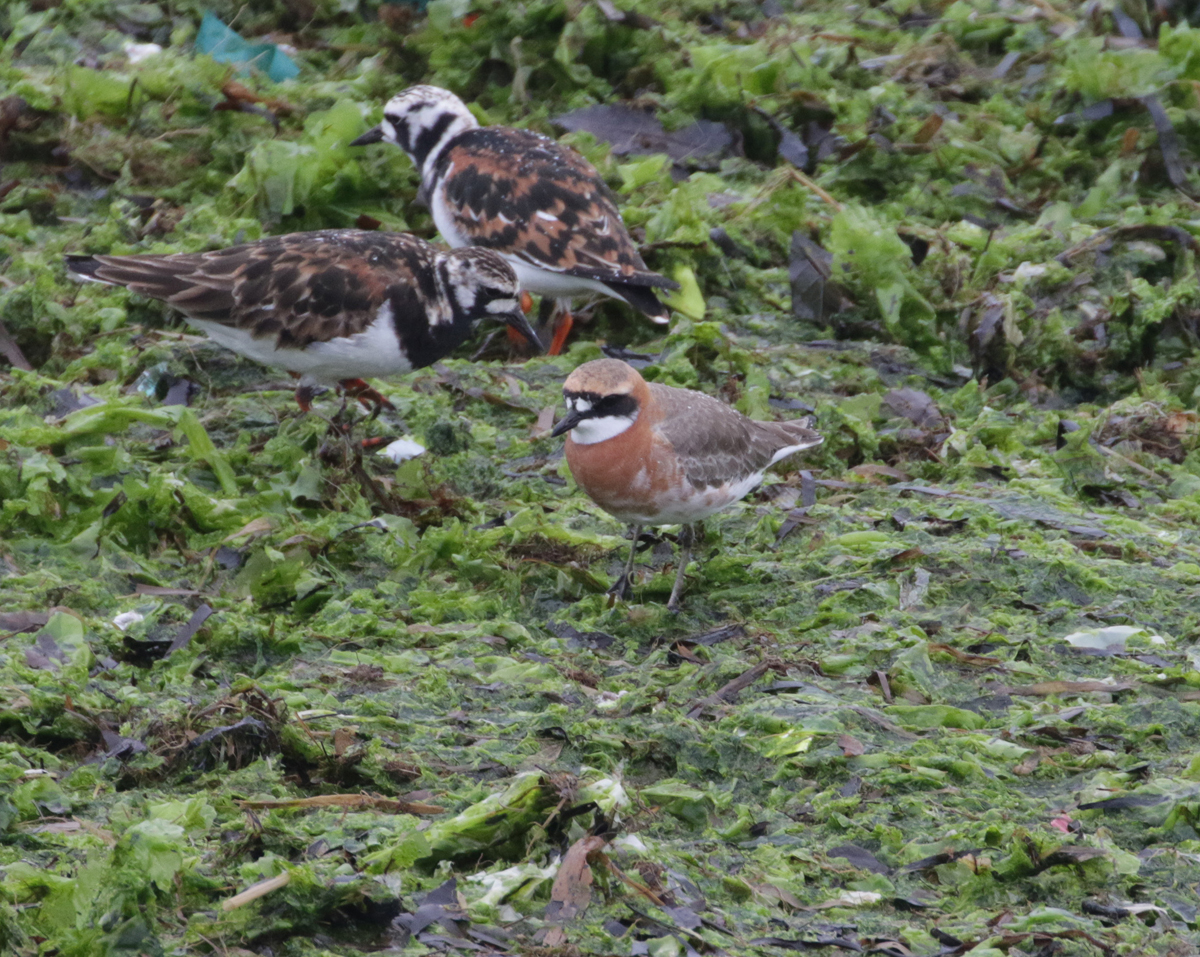
Ruddy Turnstones were looking pretty good too, 66 birds was the largest group I came across. Again the light wasn't very helpful and it was difficult to get good shots of them.


There weren't many Lesser Sand Plovers around and most were on distant sand bars, this bird with the Turnstones was the only close bird of the day. I don't see many in full breeding plumage and rarely see birds with such extensive red on the flanks and lower breast.


Not the 'best' of the Common Greenshanks but the only one that came close.


Whimbrel were very common along the shoreline and in the fields. In my pre-camera days I'd have IDed them and moved on but one of the great things about taking pictures of common birds is I notice things I would otherwise have seen. In this case I was surprised by the difference in primary projection, which presumably has nothing to do with age; the first bird has three visible tips well beyond relatively fresh looking tertials whereas the second has only two just showing beyond more worn tertials.


Tuesday, 31 October 2017

Dowitchers and Greenshanks at a high tide roost

There were a few late passage waders on October 27th and the first birds of the day, Great Knot, probably fall into that category. However most species I saw are likely to spend the winter locally.


The Great Knot were close enough to chance a couple of shots despite the poor pre-sunrise light. If I'd waited any longer they'd have been against the rising sun so it wasn't as though there was any choice. Perhaps it's just coincidence that the only Great Knot I ever get close to are very early in the morning and the resulting images are never satisfying.


Great Knot


If it isn't dim early light then it's strong midday sun, or that's how it sometimes feels. The regular Common Greenshank high water roost on the other hand is a different matter, it's simply a matter of going when high tide coincides with the sun at the right angle. This dosen't happen every day obviously but last Friday the timing was just right. The Greenshanks were expected, they're always there if they haven't been disturbed, but the Long-billed Dowitchers were not. I've never seen them on the estuaries before and they'd probably been displaced from a pond or lagoon by the high water levels caused by the last typhoon but whatever the reason for their presence they were a pleasant surprise.


Part of the wader roost on the steep concrete riverbank. The Greenshank can usually be found at this spot providing no one has disturbed them but the Dowitchers here are a first for me.


Tuesday, 8 November 2016

Early November in Mie

The day before I drove to Saitama to see the Wood Warbler I was birding in Mie, the usual Tsu / Matsusaka area. Since my previous visit a couple of weeks earlier duck numbers were up but still well below winter peaks. Perhaps sea ducks are a little slower arriving but this isn't an important area for them and numbers never impressive. I didn't see any Red-breasted Mergansers, Common Goldeneye or scoters, the former is common in winter, Goldeneye is only ever present in low numbers and the scoters aren't even regular. The first Eastern Buzzard had arrived, Northern Goshawk and Eurasian Sparrowhawk both put in an appearance adding to the sense of seasonal change. Daurian Redstarts were common and there were even a few Dusky Thrushes. Dusky Thrush is never occurs in big numbers until later in the winter, presumably they drift in as the real winter weather bites elsewhere. On the wader front wintering Long-billed Dowitchers were in (only three but that's as good as it usually gets), Northern Grenshanks can be seen throughout winter but a Spotted Redshank was the first for a while, likewise three Wood Sandpipers. A couple of lingering Barn Swallows were keeping low as if not wanting to advertise they weren't where they ought to be by now.


The first Eastern Buzzard I've seen in the area this "winter".


Juvenile Northern Goshawk.
Lunchtime; the agony of choice.


Northern Lapwing; part of a flock of 31.


Northern Greenshank; numbers vary winter to winter but their favourite high-water roost site doesn't seem to.


Short- and medium-billed Far Eastern Curlews, no monsters today.


Wood Sandpipers.


Heading out with the tide; the birds too.


Great White Egret numbers seem a little down and Little on the up, more of a balance. Cattle were still present on 8 Oct but none by the 21st, Intermediate are still hanging. I've only ever seen one mid-winter Cattle but Intermediate is more likely.


Great White Egret.


Intermediate Egret.


So often spoonbills either have their bill hidden under their wing or under the water. So it was nice to see this one catching the evening sun as it flew in.


Immature Eurasian Spoonbill.