There's a good range of robins that could been seen at different times of year, some widespread others more localised. Some outright rare.
Swinhoe's Robin is a scarce spring migrant in western Japan, more often heard than seen and
becoming increasingly rare to the east, it is extremely unlikely to be found in Kansai. Bluethroat is encountered even less often but records are more widespread and have a more autumn bias. I found one on Hegura and it has turned up in Osaka. European Robin is a major rarity in Japan but it has also occurred on Hegura.
The remaining species are more realistic targets. Japanese Robin and Siberian Blue Robin both breed in the mountains of Nara and Blue Robin is sufficiently common to be quite easy to find. As well as breeding in the region they seem widespread as migrants, I occasionally see them around Kyoto (where they are also reported to breed but I've never met with one during the breeding season) and they are sometimes seen in the larger parks particularly in Osaka city. Siberian Rubythroat is the least likely of Japan's breeding species to be seen in Kansai, though it's a regular migrant its habits don't make finding them easy. I've had one or two in tangled scrubby areas along the Uji/Yodo River. They're fairly common on Hegura and many fetching up along the mainland coast must go unfound. Red-flanked Bluetail is mainly a winter visitor to Kansai, it's common on the hills around the city and throughout the region as a whole. It's also frequent but not guaranteed in city parks where they can be much easier to get good views of. I come across them on any walk through the surrounding hills and I'd be very surprised not to see them at easily reached sites like Takaragaiike or Fushimi Inari.

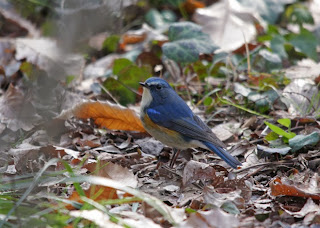
Male Red-flanked Bluetail in Kyoto botanical gardens, 3 February 2013.
 This Bluetail was particularly confiding because of mealworms being put out for a Red-breasted Flycatcher.
 This surprisingly plain brown RBF on Yonaguni lacked any hint of orange at the bend of the wing, but it did have blue in the tail putting a damper on initial excitement, 6 April 2013.
Daurian is the only common redstart in Kansai, or Japan for that matter, though I did come across a Black Redstart on the Uji River in Kyoto about 20 years ago! Daurian arrive on Hegura in large numbers from early October and I usually have my first in Kyoto by mid-month. I'll often hear one calling unseen from roof tops in the city centre back streets and they are easy to find in any open areas, gardens, temples, riversides etc.
A very fresh brown-backed male on Hegura, 11 October 2011.
A more worn male along the Katsura River in Kyoto, 29 October 2010.
 A smart looking April male.
Female Daurian in Tsu city, Mie 10 January 2014.
The only
saxicola chat that can be expected in Kansai is Siberian Stonechat, it's a common spring and autumn migrant in open scrubby areas along Kyoto's rivers. The other species are all vagrants to Japan.
Japan's second record of Whinchat was discovered 4 October 2009 on Hegura, two days before I arrived, and stayed until 13 October.
 Juvenile Siberian Stonechat in Hokkaido 11 August 2012.
 A common migrant in Kyoto, this one of several birds along the Katsura River, 1 October 2011.
Spring male, 4 April 2013.
There are five species of wheatear on the Japan list, all rare and not to be expected by any visitor. Off-shore islands are the best chance to see any of them. An Isabelline on the Yodo River between Kyoto and Osaka in October 2012 was totally unexpected. Normally I'd be on Hegura at that time so it was incredibly lucky I wasn't able to go that year!
 A confiding Isabelline Wheatear at Hirakata, Osaka 11 October 2012.
Pied Wheatear on Mishima (Yamaguchi) 11 May 2010.
Record shot of Desert Wheatear, Hegura 10 October 2004.
Blue Rock Thrush
M.s.philippensis is the only member of the family likely to be seen in Kansai. Others are rare in Japan and a male
pandoo (on Hegura) is the only other taxon I've seen. In Japan it's known primarily as a coastal breeder with some birds occurring inland in winter. It breeds commonly along the region's rocky coasts and in coastal towns and villages. However I know several pairs breeding at inland factories, including in southern Shiga which is probably as far inland as you can get. I don't know if inland breeding is a recent thing but I've been coming across more and more pairs in the last 10 years and one factory I visit now has three breeding pairs.
 A spring (4 April) philippinensis male.
 Spring (5 May) female.
 Fresh (2 September) male.
 Fresh (2 September) female.
 Noto Peninsular, October 10 2014.


