Showing posts with label Warbler Pleske's. Show all posts

Friday, 16 June 2023

Middendorff's(?) Grasshopper Warbler on Hegurajima

Spring migrants should all have completed their journeys by now, any that haven't are potential megas waiting to be found. It's therefore time to reflect on the good birds I did see (Thick-billed Warbler), those I didn’t (Redwing and Chinese Blackbird) and what I might have... and to that end, I do have a ‘funny’ locustella warbler that has been bothering me ever since I came across it on a day trip to Hegurajima on 9 May.

Despite some unresolved questions about its appearance at the time, I concluded it had to be a Middendorff’s Grasshopper Warbler before heading for the ferry. Once back home I looked through my iffy images which only amplified my confusion.

I first saw it in bright sunlight clinging to the outside of a clump of pampas grass in one of the harbour-front ‘gardens’ as I was drifting towards the waiting ferry. My instinctive reaction was Oriental Reed Warbler, not only did it seem large and long-tailed but it had the uniform light-brown upperparts you might expect from first glance of a brightly sunlit Oriental Reed. Before I got the bins on it, it flew into deep shade and tangled vegetation at the foot of the steep slope next to a house. That might have been the end of it as I wasn’t going to spend much time trying to get a better view of an Oriental Reed when my four and a bit hours on the island was all but up. However, I caught a glimpse of it creeping around on the ground and waited a little longer. I managed to see bits of it as it crept under or clambered through lower stems; enough bits to realize it wasn’t an Oriental Reed.

It was 30 metres away in deep shade and frequently obscured by vegetation, I couldn’t make out much detail but quickly checking through shots on the back of the camera I could see white tips to the longest tail feathers and concluded it must be a Middendorff’s, although I was a bit puzzled by my initial impression of it being large and long-tailed.

The bird’s appearance has niggled ever since. My thoughts then turned to the size and structure seeming better suited to Styan’s, which I've never seen on Hegura, while the plumage leans to Middendorff’s without it being quite what I’d expect. However, lightly streaked locustella with white tips to the tail has to be either a Styan’s or Middendorff’s, that much is straight forward, but which, and from which population?

I see plenty of Middendorff’s on Hegura in autumn (even the odd ones in Kyoto city), particularly autumn juveniles, which aren’t really relevant in terms of plumage but it’s been many years since I’ve had good views of spring Middendorff’s, which effectively means I have zero experience. This might be partly responsible for me thinking the plumage looks a bit ‘off’. Nevertheless, plumage aside, Middendorff’s always strike me as well proportioned, somewhat lightly-built, with a relatively fine bill and a shortish tail, unlike this bird. I can see my ‘local’ population of Styan’s throughout summer, from fresh arrivals in May to worn and faded birds in August. They’re a stronger-looking warbler with a deep bill and a longer, broader tail, matching the Hegura bird to an extent, but in terms of plumage they’re peas from the same pod (apart from the extent and saturation of greyish-brown wash on the underparts) and nothing like the Hegura bird.   

It’s tempting to leave it as Middendorff’s/Styan’s. However, the intriguing possibility of identifying a subcerthiola Middendorff’s or a ‘continental’ Styan’s prevents me from quite letting this go. Kennerley (Reed and Bush Warblers) describes subcerthiola as larger than ochotensis and northernmost birds as a match for Styan’s in size. Could this account for my feeling this was a large bird?  I have no idea whether subspecies are identifiable in the field so it seems a bit of a stretch.

 Things which to me don’t seem to sit well with the Middendorff’s indentification:–

Structurally, this was a large, heavily-built warbler with a very deep bill and a long, broad tail which never suggested it could possibly be neatly rounded if spread; the tail was like a plank!

At no time did I see the usually fairly obvious whitish edge of P2, nor can I detect it in any of the images I have.

Things that don’t seem to sit well with anything:–

The tail structure looked odd. T1–2 were broad and surprisingly squared-off, further, instead of having evenly spaced T3–6 with T6 about level with the tips of the undertail coverts, this bird T5–6 bunched closely together and well past the undertail coverts. Additionally, it lacked both cross barring and white tips to the underside of the tail feathers. As it was possible to detect subtle whitish undertail covert tips on a pale ground, any tail markings should have been fairly easy to make out even in these views, I would have thought. Only T1–2 had white tips, narrowly on the former and more prominently on the latter.

The sides of the throat and the upper breast were heavily streaked, the sides of the breast were grey and met in the centre as a mottled grey breast band producing a clear divide between the white throat and yellowish underparts. Prominent breast streaks and yellowish tints might be expected in juveniles but not in spring birds I wouldn't have though, certainly not to this extent. Even then, the yellowish hues of juveniles are more centred on the throat rather than the underparts.

An important point to stress is that assessing plumage details both in the field and in these images was/is tricky because the bird was constantly moving between strong sunlight and deep shade, it was often dappled and rarely in good viewing conditions. In strong sunlight the upperparts looked uniformly pale brown but in light shade the bird was a much darker brown with greyish nape and cheeks and with clear dark centres to crown and mantle feathers creating a subtly streaked appearance. There's a suggestion in one or two images that the rump/uppertail coverts might be slightly paler than the mantle but I didn't notice that in the field and am therefore unsure about this point.

One thing which may or may not be of relevance is that looking through the Macaulay Library images of Middendorff’s dated early May, there were two images that caught my eye but neither showed the whole bird so I don't know whether they were really similar but in each the bird shown has a very streaked throat and both these images were taken in the ROK in early May. Is this coincidental? I’d have assumed the most northerly breeding locustella would be arriving at a later date? How much fresher-looking are early May birds compared to a month later? More questions than answers. 

First some shots of my local Styan's Grasshoppers for comparison.

It always seems sunny when I go so a shot in duller conditions is good. Strong, deep-based bill and relatively long tail are apparent. This late June bird is already looking a bit tatty about the vent/undertail coverts.

They are very plain-looking birds (this early June) but have a strong bill and quite long tail extending well beyond the longest undertail coverts. 

The undertail cross-barring and evenly-spaced white tips should be equally obvious on Middendorff's I'd have thought.

And a couple of mid-October Middendorff's...

To me, this would is a fairly typical Middendorff's, dainty, spiky bill and short, rounded tail.

Despite the foreshortening at this angle, the tail gives a rounded impression, fitting well with the full undertail coverts.

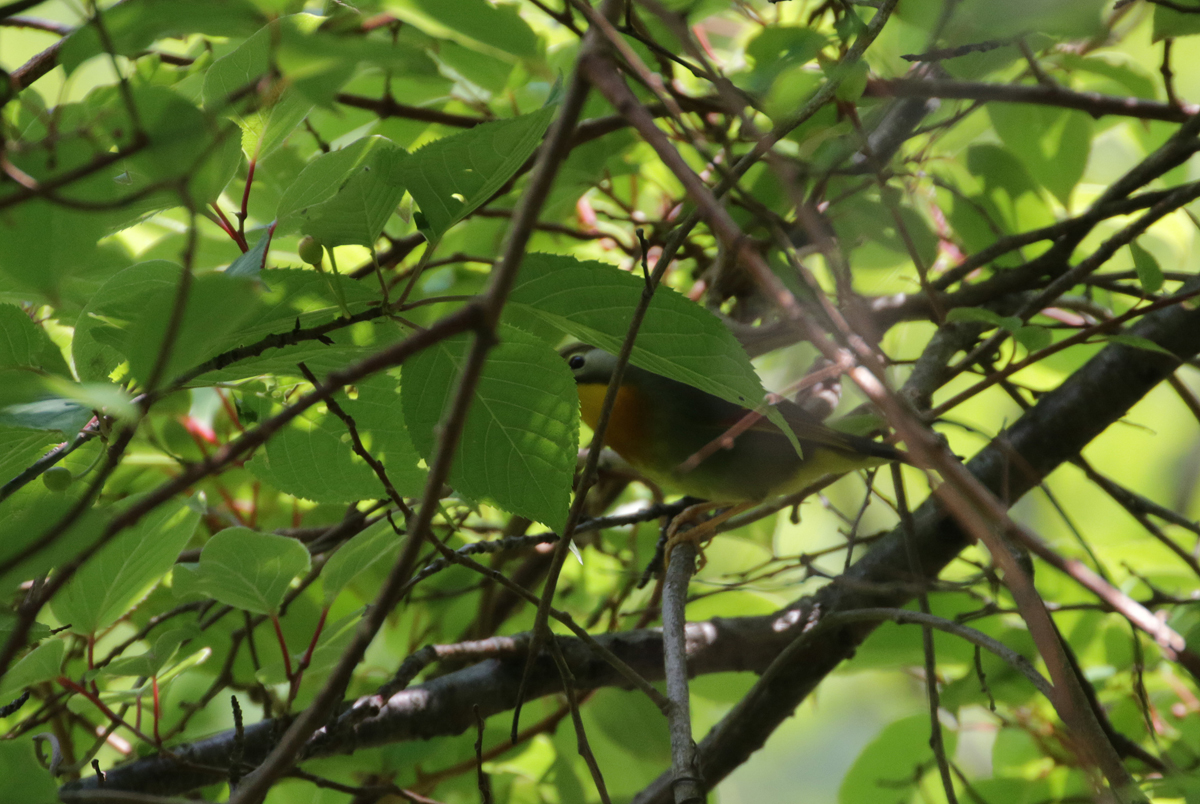
And the bird in question...

That's quite a bill its got, more in the Gray's/Sakhalin class. Bold throat streaking extends diffusely onto the flanks.

It was only in good light (ie shade but not too deep) that head and mantle streaks became apparent. I don't think the pale tip to the bill means anything but it was always noticeable.

This is what I mean by 'tail like a plank', long, broad and straight. There's a hint of contrasting uppertail coverts here.

This shows the narrow white tips of T1 and broader tips of T2.

I almost feel I'm trying to identify a SE Asian bulbul rather than a locustella. The undertail is remarkably uniform and the spacing of the feathers looks very odd; this is never going to produce a short, rounded effect if spread. Yellowish tinted underparts are strange too.

Why is the almost hidden photo-bomber in focus?! The grey sides of the breast meet in the centre creating a clean divide between the white throat and yellowish underparts.

Birding would be so boring if everything was easy.


Friday, 27 May 2016

Pleske's Warblers and Short-tailed Shearwaters

My Final day out with Jack Krohn took us south down the Kii Peninsula, aiming to see Pleske's Warbler. The Warbler was easy enough but the big surprise was hundreds of Short-tailed Shearwaters streaming by. How often do you see hundreds of Short-tailed Shearwater and Pleske's Warbler without leaving dry land?


I've often suspected seawatching off the Kii Peninsula could be great in the right conditions but it's quite a trek to go on spec. Particularly as even, with the aid of google maps, it's difficult to know where the best watch point would be under different conditions. On top of that if there weren't seabirds moving there wouldn't be much chance of anything else in compensation.


On this occasion the forecast had predicted the same fine weather we'd experienced all week, so we were a bit concerned that the sky wasn't beginning to pale as we neared our destination. The hills are normally clearly shilouetted long before the sun rises. So it was disappointing but hardly surprising that when daylight did break the sky was heavily overcast. The strong onshore wind was a different matter.


We got great views of several Pleske's, there was even a hidden Oriental Reed Warbler singing from somewhere within the dense, dark copse and before heading for the hills I wanted a quick look at the sea. With that wind I was expecting shearwaters to be passing but I was taken aback, and delighted, to find that they were Short-tailed rather than the usual Streaked. Hundreds of them streaming by, the closest were just over the rocks but numbers increased with distance and far more were no more than specks arcing above the grey horizon.


And of course there were the Pleske's...


Other coastal birds we picked up were Jack's only Temminck's Cormorant of the trip and better views of Black Kite than we'd had so far.


Delayed by Shearwaters and breakfast we were a little late getting up into the hills, early morning activity was over and woodland species harder to find. The target was Siberian Blue Robin and though we eventually heard a couple we weren't any singing close to the road. The same could be said of Ruddy Kingfisher... but the same could always be said of Ruddy Kingfisher.


The commoner woodland birds were easier to find and Jack finally caught up with Eastern Crowned Warbler here. Coal and Varied Tits were everywhere and Red-billed Leiothrix even put in an appearance though these two birds seemed a subdued breeding pair rather than the typically encountered babbling flock.


The total list of species recorded with Jack:-
Copper Pheasant
Green Pheasant
Gadwall
Falcated Duck
Eurasian Wigeon
Mallard
Eastern Spot-billed Duck
Northern Pintail
Common Pochard
Tufted Duck
Greater Scaup
Streaked Shearwater
Short-tailed Shearwater
Little Grebe
Oriental White Stork
Cattle Egret
Grey Heron
Great White Egret
Intermediate Egret
Little Egret
Pacific Reef Heron
Great Cormorant
Temminck's Cormorant
Osprey
Black Kite
Grey-faced Buzzard
Common Moorhen
Common Coot
Eurasian Oystercatcher
Grey-headed Lapwing
Grey Plover
Little Ringed Plover
Kentish Plover
Lesser Sand Plover
Common Snipe
Bar-tailed Godwit
Whimbrel
Far Eastern Curlew
Spotted Redshank
Common Greenshank
Wood Sandpiper
Grey-tailed Tattler
Terek Sandpiper
Common Sandpiper
Ruddy Turnstone
Great Knot (Jack only)
Red-necked Stint
Dunlin
Black-tailed Gull
Little Tern
Rock Dove
Oriental Turtle Dove
White-bellied Green Pigeon
Northern Hawk Cuckoo
Eurasian Cuckoo
Oriental Cuckoo
Lesser Cuckoo
Japanese Scops Owl
Oriental Scops Owl (me only)
Brown Hawk Owl
Grey Nightjar
Ruddy Kingfisher
Japanese Pygmy Woodpecker
White-backed Woodpecker
Japanese Woodpecker
Ashy Minivet
Bull-headed Shrike
Eurasian Jay
Carrion Crow
Large-billed Crow
Japanese Tit
Coal Tit
Varied Tit
Willow Tit
Barn Swallow
Asian House Martin
Red-rumped Swallow
Long-tailed Tit
Japanese Skylark
Zitting Cisticola
Brown-eared Bulbul
Japanese Bush Warbler
Pleske's Warbler
Oriental Reed Warbler
Eastern Crowned Warbler
Japanese White-eye
Eurasian (Winter) Wren
Eurasian Nuthatch
White-cheeked Starling
Japanese Thrush
Siberian Blue Robin
Blue Rock Thrush
Narcissus Flycatcher
Blue and White Flycatcher
Brown Dipper
Eurasian Tree Sparrow
Grey Wagtail
White Wagtail
Japanese Wagtail
Oriental Greenfinch
Japanese Grosbeak
Meadow Bunting


Tuesday, 9 June 2015

Pleske's Warbler

I had a free day on Sunday, and a chance to give the new camera a run out at last; only the second outing and first birding trip in three weeks of ownership! Compared to winter there aren't so many obliging practise subjects around, most interesting stuff being hit-and-miss woodland species, and I wanted something more or less guaranteed to perform. Pleske's Warbler seemed the ideal candidate. I don't get that far down the Kii Peninsular very often so the birds are always nice to see and because their breeding area is tiny they're certain to be there. Whether they're being cooperative or not might be a different matter but this early in the season I felt certain the males would be perched up singing for extended periods, and so it proved.

I arrived well before sunrise and was amazed to have a singing bird somewhere in the darkness close to the van as I parked. What's this... no need to walk out to the island? Pressure for territory in such a small area of habitat will be extreme (about seven birds were singing in a 50 x 20m area) and perhaps late arrivals might be forced onto the mainland, though this was a first for me.

I took this (iphone) shot in the pre-sunrise morning, the bird had been singing in this clump of bushes since I arrived and was still going strong by the time I left later in the morning.

The rear view showing how small a clump of bushes it is, all the more surprising being wedged between buildings.

 A departing shot later in the morning. That's the Pleske's not a leaf visible on the top of the bush just to the right of the utility pole.
 
A closer view of it singing from the bush top.


There can't be many people, if any, who have Pleske's in the garden. Certainly not on the mainland.

There was one more mainland-singing bird further along, but out on the usual spot the males were all quite high in the trees. Birds at a more convenient height weren't so keen on posing for the camera. In previous years I've had good views in the dense bushes but this year all the singing birds were 5-8m up.


Wednesday, 1 January 2014

Marsh Grassbird to acros

Marsh Grassbird used to be a scarce winter visitor to Ogura when I first arrived in Kyoto but it no longer seems to occur. There used to be 3-4 Japanese Reed Bunting each winter in the same area too but I haven't seen one for over 15 years. Given their similar breeding range and habitat it's interesting that both should drop off the local birding map.

Marsh Grassbird display flight, Hotokenuma, Aomori, 7 August 2009.

It was a pleasant surprise that such a localised species was so numerous at Hotokenuma.

Asian Stubtail is quite a common breeder on the hills around Kyoto. It's a forest floor skulker but not shy and can be easily call in.

A poor shot of a migrant Asian Stubtail on Mishima, Yamaguchi. 1 May 2010.

Japanese Bush Warbler is a very common species in and around the city. I've yet to see Korean Bush Warbler here but I have seen ssp borealis on Hegurajima in October so they certainly could occur. I've also heard singing Cettia c. canturians (Manchurian Bush Warbler) on Mishima in spring.

Japanese Bush Warbler in the Kyoto botanical gardens, 3 February 2013.

The nominate race diphone on Chichijima, Ogasawara. A potential split.

Korean Bush Warbler C.c.borealis on Yonaguni, early April 2013.

Pleske's Warbler is the only locustella breeding in Kansai, on islands off the Kii Peninsular. Others are possible on migration, Lanceolated has occurred in Osaka Castle Park for example and I've seen a Middendorff's at Ogura, but none should be expected.

Some years quite a number of Middendorff"s pass through Hegurajima and sometimes just sitting in the undergrowth is enough to get reasonable views. 10 October 2010.

Middendorff's on Hegurajima, 14 October 2013.

Pleske's Warbler, Wakayama, July 2007. The bill is obviously much larger than that of Middendorff's.

Pleske's Warbler, Wakayama, 23 June 2013.

Oriental Reed Warbler is the only breeding acrocephalus in Kansai and it's common in suitable habitat. I once heard about six Black-browed Reed Warblers singing in May at a site near Kyoto city and more recently a summer bird at Lake Biwa.

Oriental Reed Warbler at Ogura, Kyoto city, 3 May 2004.

Oriental Reed, Mie 14 August 2014. 

Oriental Reed, Lake Biwa 7 June 2014.

Breeding Black-browed Reed Warblers at Hotokenuma, Aomori, 7 August 2009.

Migrant Black-browed Reed Warbler on Hegurajima, 7 October 2011.