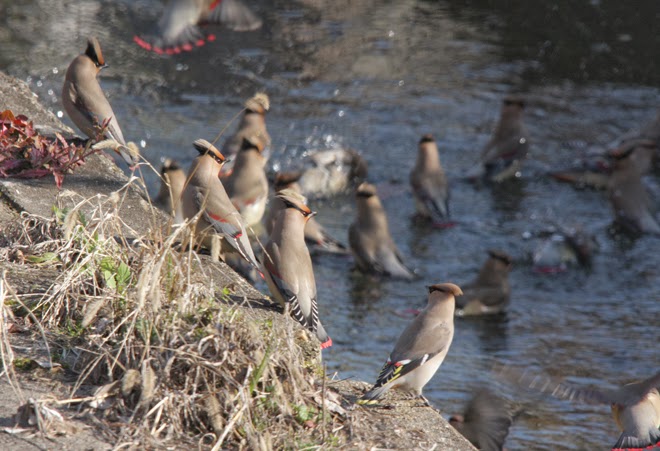
I had a free morning yesterday and decided it was about time I checked out the botanical gardens, a fair barometer to guage what's going on in the area. Rather than take the subway right to the gates I got off early and walked up the Kamo River, as much because it's a pleasant walk as in expectation of seeing anything unusual.
As I waited at the signal to cross the road to the river there were Japanese Grosbeaks in the bushes and trees on the other side, really close to the people waiting on the pavement. A taste of things to come. As I strolled up the river there was a constant coming and going of Grosbeaks in the line of trees to my left along the top of the bank and when I eventually reached the southern gates of the gardens there were about 100 more feeding in the trees over the ticket office.
Rather than head straight into the gardens I pushed on upstream. The divide between the typically cloudy, snowy Japan Sea weather and the clearer skies of the Pacific side of western Japan cuts east-west through the northern part of the city in an often obvious fashion, and this was a typical day. Not unlike slicing through the top of a soft boiled egg the weather along the northern edge of the city can be very disappointing. No more than a kilometre north of the botanical gardens a fine sleet was falling and though now close to the hills not even their outlines were appearing. Turning back for the gardens summits to the south, running away into the distance, stood out against a bright sky. A real Kyoto moment.
The botanical gardens is always a good bet for Grosbeak whatever the season and though there can be large numbers in winter I don't think I've ever seen this many before. Apart from the flock by the gate there was another very large flock feeding in sasa within a wooded area. Before I reached them I was amazed by the noise, loud and continuous, a popping and crackling like the crescendo of a distant fireworks display that climaxed in a confusion of whirring wings and flashing vents and bars as they burst upwards to perch overhead. Flocks aside, small parties were perched in trees and birds were flying around throughout the gardens.
There weren't any other surprises, birds were much as I'd expect for the time of year, but the were still a few good birds around; confiding male and female Red-flanked Bluetail, a few Dusky Thrushes, a Falcated Duck on the river. Most pleasing of all though, just that birds were relatively approachable and it was possible to routinely get the kind of views that are the exception in local forests.
Falcated Duck 1
Eurasian Wigeon c50
Mallard 20-30
Northern Pintail 15-20
Eurasian Teal 15-20
Tufted Duck 2
Grey Heron 3
Great White Egret 2
Little Egret 3
Great Cormorant c10
Black Kite 1
Black-headed Gull 50+
Oriental Turtle Dove common
Common Kingfisher 1 heard
Japanese Pygmy Woodpecker 2
Carrion Crow
Large-billed Crow
Eastern Great Tit fairly common
Long-tailed Tit 2 parties
Brown-eared Bulbul common
Japanese Bush Warbler 2
Japanese White-eye several heard
White-cheeked Starling common
Pale Thrush several
Dusky Thrush 12-15
Red-flanked Bluetail 3
Daurian Redstart 1 heard
Eurasian Tree Sparrow very common
White Wagtail 5
Japanese Wagtail 7
Oriental Greenfinch 8
Japanese Grosbeak 200+
Black-faced Bunting several
Showing posts with label Tit Great. Show all posts
Friday, 24 January 2014
Monday, 23 December 2013
waxwings & tits
Japanese Waxwing is irregular in Kyoto, some winters they can arrive in large flocks and disperse into smaller parties as berry supplies are exhausted. In other years they are totally absent. In waxwing years there is usually a small number of Bohemian amongst them. Where they may fetch up is unpredictable but the botanical gardens area is fairly reliable as there are a number of good berry trees in the area. The shots below are of two flocks that were faithful to some excellent berry bushes in the respective winters of 2011 and 2013 but in both locations the bushes were removed the following spring. I suspect the residents didn't appreciate the impressive mess that can be made by a few hundred waxings with a large supply of purple berries.
This flock of Japanese Waxwings remained in this location for over a week to my knowledge. Spot the lone Bohemian in the line up! 9 February 2013.
A flock near the botanical gardens 6 January 2011. In this case the size difference between these first winter Japanese and Bohemian seems extreme.
Spread wings of adult (bottom) and first winter (Top), the first winters have a white dash towards the tip of the outer web of the primaries whereas the adults have a broad white tip to the inner web and a small spot on the tip of the outer web that can be red or white but is often a compromise pink.
All the breeding Honshu tits occur in Kansai but Willow is only a winter visitor to the hills immediately surrounding Kyoto, though it does breed quite commonly at higher elevations in the region. Eastern Great, Varied and Coal can all be found in the city parks as well as the surrounding hills, all are common but the former two are conspicuously so.
Chinese Penduline Tit used to be regular in the reedbeds along the Uji/Yodo River but I haven't seen any for several years. If this is only due to the massive reduction in suitable habitat they might still be expected in the area but I suspect they aren't wintering here as frquently as they were a few years ago.
Coal Tit in the botanical gardens, Kyoto city. 15 March 2013.
Marsh Tit is restricted to Hokkaido in Japan so that's one fewer identification problem to worry about in Kansai. This bird near Abashiri, 19 August 2012.
This flock of Japanese Waxwings remained in this location for over a week to my knowledge. Spot the lone Bohemian in the line up! 9 February 2013.
A flock near the botanical gardens 6 January 2011. In this case the size difference between these first winter Japanese and Bohemian seems extreme.
Spread wings of adult (bottom) and first winter (Top), the first winters have a white dash towards the tip of the outer web of the primaries whereas the adults have a broad white tip to the inner web and a small spot on the tip of the outer web that can be red or white but is often a compromise pink.All the breeding Honshu tits occur in Kansai but Willow is only a winter visitor to the hills immediately surrounding Kyoto, though it does breed quite commonly at higher elevations in the region. Eastern Great, Varied and Coal can all be found in the city parks as well as the surrounding hills, all are common but the former two are conspicuously so.
Chinese Penduline Tit used to be regular in the reedbeds along the Uji/Yodo River but I haven't seen any for several years. If this is only due to the massive reduction in suitable habitat they might still be expected in the area but I suspect they aren't wintering here as frquently as they were a few years ago.
Coal Tit in the botanical gardens, Kyoto city. 15 March 2013.
Marsh Tit is restricted to Hokkaido in Japan so that's one fewer identification problem to worry about in Kansai. This bird near Abashiri, 19 August 2012.
Subscribe to:
Posts (Atom)