Watching the bird I was struggling to think of any local gulls, either 1CY or 2CY, that could show the combination of features I was seeing. Though in fact it seemed fairly obvious that this was a 1CY. Caspian Gull Larus cachinnans cachinnans (something I've never seen) was the only thing I could think of that could show a bold dark greater coverts bar with a second generation saddle this early in the winter, particularly with the scapulars predominantly grey. Heuglin's Gull L.h.taimyrensis looks very similar in some respects, structurally far more similar than anything else we get here, but it rarely replaces more than just the odd scapular until moult really picks up in January and it wouldn't be as advanced as this bird until mid- to late March. In any case the new scapulars are initially very dark before fading to silvery with heavy anchors and bars. From what I could vaguely remember reading of Caspian there seemed to be one or two other supportive features but because of its rarity in Japan, unreliable memory and the casual way I'd found it didn't really believe it could be.
After going through the images at home there are certainly some features favouring Caspian, notably the combination of early saddle moult and resulting pattern of the next generation feathers along with a dark greater coverts bar which is impossible to account for in a Japanese context. But others cast doubt and the more look at the images the more doubt creeps in. In particular I'm worried about the depth of the bill and prominent gonys, the heavily marked underparts and relatively extensive head streaking, also I'm uncertain whether the primary projection is long enough in relation to the tail.
As the OSJ place mongolicus within cachinnans Caspian Gull is considered a winter visitor to Japan. However L.c.cachinnans isn't listed in the most recent edition (2012) of the OSJ Check-List of Japanese Birds, though there have certainly been claims in the past, so it would be a major rarity if confirmed in Japan.
Other birds which need to be considered in a Japan context are Mongolian L.(cachinnans) mongolicus and Vega L.vegae, though there's always the hybrid angle too, especially when Slaty-backed L.schistisagus influence can produce some odd-looking gulls.
 With adult Vegas. The proportionately small and contrastingly white head, proud chest, flat back, attenuated rear, long primary projection and very long legs all look suggestive of Caspian Gull. Though taimyrensis can look very similar to this in both structure and overall colouration, it would be slightly shorter-legged with the wing-tips closer to the ground. The light is very dull but the central breast/belly too dark for cachinanns?
 It stands very tall behind Vega however this due solely to the leg length, as can been seen in the shot below, when on water it all but disappears behind Vegas' greater bulk. In this view the head is darker and it seems fine streaking looks way too extensive for cachinanns, the fine streaks are real but the dark-headed appearance here is misleading.
 At times I felt the bill looks too massive for cachinnans, with very pronounced gonys. Nevertheless the overall bill/head/neck proportions might be acceptable for cachinnans, the head shape looks good and is much whiter than the Vegas but is extensively streaked.
 Coming a little closer it became obvious this wasn't a 1CY taimyrensis, the combination of juvenile coverts with second generation scapulars in (early) December is something I've never seen. Heuglin's taimyrensis shows a dark greater coverts bar but would still have fresh-looking full juvenile saddle at this time.
  Most scapulars are adult-like grey with narrow blackish shaft streaks and faint darker grey anchors. Some lower scapulars have sub-terminal blackish diamonds and one, in this view, has a blackish base and diamond linked by the shaft streak. This is pattern is never seen in Japan at this time of year on this age of gull. Surprisingly the bill actually looks slimmer and far more cachinanns-like here.
 Juvenile taimyrensis, 13 November. This taxon doesn't moult a significant number of scapulars until January.
 First winter taimyrensis, 20 March. New scapulars are very dark but older feathers are silvery.
 A juvenile Mongolian 13 November. I don't see many juveniles as most have already moulted before they arrive but this is typical of the birds I do see.
 A fresh first winter Mongolian 14 November.
  Late winter taimyrensis left and mongolicus right, 20 March.
 Vega, 24 December.
  Vega, 3 November.
 The possible cachinanns viewed from the rear the scapulars give the appearance of being mainly grey with dark centre lines. The tertials are black with white tips. The brownish shawl around the base of the hind neck looks very heavy but the poor light doesn't help.
 The possible cachinanns again. The underwing is surprisingly uniform as the greater coverts are unmarked and seem more or less concolourous with the flight feathers. The medians are mostly unmarked but whiter which produced a white bar in the centre of the underwing. Note the pale inner webs of the primary window showing through.
  Taimyrensis underwing in late winter, 25 March.
 Mongolian underwing in late winter, 20 March (taimyrensis on left).
 The possible cachinnans again. A very brief burst of late sun rendered the underwing whiter than the grey in the earlier image. Only the primary tips are contrastingly black here, even p8-10 are quite pale looking. Worryingly the crown is streaked.
 Vent mostly white with a single row of bold markings around the edge, basically mirroring the upperside. The pale underside of p10 may be no more than reflective but there's clearly a suggestion of a darker tip showing through.
  At rest the tail looked black with a bold ladder effect on the outer web of t6, here the detail can be easily seen. The primaries have a pale window, the inner webs are much paler than those of taimyrensis. The pale saddle contrasting with the dark wings is remarkable for any gull in Japan at this time of year.
 Late winter taimyrensis, 25 March.
 Juvenile Mongolian, 13 November.
 The possible cachinanns again. A very striking feature is the grey looking V up the back, this never looks as contrasting with other gulls that show it, such as Mongolian. Though it looks uniform grey here it is actually finely mottled with grey-centred feathers.
 Another shot showing that remarkable pale back as it flies away.
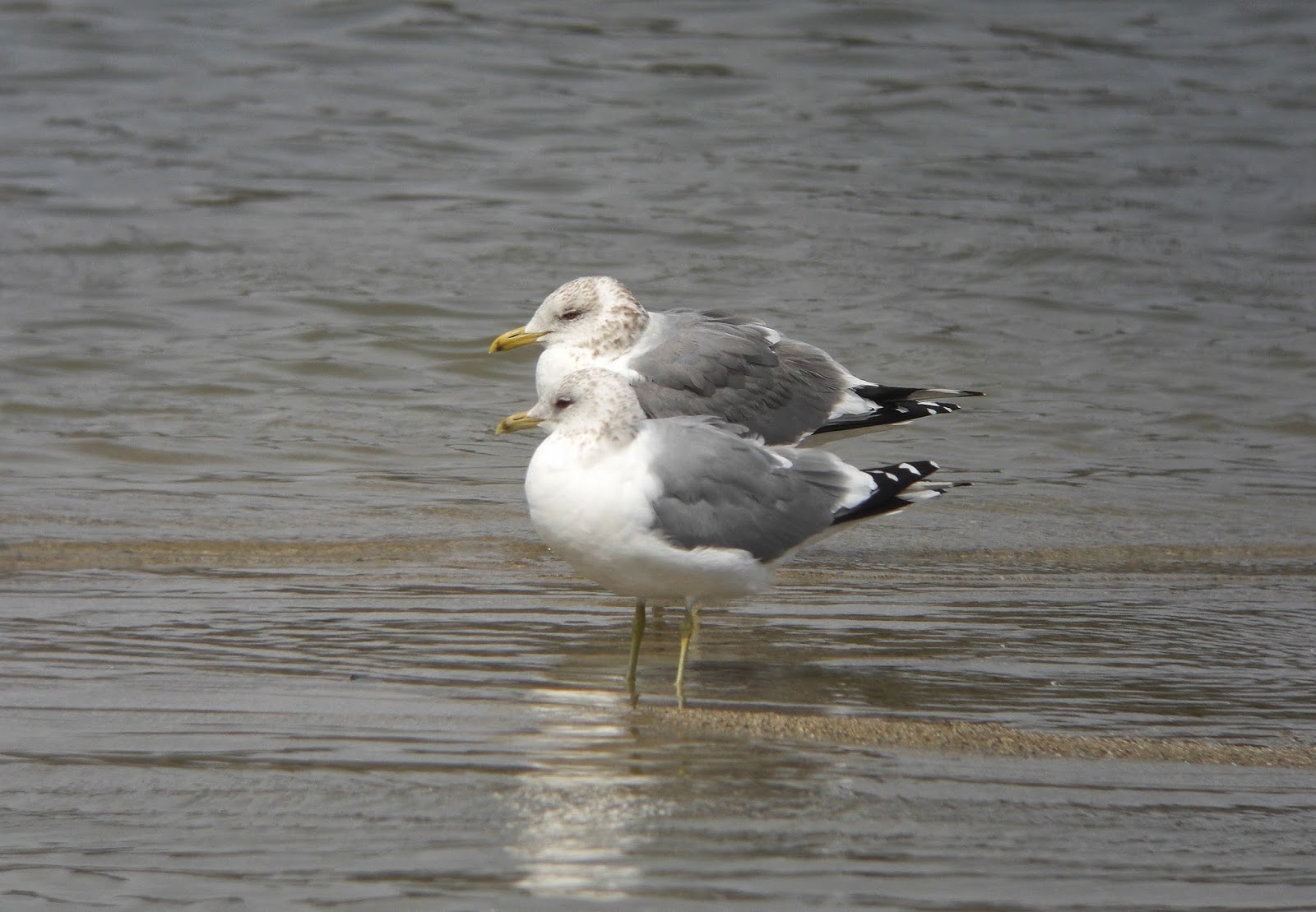
 On the water (with Common Gull) the jizz is again suggestive of cachinnans rather than our local birds.
I keep going round in circles with this bird, there are a number of things that don't sit comfortably with a Caspian identification as I believe it should look according to what I've read. I'll be on the verge of dismissing it then the anomalies kick in again. The small pear-shaped head, that the bird stands so tall but sits so small compared to Vega, the saddle which is three months ahead of taimyrensis and the different pattern to all the local gulls. The coverts bar alone rules out Vega too. Then there's the uniform underwing and pale back wedge to explain. Even by gull standards it's a strange one but depite my doubts it's closer to cachinnans than anything else.




.jpg)
