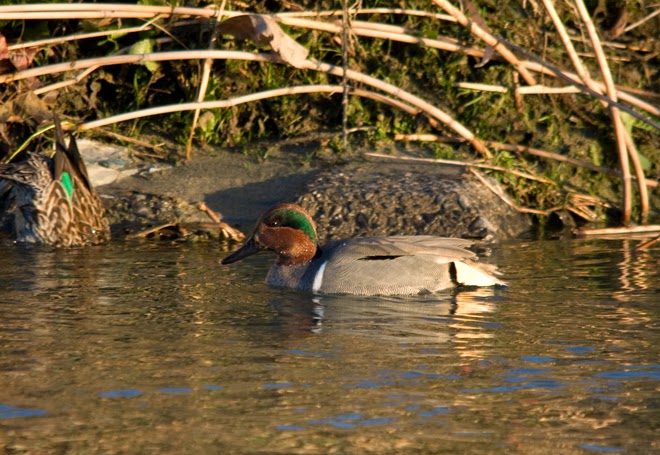
The only common resident duck in Kansai is the Eastern Spot-billed, though there are a few Mallard, even if the appearance of some suggests questionable genetic heritage, and also a small number of Mandarin Ducks in the hill forests though these require a great deal of luck to see and they are much easier to find in winter. The region does well for dabbling ducks in winter, Ruddy Shelduck and Green-winged Teal are the only rarities we get. I've only heard of one Green-winged in Kansai but they may be both under-recorded and under-reported, Kanto has far more reports which may indicate it is commoner further north.
Baikal Teal and Falcated Duck, the species most visitors will be interested in are both easily found. One problem with Baikal Teal is that the largest wintering flock, at Kohoku-cho north east Lake Biwa, is always rather far out on the lake. The birds are invariably hidden by vegetation on some artificial islands with, at best, just a few males identifiable at that distance. I've seen a flock of 2000 flushed by a harrier when moments earlier none had been in view. Because Kohoku-cho is good for so many interesting birds this is still a good place to catch up with them but for better views Katano Kamo Ike in Ishikawa, just outside Kansai, is a much better bet. They tend to be irregular elsewhere, if you're lucky you might even see them on the back pond at the Golden Pavilion in Kyoto, but don't bank on it.
Falcated is altogether more cooperative and can easily be found in Kyoto city. There are always some at Midoragaiike, a pond just north of the botanical gardens and it's often on rivers, particularly the Katsuragawa. It's a great looking duck and by
anas standards a frequent diver. The drake in the shots below spent the winter on a small pond in the botanical gardens, seeming to enjoy a diet of bread rather than aquatic plants.
The female is also a distinctive bird even if it can't compete with the male when it comes to looks. The following shot was taken at Midoragaiike, Kyoto city.
Also at Midoragaiike was the following Falcated Duck x Eurasian Wigeon hybrid, the only one resulting from this pairing I've ever seen. There could never be any doubt about its parentage with obvious features from each progenitor species. The tertials aren't falcated, it lacks the black division through a larger white rear flank patch and the breast is obviously Wigeon pink. The head pattern is more subtly different with the red stronger than on Falcated and without the long, sweeping nape feathers. The bill is an interesting pattern; a great duck.
Despite the mixed parentage there doesn't seem to be any doubt in the bird's mind which species it belongs to.
 Even with the oddly marked wings and underparts it still has a Falcated feel to it, albeit a compact version.
When I first came to Japan Common Shelduck wasn't a species I'd expect to see in Kansai, I've still only seen one in Kyoto city but then they are a coastal bird. Now, it's no surprise to run into then on the Japan Sea coast of the region in winter and they became quite regular in the Osaka area though on going habitat loss is making them more unpredictable again. The place to find them in Kansai is the Tsu city/Matsusaka city area of Mie Prefecture where they are reasonably common on the extensive tidal flats.
Common Shelducks moved off the tidal flats at high tide.
 A bird in a muddy field giving much better than usual views.
Much rarer is Ruddy Shelduck, and not just in Kansai. They do crop up on the Japan Sea side of the region, this bird was a total surprise one day when birding near Katano Kamo Ike in Ishikawa.
A poor quality video grab of a fantastic bird.
While Mandarin Ducks are very difficult to find in summer, winter is an entirely different matter. However they are remarkably faithful to their regular wintering ponds or lakes and it's unusual to see them away from these favoured spots. In Kyoto city there's only one guaranteed location, the International Conference Center lake at Takaragaiike. Typical of Mandarins, they're usually lurking under overhanging bushes below the path but of course they do swim out onto open water and even wander around in surrounding woodland like the birds below.
They are also easy to find in Nara city, if going public transport check the ponds near the site of the original palace complex.
Eurasian Wigeon is possibly the commonest duck in the region, they occur on rivers, ponds, tidal areas and there are vast numbers ringing the shores of Lake Biwa.
American Wigeon is sufficiently numerous to bump into here and there over the course of a winter but there are far more individuals of with mixed genes, some of which can be very close in appearance to one or the other species. The male below showed no sign of Eurasian in its ancestry though several birds on the same lake in Hyogo prefecture clearly did.
Another good looking male on the Kamogawa outside the botanical gardens in Kyoto city, it differs in having more extensive fine black flecking on the face creating a more clearly defined comb between eye and bill. Of interest is the female type next to it. Both it and the Eurasian in the foreground are conveniently showing their greater coverts with the mainly whitish, black-tipped feathers of American very different to the mainly blackish, white-tipped feathers of Eurasian.
Male and female American Wigeon.
Greater coverts of female American Wigeon; mainly whitish with black tips.
Of course if males can be difficult to be certain about because of introgression then having confidence a female American doesn't have any Eurasian influence in its family history is next to impossible here. The bird below was in the same flock of Eurasian as the above birds. At times it stood out with a very grey head and ghost of the male head flash, at other times I couldn't find it. Light conditions and viewing angle played a big part.
Head patten and greater coverts markings both indicate American, as did the underwing.
I was never a big duck fan in the UK and regrettably hardly ever gave Wigeon a second look. Now I'd really like to know how much individual variation they show where hybridisation isn't so prevalent. I lean strongly towards a bird like the one below having mixed genes and they do come even closer to Eurasian than this while still arousing suspicion.
As a self-confessed former duck neutral I can state with absolute certainty that Mallard would have been overlooked on every waterway I ever visited. However, now that it's no longer the default querulous, bread-eating park duck it's shot up the duck league table in dramatic fashion. I really never noticed what a smart-looking bird it is. Of course it isn't uncommon here, there can be some good concentrations at some locations on Lake Biwa and estuaries in Mie, nevertheless numbers are much lower than those of several other species.
As both Mallard and Eastern Spot-billed breed in the region it's unsurprising hybrids occur, such as the one below. Saddly it isn't as attractive as many hybrids can be.
 |
| Eastern Spot-billed Duck x Mallard hybrid. |
Eastern Spot-billed Duck.
Other widespread and common species that can be easily found in Kyoto city include Northern Pintail, Gadwall and Common Teal.
Kamogawa, Kyoto city.
Midoragaiike, Kyoto city.
Male Green-winged Teal, Nagoya February 2014. I suspect this rare visitor is slightly more regular further north in Japan, there are very few Kansai records I've heard of.
Adult breeding male Eurasian Teal.
First winter male.
Eclipse male.
Eclipse male (centre right) and female (centre left).
Northern Shoveler is also widespread but more localised. It occurs at Lake Biwa but usually either on well vegetated nearby ponds or in the only location shallow and sheltered enough for the water to be covered with lotus. Oddly it is also quite common on the tidal, bare river banks at the mouth of the Yamatogawa in Osaka.
Yamatogawa, Osaka.
 Male and female Northern Shoveler.
Garganey are the surprise package in Kansai and can turn up anywhere during spring and autumn migration. I've seen larger parties elsewhere 13-15 is the largest party I've met with in Kansai, ones and twos are the norm. This male and female appeared in spring on the Katsuragawa in Kyoto not far from my home.


 This Kestrel was loyal to a short stretch of road, present each time I passed on my way to check if the Dowitchers were viewable.
 The closed eye and the fact that it was sleeping in the open ought to have been enough to suggest something was seriously wrong with the animal but I was still shocked to see the extent of mange when it made off.