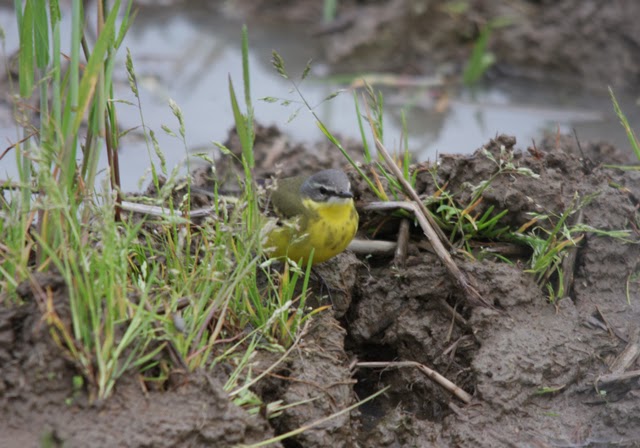
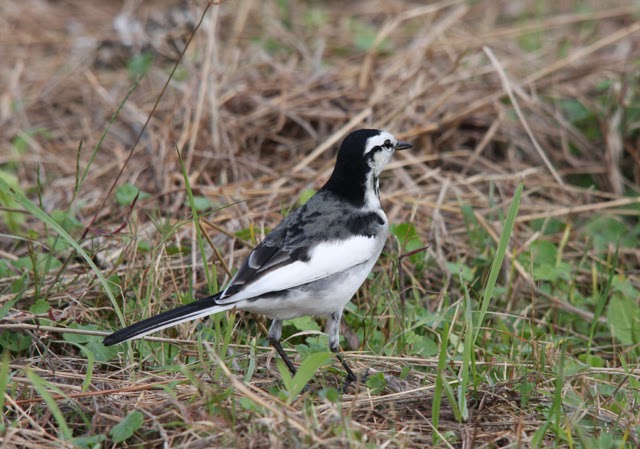
I don't believe there can be too much uncertainty about the second part of the title, at least not the "small field" part. Troublingly, there were a couple of Citrine Wagtails in the field and more than one mtDNA study indicates taivana and macronyx Eastern Yellow Wagtails share a common ancestor with Citrine Wagtail, and that they are more closely related to it than they are to the nominate tschutschensis! So the pedant might find room for a slightly raised eyebrow but following the broad tide of current taxonomic understanding I think it's safe to ignore the Citrines as far as this post goes.
Coming now to the first part of the title, the questions are more pertinent. Starting with what exactly is Eastern Yellow Wagtail, moving quickly on to what exactly is Western Yellow Wagtail and culminating with the crucial how do you tell them apart?
Yes, let's not beat about the bush, the unequivocal objective here is to get Western Yellow Wagtail onto my Japan list.
So to depart from popular convention; first the good news... It's actually quite easy to get Western on the list, though keeping it there may require a blinkered, if not a head in the sand, approach to modern taxonomy. The much respected Alstrom and Mild's Pipits and Wagtails tells us the large genetic difference between morphologically similar thunbergi (Western Yellow) and macronyx puts the latter firmly in the Eastern camp, however they also place plexa within the Western group, as "eastern thunbergi". So a tick? Ahhh, sadly no, there is afterall the lurking bad news. All major authorities have aligned within the last few years to include both these taxa within Eastern Yellow Wagtail. So that's that, isn't it? Or is it...?
It strikes me the only thing for it is to get a bang to rights thunbergi in Japan. How hard can that be?
How hard indeed? That it isn't on the Japan list suggests there may be a modicum of difficulty.
The most recent edition of the OSJ list (2012) ,which doesn't recognise the split between Eastern and Western Yellow Wagtails, gives five subspecies as having been recorded in Japan, plexa ('accidental visitor' with five records), leucocephala ('accidental visitor' with two records), macronyx ('irregular visitor' to most of Japan but 'passage visitor' to Tsushima and the Danjo Is.), simillima (now usually synonymised with tschutschensis as 'passage visitor' to... well, the relevant parts of Japan from my perspective, ie migration islands and points west) and taivana (again, as 'passage visitor' to relevant parts of the country).
Ignoring the distinctive leucocephala and, for the moment, the commoner tschutschensis and taivana we are left with the thunbergi-like macronyx and plexa. So any claim of thunbergi needs to overcome the macronyx hurdle. How can this be managed?
Alstrom and Mild say of macronyx that "it isn't safely separable from thunbergi", well that isn't exactly encouraging, is it? But elsewhere they state "...there is considerable overlap in all these respects, and the majority are indistinguishable from thunbergi". Ah haa! Does not the majority are indistinguishable suggest a minority are morphologically distinguishable? So what are "these respects"? Hang-on, let me read further.
It turns out they cite other authors under "is said to differ..." and their own "examination of a long series of specimens". There is contradiction regarding upperparts.
We have macronyx "is said to differ" from thunbergi by:-
paler ear coverts
purer and brighter green mantle (Vaurie 1959)
deeper yellow underparts
more conspicuous wing bars
longer hind claw
darker (browner) less green upperparts (Stepanyan 1990) and
(Red'kin & Babenko 1999)
Then there's their own findings:-
cleaner grey forehead, crown and nape
blackish-grey lores not usually onto forehead contra thunbergi
blackish-grey ear coverts not reaching as far (usually smoothly
merging just behind eye, with slightly cleaner grey rear ear coverts
and neck sides)
slightly brighter upperparts
slightly cleaner yellow underparts (rarely shows necklace)
slightly wider, more clear cut and yellower wing bars
slightly longer hind claw
Obviously the first step is to scrutinize each and every macronyx I come across to familiarise myself with the commoner toxon, right? Err, no, the first step would be to find a macronyx, any macronyx. Despite what the OSJ may say about status, a bird this spring was my first (or, okay, probably second), macronyx ever. Whereas I've previously identified several plexa which according to the OSJ list had only five accepted records at the time of publication!
Have my identifications been in error or could the OSJ have got it wrong/be totally out of date? Incidentally, Alstrom and Mild cautioned against relying to heavily on currently published information regarding the migration routes and wintering areas of thunbergi and macronyx throughout Asia due to the difficulty of field identification. Here are some images of birds I believe to be plexa.
 |
| This was the plexa in the field on Tsushima in May this year. Rather distant but the dark ear coverts, the long, narrow and broken supercillium as well as the greenish greater coverts bar seem to be recurring features of birds I believe to be this taxon. |
 |
| One of several plexa in April on Yonaguni last year (2019), very similar in all respects to the above bird. |
 |
| Another of the Yonaguni birds, the hind claw is outrageous. |
By contrast the folowing are the only two birds I've seen that I believe to be macronyx, starting with the bird this May on Tsushima.
 |
 |
| A presumed macronyx Eastern Yellow Wagtail on Tsushima, May 2020. |
It clearly differs from the above plexa by the absence of a supercillium, the white rather than greenish wing bars and the more strongly necklaced appearance. That said, I suspect this is a female due to the duller overall colouration than I'd expect from a male, particularly the washed-out upper breast and less bright mantle. Worryingly, this bird ticks all the thunbergi boxes given by Alstrom and Mild for the tentative separation from macronyx. The criteria given above referred to the comparision of males, thus I suspect a female macronyx versus male thunbergi may present an even more complex, if not insoluble, field identification conundrum.
 |
| This was the first plexa/macronyx wagtail I ever saw, a bird on Mishima a good many years ago. It was a total puzzle at the time and, though I tend towards macronyx nowadays, it could still go either way. |
 |
| A heavier crop of the same shot. As with the earlier macronyx, the wing bars are white unlike(?) plexa but this bird has a trace of a supercillium. Alstrom and Mild state that it isn't unusual for female macronyx to show a narrow supercillium and this differs from that of plexa in that it's more prominent before, not behind, the eye. Red'kin & Babenko state female plexa is almost indistinguishable from the male. |
So there we are, things really aren't looking too rosy as far as getting Western on my list is concerned; in fact I'd say I'm out of options here. Clutching at the last remaining straw, might the IOC move the goal posts? Right, thought not.
Such small samples don't touch on how much individual variation might exist or how that may affect identification. Looking at the more common tschutschensis, there is considerable, if sometimes subtle, variation but it's hard to say whether this is individual, geographical or a combination thereof. A number of formerly recognised taxa are now gathered under the tschutschensis umbrella creating a whole new set of potential variables without needing to touch on the horror that hybrids could introduce to the mix.
 |
| Most birds, of any age, should have completed or be close to completing pre-breeding moult at this time of year. The greenish tints on the rear ear coverts and nape should soon disappear as the tips of fresh feathers wear off. (Yonaguni, April) |
 |
| A presumed female due to the overall dullness, it has the least loral black of any images I have (Tsushima, May). |
 |
| By contrast, this was probably the darkest-headed bird in the field (May), I'd have liked to get a better view of the forehead in particular. And for variation's sake check if the median coverts are white. I've got plenty of tschutschensis images showing both white or green greater coverts bar but none as yet with a white median bar. |
 |
| Even against the light the white sub-orbital ring and pale base to the lower mandible are obvious. None of my small macronyx/plexa sample show either of these features. |
 |
| This was a rather arresting individual (Yonaguni, April) with its broken supercillium and extensively white throat. It also shows the white sub-orbital ring and pale base to lower mandible. |
 |
| Same bird as above with probably the most extensively pale lower mandible I've noticed, not that I habitually check. |
 |
| A very smart, clean and bright individual. |
 |
| I suppose this could be called a bog-standard tschutschensis, if there is such a thing. |
Then there's taivana, the straight forward member of the Eastern group of taxa. The first three images are of early May birds on Tsushima and the final one, which is very clearly in moult, on Yonaguni in April.
 |
 |
 |
 |
| Some missing median coverts and tertials, the outer tails are still growing, it's surprisingly tatty overall. This is probably the least advanced bird I've come across on spring passage. |
Did I start by saying I liked large white-headed gulls and yellow wagtails? Forget the wagtails, I'll stick to the far easier gulls.