Showing posts with label Redstart Daurian. Show all posts

Friday, 7 August 2020

Mt.Tateyama: the expected and unexpected birds up there

There are those who are so rigorously scientific in their approach to birding that the word scrupulous is almost an insult, falling so far beneath their admirable standards. These birders don't even have a cupboard let alone a skeleton stashed away. At the other extreme there those who might be labeled stringers, usually, but not always, due to a lack of care rather than scruples, and are probably also blissfully skeleton-free. Then there's me, and if we're totally honest then there's probably most of us, falling somewhere between the two ends of this large and somewhat elastic scale. 

Do I have a cupboard? I do. 

There have been various times over the last 50-60 years when mysterious scratchings and scrapings have led to uneasy nights. If ignored, I can attest, these will row into soft rapping and muffled thuds and eventually escalate to outright banging. Those earlier nights of unease will be as nothing to the inevitable tortured tossing amidst tangled sheets. Two birds that were once on my Japan list had to come off to preserve my sanity. It's not that I'm sure the identifications were wrong, more I'm unsure the identifications made at the time were right. I'm not referring to the ridiculous newbie stuff, the basic errors that anyone could make coming to a new country with no prior knowledge about its avifauna. Yes, I'm looking at you Black Woodpigeon in Kyoto city. 

There has been another skeleton, one of a rather different sort, that has persisted for years, dare I say it... decades! How often have I nervously shuffled my feet or tried to quickly re-direct a conversation? Why do I always fail to mention a couple of birds when someone asks whether I've seen all Japan's breeding species?

Why indeed.

Just as it took me 10 years to visit Nara, a must-see destination for overseas visitors which is less than an hour away by train, I haven't, sorry hadn't, scaled anything over a handful of metres high in the Japan Alps. Just like Nara, Mt. Tateyama isn't a million miles up the road but that's just the thing, isn't it? It's the proximity that makes some things so easy to put off.  As a master of deferment it's always been a case of "next year"... "well definitely next year!" You may have noticed the use of the verb 'scale' earlier, I'm going to leave that hanging.

Unlike the impalpable tomorrow, next year has finally come... it came this week in fact! Not only that but the two toe-curlingly postponed Japan ticks duly came along too. At long last I have Alpine Accentor and Rock Ptarmigan on my list. No more embarrassed shuffling of feet, no more ham-fisted attempts to steer the conversation elsewhere. And yesss, no more sleepless nights, my cupboard has been vacated.

As an utter alpine novice, I was surprised to have absolutely fabulous weather. Two completely calm, cloud free days is surely strange, isn't it? Or is it? I wouldn't know but what should have been more predictable I suppose was the number of people up there. Yet I was taken aback that every distant ridge was lined with pilgrims, each far-flung peak clustered with adherents and all the steep zig-zagging paths crawling with uniformly ascending or descending humanity depending on the time of day.  

Okay, the birds. My mate wanted to get Japanese Leaf Warbler for his trip list but I told him they'd be really difficult by now as they wouldn't still be singing. No prizes for guessing what the commonest species was then, the commonest and most vocal. Japanese Leaf Warblers were singing everywhere from dawn to dusk!

Japanese Leaf Warbler: the unexpected element referred to in the title. These birds were singing everywhere but tended to remain concealed in the haimatsu except in the early morning or late evening.

If the Jp Leaf was unexpected then juvenile Daurian Redstart wasn't even on the long distance radar. We glimpsed a bird diving into cover before we'd reached our accommodation just after arriving up there on the first morning. We looked at each other both thinking but hardly daring to suggest we'd just seen a Daurian Redstart. On the 4th of August... impossible! The next day, about 150m from that sighting we had an indisputable juvenile Daurian Redstart. It seems that, unknown to me, there have been breeding records in Japan in the last few years so a juvenile at this upland location at this time of year must prove another example.


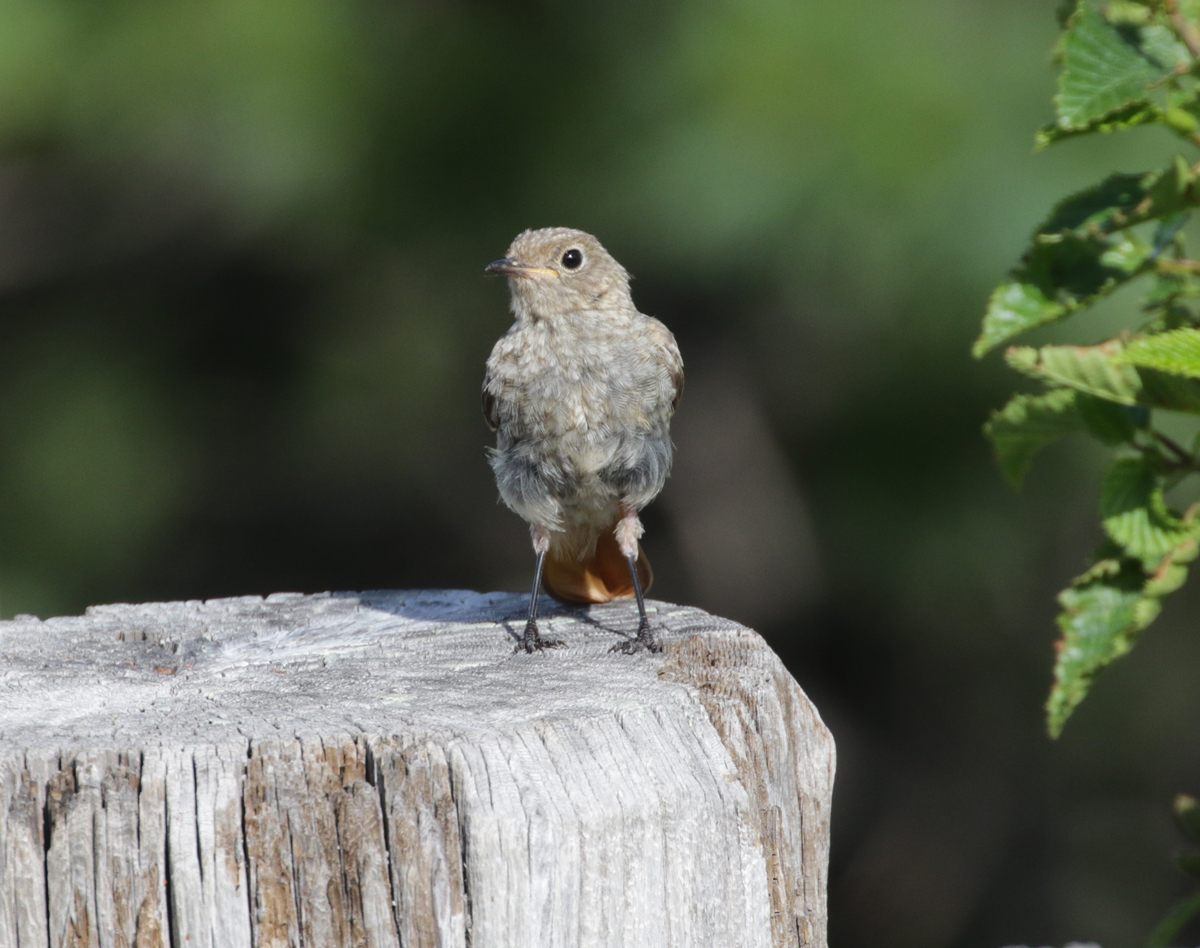
A totally unexpected juvenile Daurian Redstart. If it weren't for the two new birds I saw, this would have been the bird of the trip.


The expected birds of the title were Japanese Accentor and Nutcracker, both of which I've seen many times before though the latter is rare in Kansai. 

Japanese Accentor was singing throughout areas covered by haimatsu but it wasn't always easily seen. I wonder had the weather been less calm, warm and sunny this, and the Japanese Leaf Warbler, might have been far more elusive.

Nutcrackers are such great birds and seen infrequently enough, from the Kyoto perspective, to ensure they stay that way.


So I've covered the expected and unexpected birds, now it's the hoped for. Ptarmigan was tough, the weather was too good for them I suppose. The only two (plus two chicks) we saw were on the evening of the first day and though we had surmised the following morning was going to be our best bet to connect with them, we drew a total blank then. The trip could have been oh so different had we not caught up with these birds when we did. If the Ptarmigan were difficult, the Alpine Accentor couldn't have been more obliging, I saw my first sitting on a fence post surrounded by milling tourists before I'd left the bus terminal. Compared to the Japanese Accentors, they were far more mobile but tended to be in more open situations and along with being very approachable meant they were easily seen well.


Not exactly the point blank views many people are lucky enough to get with this confiding species, but good enough for me! Truth be told everything up there was confiding, it was simply a matter of luck how close a bird happened to be.


Despite having spent a total of about five months trekking in the Nepal and Indian Himalayas, not to mention trips to the European Alps, Alpine Accentor was a lifer!  

Monday, 28 November 2016

Bits 'n' bobs from Mie

I was in Mie this weekend, mainly to check through the gull gatherings on the beach north of Tsu-shi, and so didn't visit all my regular locations from south of Matsusaka north to Tsu. The stand-out bird, or birds I should say, were divers. It's always seemed odd to me that I've never seen a diver offshore in this area; yesterday I saw 19. There were 15 Pacific and four Red-throated visible from the beach, dotted through the huge rafts of ducks and grebes that were even more obvious than usual on a sea as flat as it ever gets. None were close enough to attempt a photograph but scoping through them a couple of Pacific still had chequered upperparts and one of the Red-throated even had remnants of a throat patch. Apart from the divers (and gulls) there weren't so many birds to comment on.


This is as good a time as any to mention a roadkill sighting in October that I'd meant to write about at the time. Quite amazing really.


I have a reasonably good Japan mammal list but I've never seen Japanese badger despite spending plenty of time in forest areas which look suitable. So it was unfortunate for me, and far worse for the badger of course, that the closest I came to one was spotting a freshly dead animal on the road while driving to Mie. The amazement factor kicks in when on the return drive there was another dead badger, in the same forest but lower on the mountain, this had plainly been hit during the afternoon in daylight. Was this an astonishing coincidence or was something else have created the situation where two animals would be on the road and hit by vehicles within about 14 hours? Since then things have been back to normal with no sign they even exist in this forest.


Buff-bellied Pipit in slanting light of the rising sun.


Another early bird in the same strong light.


This Little Grebe was just below the Kingfisher, in deep shadow.


The setting sun was much kinder to this Greater Scaup in a small fishing harbour.


Sanderling, while gulling on the beach.


Shorebirds and industry are a frequent mix, it's the lone tree that strikes the unexpected note for me.


Common Sandpiper


Female Daurian Redstart


Male Daurian Redstart


Friday, 9 January 2015

First 2015 trip to Mie

I'm having a wonderfully slow start to the year at work and was free the 7th and 8th, so off I went to Mie. I'd thought about northern Lake Biwa but the forecast for more snow up there didn't look to promising, though in the event the weather wasn't that great in Mie either.

As usual I waited on the seawall for dawn. The scene looked so serene with the full moon shining down on the exposed tidal flats but the buffeting the van was getting from wind told a different story. And it was cold.

By the time dawn was approaching the flats had already been drowned but the silhouettes of hundreds of ducks, thousands even, were beginning to emerge where there had previously only been disembodied voices. Uninhibited whooping whistles from the Wigeon on the sea and just the occasional subdued equivalent from the raft of Pochard on the landward side of the wall - stubborn silence hadn't given away about 600 Pintail.

On the same pool there were five Long-billed Dowitchers in exactly the same spot as two months ago, though the number of Stilts was down.

As I usually start birding in the same spot I'm never going to get better shots of the Dowitchers than these early poor light shots.

It was very much a digiscoping day, waders and ducks at long range and the quality of images isn't anything to write home about. 13 species of wader wasn't bad for the time of year but whatever time of year there's always one or two species that can't be missed, that are. The ones that inexplicably aren't to be found. And on the day it was the turn of Ruddy Turnstone and Grey-headed Lapwing to go missing. The hundreds of Dunlin and Sanderling weren't a surprise but slightly better were three Northern Greenshank and four Green Sandpiper. I think the best find must have been a couple of Lesser Sand Plovers, a bird not normally found here in winter.

Dunlin were very common and would allow great photo opportunities but as usual there's always something better somewhere, if I could only find it, and the common birds can wait. Even so, I love these long-billed birds.


An unexpected find, Lesser (Mongolian) Sand Plover.

The first really interesting bird of the day was a Slavonian Grebe, a bird I hardly ever see in Kansai. In fact I can only recall three off the top of my head. And another surprise was an eared owl, probably Long-eared going by the habitat and the fact that they do winter here whereas the once common Short-eared has all but disappeared as a wintering species. Having said that there is a wintering bird on the Yodo river just south of Kyoto this year. All I got of it was a glimpse as it weaved between some trees and was gone.

If the Slav Grebe was distant, Little and Black-necked were common and there would always be some closer birds. For Little that usually meant in a ditch rather than on a pond and for Black-necked in a harbour rather than on the open sea or pond.


I really didn't see many passerines but the following two were both in a small park behind the sea wall. There were also three or four Hawfinches but not surprisingly they weren't going to sit up for the camera.

Female Daurian Redstart. 

There are always a number of Olive-backed Pipits in a small park behind the sea wall.

Coming to ducks, I'm always checking harbours hoping to find some interesting sea ducks but the vast majority are Common Pochard.


Greater Scaup tagging along with Pochards.

Towards evening I came across a group of Stejneger's Scoters not too far off-shore, this is only the second time I've found this species in Kansai and definitely qualifies as bird of the day.

Stejneger's Scoters just too far out for decent digiscoping.

Saturday, 18 October 2014

A few early winter birds at Ogura

I didn't get down to Mukaijima station until 10am, a really lazy start, but my main target today was to check out the autumn White Wagtails. More of that later. Just outside the station, coffee in hand I found the first winter bird, a male Daurian Redstart.


Daurians are usually one of the first winter visitors to arrive and I expect to get my first between the 16th and 20th so this one's par. No soon had I left it than I noticed a distant Eurasian Kestrel across the fields cutting through a swarm of Red-rumped Swallows but much closer an accipiter was gliding between the high school and station. No doubt a Eurasian Sparrowhawk... but no, when I got the bins on it there was my first Northern Goshawk of the winter. It landed briefly on a pylon but three Large-billed Crows soon put it to flight again. Though against the sun, I managed a few poor shots as the Crows swooped at it and as I followed it there was suddenly a Northern Sparrowhawk along side. No sooner had it claimed my attention than an Eastern Buzzard drifted into the frame. I was thinking I may as well go home, it was hardly likely to get better than this! Raptor migration here is mainly in September when large numbers of Grey-faced Buzzards and Oriental Honey Buzzards pass through but October sees the arrival of species that can be anticipated throughout winter. Even if these individuals may be headed further south.


Textbook stuff, no doubt about this ID...


... and the perfect comparison.


My first local Eastern Buzzard of the season.

While none of these birds was much of a surprise a Rook most ceratinly was. I often get my first Rook on Hegurajima at about this time but it's normally much later before any filter down to Kyoto.

Carrion Crow, a year round bird out on the fields here. 


An adult Rook, by far the biggest surprise of the day.

Coming back to birds of prey, I was able to get much better views of the/a Kestrel later. Now that they breed in the area it's no surprise to see them at Ogura at this time of year, not that it was necessarily a local bird. While Black Kites are a fixture.


I always think that habitually hovering birds are continental migrants as the local birds almost always chase down birds Merlin-style. Note the single adult male feather in the tail as well as a little grey in the rump.


Black Kite is a bird that will always be cruising the fields at Ogura.