Showing posts with label Stonechat Stejneger's. Show all posts

Monday, 12 November 2018

Hegurajima: November 1st

There have been an amazing four national firsts this autumn, two of them on Hegurajima; Claudia's Leaf Warbler and Amur Paradise Flycatcher. Though no doubt the latter has been overlooked in the pre-split past. The last week of October saw continuous strong north westerlies flowing from the continent, what might they have brought? No boats out to the island of course in those conditions and no birders out there either. Even the more reliable Tobishima service wasn't operating meaning no possibility of anyone chasing the Ruby-crowned Kinglet there, the most recent of the four new birds for Japan.


The winds eased on Thursday 31st allowing sailing the following day... and more time for birds to leave. The problem with a day trip to the island from November onwards is that you only get 3.5 hours of birding because of the ferry's earlier winter return timetable. In effect only a little over three hours birding which makes the 404km each way drive seem much further than when I'm staying on the island.


I used to think there must be a good reason why the ferry schedule changes in winter. Now I'm not so sure. Why does it need to leave the island an hour earlier and be back in Wajima at 15:30 back in Wajima 1.5 hours before sunset at this time of year? It's not as if they have a lot to do once back in port and they surely don't require daylight to do it... Wajima is on the grid. Perhaps they don't realise the port has lighting because they've never been there after dark. Strange as it may seem now, when I first went to Hegurajima we drove all round Wajima looking for a convenience store... there were none! For many subsequent visits I had to be prepared and provisioned before getting out into the sticks then there was one, and the following year they were all over the town. A bit like Daurian Redstarts in mid-October. And another thing while I'm at it... did you ever wonder why the ferry leaves Hegura five minutes before the 15:00 (now 14:00) scheduled departure time? It seems departure time is as the ferry leaves the harbour not the quay. Thank goodness other forms of public transport don't follow the same logic, even other ferry services I use for that matter.


What about the birds then? I'm coming to that.


There were enough birds on the island to encourage the thought that a mega was just around the corner. Perhaps there was. Unfortunately you can't turn all the corners in three hours and I obviously didn't choose the right one(s).


Highlights were Eurasian Skylarks, ie not japonica, and a couple of Pine Buntings. Neither are unexpected here but equally they aren't birds I'm going to see staying at home in Kyoto. Red-throated Pipit I might see once in a blue moon in Kyoto while Stejneger's Stonechat, White's Thrush and Eyebrowed Thrush are birds I could see but usually don't. I'd sum it up as a low number of species with a high degree of scarcity from the Kyoto birders perspective.


It's actually worth going for the Pine Buntings alone! I didn't see them until five minutes before boarding the ferry, they were just hopping around on the road in the harbour.


Great birds, great family.


I definitely could have seen Rustic Bunting staying in Kyoto. But not on a rugged rocky headland with red berries!


There were at least 10 Eurasian Skylarks that I flushed from long grass along the west side of the island. This bird at the southern end of the island was the only one that perched briefly in the open allowing an all too distant shot before it dropped back into cover. In flight they looked slightly larger than Japanese even without direct comparison, they were cleaner white below and the flight calls were also sufficiently different to attract attention. 


In the harbour area a couple of people were trying to get good views and photographs of O Hibari (large skylark). Maybe I'm totally wrong on this but I often feel the name O Hibari is used as a catch-all for the various races of Eurasian Skylark that could turn up here in autumn/winter due to the difficulty/impossibility of confirming racial identity; I am told by a friend that O Hibari refers specifically to pekinensis and that lonnbergi is Karafuto Chu Hibari but it's always the former name I seem to hear mentioned. Incidentally, I'm told Chu Hibari intermedia hasn't been recorded in Japan which, again, is presumably is down to the difficulty/impossibility of separating the races of Eurasian Skylark in the field rather than it never reaching these shores.


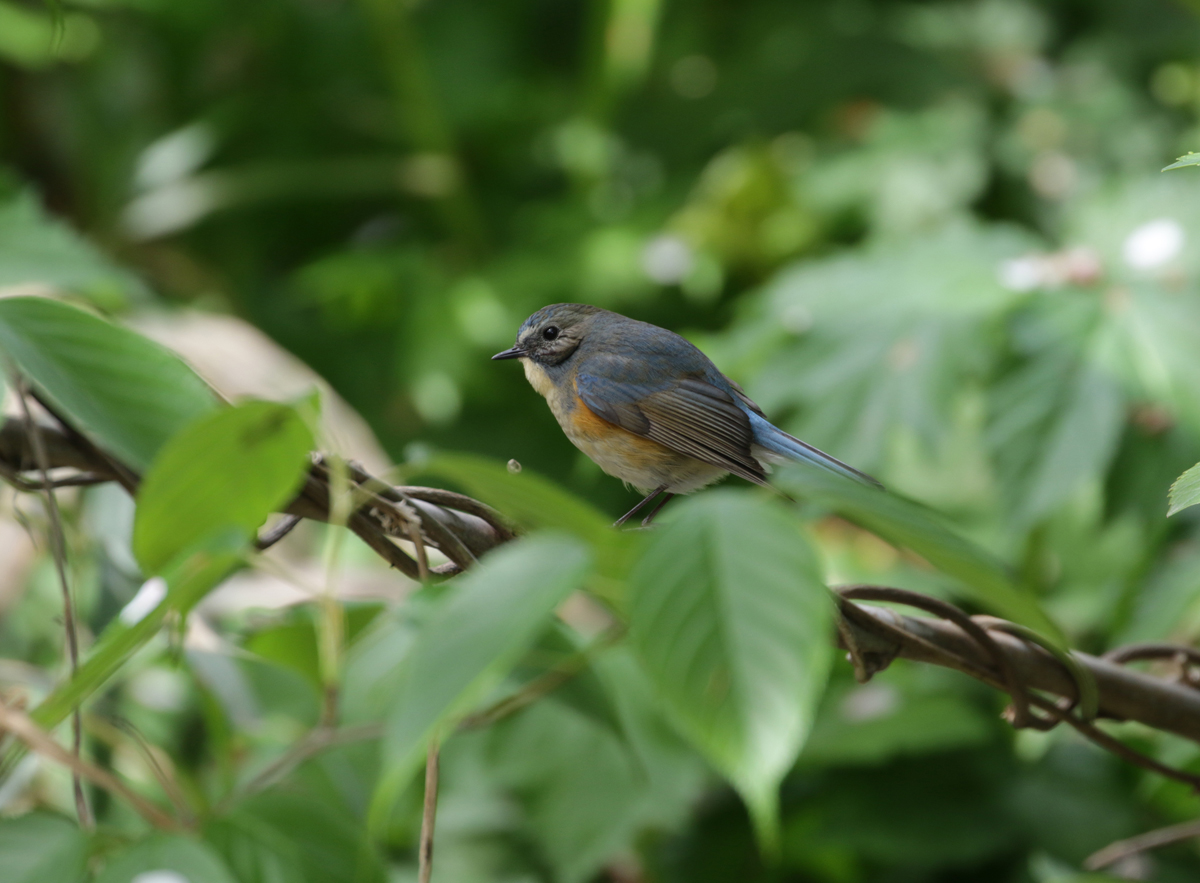
Female Stejneger's Stonechat, probably a first autumn with the heavy white tips to the primary coverts.


As there wasn't a great deal of interest sufficiently close to photograph on the island, good images of the skylarks would have been very welcome, I'll add some shots of a first autumn Asian Brown Flycatcher taken on Oct 12th during the previous visit. This was quite a strikingly marked bird which I first saw in heavy rain making observation and more particularly photography difficult. I was struck by flashing white about the wings as I first glimpsed it dash away between the trunks of some pines ahead. Ever the optimist, I was excited by the possibility of Pied Flycatcher and in true ficedula-style it vanished. Fortunately I did relocate it some time and though that brought spirits down on a par with the weather it was a relief to sort it out. I found it again the following day in much better weather conditions about 400m from the original site and was able to get a few closer shots. I assume the the discrepancy between this and the Asian Brown Flycatchers I expect to see at this time of year are all due to retained juvenile body feathers. According to Leader (British Birds 2010), juvenile Asian Brown Flycatcher undergoes a complete body moult before migration and only the exceptional bird will retain any juvenile feathers beyond August. Certainly I've found very few online images of Asian Brown showing any of the features of this bird and none with all of them.


The first good view of the bird in the rain on the first day, I was more or less using the camera inside a plastic bag and could hardly see the bird at all through the view finder. The uppertail coverts are contrastingly dark, the longest with bold rounded pale spots, according to Leader the ground colour of retained juvenile feathers is blackish and much darker than the next generation feathers.


The median coverts bar is quite arresting and the dark and white streaks in the crown are just visible here, there's an almost Spotted Flycatcher feel to the head in this view. The pale area in the primaries remains a mystery as it isn't visible on the closed wing but it may have contributed to my initial impression of a very white-winged flycatcher as I glimpsed it in flight. Fortunately I could get better views the following day.


One of the most obviously different to the norm features is the presence of large, round spots longest uppertail coverts, the darker appearance of the lower rump and uppertail coverts is noticeable but not nearly as pronounced as in the wetter conditions of the previous day. Less eye-catching but no less interesting are two lower rear scapulars which also have large pale spots. 


The white markings on the forehead and crown are formed by white tips to some feathers.


This Japanese Bush Warbler shot is also from mid-October when they were very common on the island. I'm uncertain whether they are far less common now or simply less vocal.


Monday, 8 October 2018

Hegurajima: October 3rd-5th

I was delightedly surprised to be able to get reservations at the minshyuku Tsukasa at short notice. Four nights for the following week and two nights a week later, most early Octobers I can't get a room at such short notice. I was far less delighted... or surprised for that matter... to have one day cut off the beginning and end of my visit by ferry cancellations. A 50% cut, it could have been worse and I'm worried about the chance of a 100% cut later this week!


There had been a clear out the night before my arrival and though birding was good and the sense of expectation as high as ever when arriving on Hegurajima, it was a little slow. There were plenty of the commoner muscicapa flycatchers, a few Stejneger's Stonechats and Kamchatka Leaf Warblers, enough to keep you hopeful and on your toes.


Chestnut-flanked White-eye was the first good bird of the day in the early afternoon though I'd already seen a bird I thought was this species but hadn't been able to confirm it. Over the three days on the island I realised Chestnut-flanked was the default species present; at first I thought perhaps a highly mobile party was responsible for multiple sightings in different parts of the island but it soon became apparent that possibly all the white-eyes present were Chestnut-flanked, and there were many of them, all over the island. Ultimately I only saw two definite Japanese White-eyes during my stay!


The other species I was pleased to see was Brown Shrike. I seem to remember often seeing juvenile/first autumn Brown Shrikes on Hegura years ago but they had dried up until this trip when there were three birds (two juveniles) on the first day. Only one of them lingered beyond that first day.


The first bird, nice crisp markings throughout.


The second bird has already moulted come scapular and mantle feathers. This was the only bird that stayed throughout my stay and frequently perched on the overhead wires.


The third bird looks like an adult female. I'd have liked better views of this pale bird but I only saw it once, very briefly, at quite long range. 


As the afternoon wore on I picked up Middendorff's Warbler, the only one of the trip, then 'Gray's Warbler' which was a personal first for the island. As you might expect views weren't great or prolonged but I was happy enough to have been in the right place at the right time. I heard later that there have been several birds seen recently.


Even a poor record shot is a minor miracle, whether it could be the continental fasciolata Gray's Warbler or Japan breeding amnicola Sakhalin Grasshopper Warbler, I'll never know.


As light was beginning to fail I make my way towards the scrubby area in the harbour for a last scout around before dark. Suddenly a drongo dashed into view above the tree tops to my left, caught whatever it was after, then swung back out of sight! I rushed in the opposite direction to the edge of the quay to try to get a view of the area behind the first row of taller trees. As luck would have it the drongo was perched in one of the few spots that could be seen and I could make out it was... Ashy. I confess I was disappointed, it's a great looking bird, spectacular even, and of course a real rarity in Japan. But it's also my third Ashy on Hegura, Hair-crested would have been nice, really nice. I watched it making sorties from the same perch long enough to get record shots and went to get any birders who were already at the minshyuku. I was back with a couple of birders in less than five minutes and I pointed out the perch with the bird sitting in the same spot. Just as I lifted my binoculars the bird, actually birds, flew. A Brown-eared Bulbul had taken over the Drongos spot on the tree top and it flew conspicuously away while simultaneously the Drongo, which had moved lower in the tree, dropped straight down. This was a corner-of-the-eye view. The other guys' attention was drawn to the Bulbul and they didn't notice the diving Drongo. It was deep twilight by this time and hope was the Drongo would be easily seen in the morning, however it must have left overnight as it was never seen again. It's amazing to think I was the only person on the island who saw this striking and conspicuous species; we all know a large number of rares will go undiscovered but usually imagine they'll mostly be the skulkers. Yet drongos are, if anything, the antithesis of the skulker and still this one almost got away.


Ashy Drongo in the failing light. A good way to end the first day and build anticipation for the second.


It was clear from the get-go that there fewer birds on the island next day. I picked up a few things I'd missed or only heard yesterday, a Siberian Rubythroat, a couple of Yellow-browed Warblers, Black Woodpigeon and nine Little Buntings. The only birds that were new were two Dusky Thrushes that I heard overhead and two Buff-bellied Pipits were probably also just arrived.


Yellow-brows can be quite common but I only had three on this trip. They're more often heard than seen and can be difficult subjects to photograph, this was the best I managed. 


Little Buntings can also be common and tend to sit around for anyone to snap away at.


The final morning was pretty dead by island standards but by mid-morning it became obvious that birds were arriving in significant numbers. Bulbuls were becoming common, three conspicuous Blue & White Flycatchers where there had been none, my first Narcissus of the trip, an up-tick in muscicapa flycatcher numbers, the return of Stejneger's Stonechats after an absence yesterday, a Red-throated Pipit quickly became five and my first spodacephala Black-faced Bunting of the trip turned up. Unfortunately today would be the last chance to get off the island before the next typhoon arrived so I, along with everyone else, left.


A nice male spod Bunting.


One of the fresh-in Red-throated Pipits.


Male Stejneger's Stonechat.


Sunday, 30 October 2016

Stejneger's Stonechat (and Bearded Tit!)

Strong north westerly airflow out of Russia with high pressure and clear skies, a huge band of rain cloud coming to meet it western Japan. Surely Hegura had to be worth a pop. I finished work at 8pm last Wednesday, got ready, and left home at about midnight.


The drive up had me worried; once on the coastal road in Ishikawa the car was being buffeted by strong wind. So strong that I felt there was little chance the New Hegura would sail and so decided to give up any hopes of reaching the island and instead go directly to a mainland site further up the coast. However as it was obvious I'd never make it up to the headland for dawn and I had to pass through Wajima anyway, I dropped into the ferry office on the off chance and was both surprised and delighted to find the ferry was ready to depart. It turned out to be one of the roughest crossings I've had on the route, quite difficult to sleep. As things turned out, the front bringing wet weather promised by the forecast hadn't reached this area yet. Skies were beautifully clear. Would there be the birds on the island to make the trip worthwhile?


Daurian Redstarts and Elegant Buntings were immediately apparent after landing. I tried the grassy harbourside for buntings, pipits and larks first.


Red-throated Pipit: perhaps the only 'island speciallity' which is also possible around Kyoto city in winter.


Unexpected but no great surprise either, a Common Starling perched briefly on the harbour wires.


There were a handful of Stejneger's Stonechat dotted around the coast.
The broader tips on the primary coverts suggest this is a first autumn but it's difficult to be sure. A couple of rump streaks are clearly visible here but not in the perched image below.
A male Stejneger's Stonechat, this one looked like an adult going by the primary coverts.


Separating the recently split Siberian and Stejneger's Stonechat is a bit of a nightmare and though the former isn't on the Japanese list it must surely be overlooked and just a matter of time before someone finds it (maybe in a mist net) somewhere. Looking generally washed-out, pale and lacking colour is supposed to be suggestive of Siberian and I would have liked to get a better view of the following stonechat but other birds intervened...


They don't come much paler than this. It looks small-billed too but you'd need in-the-hand measurements. There's an obvious white 'spot' at the tip of the primary coverts so this one has to be a first autumn.


First was an odd wagtail on the coastal path, it soon flew down towards the beach, conveniently in the same direction as the pale Stonechat. Off I went tripping and stumbling attempting to pick my way over the many large stones hidden under the dense tangled vegetation, while at the same time trying to step over the unrelenting bindweed vines. Progress was slow and noisy, keeping an eye out for birds and keeping your feet at the same time is never easy at that spot. Bearded Tit!! Where did that come from?!


I heard a once familiar pinging call and looking up in disbelief saw a 'miniature sandy budgie' flying away. It came down about 100 metres away at the other end of the small bay. I tried to hurry but there are just as many hidden rocks under long grass on the flat area between the belt of reed-like vegetation at the foot of the slope forming the bay which was to my right and and the sea to my left. With every stubbed toe and almost turned ankle more and more doubts crept in. Could it really have been a Bearded Tit? The view was terrible and wasn't the call deeper than I remember it? By the time I'd picked my way along the bay with my eyes more down than up, the bird had moved. It rose suddenly from long grass right in front of me about 40 metres closer than the point it had come down. At that distance those doubts were instantly dispelled; it wasn't just a small 'sandy budgie', it was a Bearded Tit! The pinging was spot on. It flew into the 'reeds' about thirty metres away and I waited... and waited. Nothing. It was too windy to expect it to climb the stems so I made my way round to the leeward side of the belt of reedy stuff and sure enough there it was. Again the view was very brief, it flew up onto the taller stems and quickly worked its way inside the belt.


It's a major rarity in Japan, according to the most recent edition of the OSJ list (2012) there have been six previous records. I knew there was little chance I'd get a photograph, there was only a little time before I'd have to get the ferry and the wind was going to keep the bird down, so I went in search of other birders. After five minutes walk I found Yuki Oaki and took him back the the spot. We tried the shore side of the belt first without success then returned to the spot I'd last seen it. It flew up  from the same spot and this time posed briefly on the facing reeds, not quite long enough for me to swap bins for camera. We got a perfect view at about 25 metres before it flew back into the thick of the reeds again.


By this time it was necessary to leave for the ferry and, would you believe it, I didn't see a single other birder en route to the harbour. As Yuki was taking the ferry too, we didn't get the news out in time for people to look for it the same day.


Whether the Bearded Tit arrived as a result of the strong air flow from Russia doesn't really matter, I'm just glad the weather chart prompted me to go.


As a postscipt; I'd completely forgotten about the wagtail and stonechat until I checked my camera on the ferry.

Saturday, 23 April 2016

Hegurajima: April 22 day trip

After spending a day and a half in Mie I made my way slowly to Ishikawa. The weather was dreadful, heavy rain throughout and a diversion due to a bad traffic accident didn't help. Of course I didn't mind in the slightest what the conditions were like on a relocation day and all that rain followed by forecast patchy fog over the sea the following morning had me rubbing my hands at the thought of all the migrants that might have made landfall on Hegurajima.


I picked up a few birds on the way, Brown Dipper was the only one I was unlikely to see elsewhere. I was curious what kind of bird list I could build driving round compared to my usual week spent on an off-shore island at this time of year. I was confident I could do better with numbers but could I get the quality?


The ferry to the island is usually an anticlimax, I rarely see much on this route, however there were a few things this time. An Arctic Skua was a first for me on this stretch of water, though I did once have a South Polar. Two groups of presumed Japanese Murrelets I saw turned out to be Ancient when I looked more closely. Two very distant parties of waders flying in close proximity, birds in one group slightly larger, were probably Red-necked and Grey Phalarope as both parties settled on the sea. Streaked Shearwaters were as common as ever.


Morphing murrelets; these expected Japanese turned out to be Ancient.
 

One of the second group of four which was closer.


A Streaked Shearwater letting its inner Colonectris really shine through; it could almost be a Cory's.


Approaching the island Pelagic Cormorant became common, I only saw one Temminck's out there.


Once on the island it didn't take long to see there were plenty of birds around. There were two or three Daurian Redstarts in the harbour, it's about three weeks since I saw my last around Kyoto, and Bramblings were everywhere, some looking very smart now. They've already disappeared from my usual haunts too. On the incoming side of the balance, Stejneger's Stonechats were very common on the island. Surprisingly I hadn't seen any prior to these this spring, they're usually one of the earlier passage birds on a broad front through my region.


A smart looking Brambling.


Stejneger's Stonechat was possibly the commonest migrant on the island, certainly the most conspicuous.
It didn't take long to find the first non-common bird, well Hoopoe is hardly rare, on the lawn behind the doc's. I bumped into it again later and heard it several times on my for-hour dash to cover as much of the island as practical before the ferry went back. In fact I hardly scratched the surface.


Hoopoe isn't a big rarity but they're always nice to see.
From there I quickly had a look at the coast and found a Swinhoe's Snipe on the grassy path to one of the headland shrines, then into the woodland where I flushed a Woodcock. There were plenty of Great and Coal Tits about, the odd Eastern Crowned Warbler, a Goldcrest and three or four Japanese Robins, heard only of course. A Long-tailed Rosefinch was a surprise, I've seen far more Common Rosefinch on islands in this season over the years.


No mega then; time to move on. Just as I was coming out of the trees I noticed a Japanese Sparrowhawk mobbing a Goshawk, or so it seemed at first glance judging by size but when I got the bins on them I was surprised to see a Northern Sparrowhawk mobbing a smallish harrier. Was this going to be the mega?! No, a Hen. I should have guessed, why do I get so excited over every bird? Because it's Hegura I suppose, it could have been a Pallid...


A mega approaches?


It's almost as if it sees me watching so closes its fingers to keep me guessing.


I wasn't fooled for a moment.

Next stop the harbour edge, it always holds something of interest. On the way I noticed there were no photographers at the hide, platform I should say, overlooking a shallow pool constructed to attract whatever is lurking in the undergrowth. It's funny really, two other people had taken the same ferry out in the morning and I only saw two others on the island. Great season, great weather, loads of birds and the place is all but deserted. Yet in a week, the Golden Week holiday, I bet the place will be packed to the gills. It's so difficult to book accommodation then which is fair enough with so many birders having inflexible work schedules but a good few of the visitors are retired. Why aren't they there now? The birding is fantastic and I very much doubt the Japanese national holiday will loom large in the birds' migration strategy. But as I was saying, the observation platform, I'm glad I stopped to take a peek. There was nothing rare but there were tons of birds flitting around, the best for me was an Asian Stubtail. Stubtails were singing all over the place, they're a common summer visitor around Kyoto, but they aren't the easiest thing to photograph.


Asian Stubtail: a photo tick.


One of 12 Blue and White Flycatchers I saw on the island (nine were males).


Red-flanked Bluetail.


Presumably a 2CY by the look of it.

I finally got down to the harbour area where the highlight was a party of three Greater Short-toed Larks. I see this species every spring, but three, I've never seen a flock of them before!


Red-throated Pipit with Greater Short-toed Lark.


A "flock" of Greater Short-toed Larks.


Then it was ferry back, a bite to eat behind the wheel and check out some fields further up the coast for waders to make use of the remaining day light. This wader checking idea was on the strength of having heard a Greenshank's chu-chu-chu behind Wajima that morning but apart from a snipe (I suspected Latham's) that crept off through the grass and into thicker cover before I could get down to the serious business of identification there was nothing.


So the wader idea was a bust but it had been an enjoyable day. In terms of quality I'd come up with a few species I don't see very often and in the numbers game, after 2.5 days in the field, I was on 123. This was definitely better than being based on an off-shore island. One more day to go.


List of species recorded today:-
Green Pheasant   2 plus 2 heard
Eurasian Wigeon   2 NP (Noto Peninsular)
Eastern Spot-billed Duck   7 NP
Eurasian Teal   c40 NP
Streaked Shearwater   100s
Little Grebe   1 NP
Grey Heron   3-4
Great White Egret   5 plus 7 NP
Little Egret   1 plus 4 NP
Great Cormorant   2 Wajima harbour
Temminck's Cormorant   1
Pelagic Cormorant   c50
Osprey   1 NP
Black Kite   2
Hen Harrier   1
Northern Sparrowhawk   1
Woodcock   1
Swinhoe's Snipe   1
snipe sp   1 NP
Common Greenshank   1 Wajima
phalarope sp   two small flocks seemed to be one of Red-necked, the other Grey
Black-tailed Gull   common, c1000 on flooded fields NP
Vega Gull   5
Slaty-backed Gull   1
Arctic Skua   1
Ancient Murrelet   8
racing pigeon   1 the pigeons on Hegura are always kitted out in racing legwear
Rock Dove   several NP
Oriental Turtle Dove   several
Common Kingfisher   1 NP
Hoopoe   1
Bull-headed Shrike   1 heard NP
Carrion Crow   c50 NP
Large-billed Crow   1
Great Tit   several
Coal Tit   several
Barn Swallow   3-4, several NP
Asian House Martin   c20 NP
Greater Short-toed Lark   3
Brown-eared Bulbul   fairly common NP
Asian Stubtail   2 plus many heard
Japanese Bush Warbler   common
Arctic Warbler complex   1
Eastern Crowned Warbler   c10
Japanese White-eye   common
Goldcrest   1
Chestnut-cheeked Starling   3 NP
White-cheeked Starling   1
White's Thrush   1
Japanese Thrush   1 plus 1 heard
Eyebrowed Thrush   1
Pale Thrush   common
Dusky Thrush   common
Japanese Robin   5 heard
Red-flanked Bluetail   1
Daurian Redstart   8
Stejneger's Stonechat   common
Blue Rock Thrush   1
Dark-sided Flycatcher   1
Asian Brown Flycatcher   1
Narcissus Flycatcher   1
Blue and White Flycatcher   12
Eurasian Tree Sparrow   several NP
Grey Wagtail   1 plus 2 NP
White Wagtail   several
Japanese Wagtail   several NP including a juvenile
Olive-backed Pipit   2
Red-throated Pipit   2
Buff-bellied Pipit   1 plus c10 NP
Brambling   30+
Oriental Greenfinch   common
Eurasian Siskin   1
Long-tailed Rosefinch   1
Hawfinch   1
Meadow Bunting   sev NP
Elegant Bunting   1
Japanese Yellow Bunting   1
Black-faced Bunting   common plus 1 spodocephala and 1 possible sordida (this isn't on the Japan list according to the most recent OSJ list, more of this later)