Showing posts with label Thrush White's. Show all posts

Friday, 29 May 2020

Swinhoe's Robins, thrushes and flycatchers

I must have seen enough robins in the last four weeks to keep me going for quite a while. Well not really, it isn't possible to see too many robins, they're such great birds. However it is fair to say I saw far more Swinhoe's on Tsushima than my life total prior to this trip. Siberian Blue Robin was also common but I only saw two Japanese Robins, these away from headlands and one of them as little more than a shape in the pre-dawn light on the forest floor. This was turned round in Hokkaido later in the month where Japanese was a trip-over bird (I always thought it was only the Izu race that was easy to see), and the density of singing birds was far greater than anything I've experienced in honshu. Or even elsewhere in Hokkaido actually. Siberian Blue, common as it was, was again runner up in the numbers game in that particular area. That I haven't got any photos of Japanese is partly down to hardly daring to move when birds hopped out onto the track when walking or they were through the car windscreen when driving. One Sibe Blue was too close to focus the camera on(!), while several robins, of both species, were too close to use the bins. Unbelievable.


But back to the Swinhoe's on Tsushima. I've spent so much time in the past trying to glimpse birds that have been singing right in front me. Not the birds in thick vegetation that I already know is a total waste of time but birds in a scrap of habitat, birds that you'd think were impossible to miss, yet rarely seeing so much as a flash of disappearing tail. On Tsushima I was seeing as many as three or four different birds in a day. Unheard of! The novelty of hearing three or four singing simultaneously soon wore off as this was the case at several random places we happened to stop the car. How many must there have been?


The first of three different birds photographed on the same day. This one was a little further down the hillside but it stuck its rufous tail in the sun for me.


Some birds were right by the roadside or in this case the footpath, not even bothering about cover.


Others simply sat there in the open waiting to be photographed.


These two shots are of one of the Hokkaido birds, they looked better out in the open sunshine rather than the darker setting of the Tsushima forests.


And thrushes...
The highlight was Grey-backed, one in the north and the other in the south. This used to be a bogey bird of mine. It's a scarce but regular spring bird on Mishima where, for years I contrived to miss every one. That included unmissables such as one in a single small tree that everyone in the group got on to instantly, everyone bar me. It included a male that sang from the same prominent perch in the same tree morning after morning, evening after evening, for almost a week. Without exception just before I got there or momentarily after I'd left.


Once a bogey has been bagged, however, it's rarely hard to see again. The first Grey-backed on Tsushima was under a row of straggly bushes at the edge of the rivermouth car park at Sago. I wasn't looking for birds at that moment and was so shocked I didn't even think of my camera back in the car. Finally it flew across the road into more difficult steep, cliff-steep, terrain.


Grey-backed Thrush


The southern bird was less approachable...


...and the other.


Amami Thrush (upper), taken a couple of weeks earlier, and White's (lower) on Tsushima. Pity the White's was partly obscured but still no confusing them.


Flycatchers were also very common, mainly Asian Brown, Blue and White and Narcissus, but there were also Streaked, Dark-sided and that spring speciality Yellow-rumped. There are good years and bad for them but after my birding mate saw a female it took a nervous couple of days before the trip claw-back.


When I heard this bird it was right by the roadside but it was already moving up hill through the trees before I got on to it to confirm it wasn't 'just' another Narcissus.


There were other good birds around, one of two singing Pale-legged Leaf Warblers came up a lightly wooded slope and paused to sing in the bush next to us before continuing on its way. The other was in thicker woodland along with so many Sakhalin Leaf it didn't offer any hope of being seen. Seen and identified that is. We failed to conect with a Tree Pipit, our biggest miss of the trip but did also score with a Hoopoe. This had been a running joke throughout the trip that we had to check every playing field or area of open grass for Hoopoe and come up with a reason why they weren't there. Too be honest I always see Hoopoe's much earlier and wasn't seriously expecting one this late so a bird on the cliffs and cliff path was quite a surprise.


So much for checking parks, playing fields and grassy carparks.


Tsushima trip list
Chinese Bamboo Partridge
Ring-necked Pheasant
Tundra Bean Goose
Mandarin Duck
Falcated Duck
Eurasian Wigeon
Mallard
Eastern Spot-billed Duck
Garganey
Eurasian Teal
Pacific Diver
Streaked Shearwater
Little Grebe
Great Crested Grebe
Striated Heron
Chinese Pond Heron
Eastern Cattle Egret
Grey Heron
Great White Egret
Intermediate Egret
Little Egret
Great Cormorant
Temminck's Cormorant
Peregrine
Osprey
Oriental Honey Buzzard
Black Kite
Japanese Sparrowhawk
Eurasian Sparrowhawk
Grey-faced Buzzard
White-breasted Waterhen
Common Moorhen
Common Coot
Black-winged Stilt
Pacific Golden PLover
Little Ringed Plover
Solitary Snipe
Latham's Snipe
swintail Snipe (almost certainly Swinhoe's on combination of features)
Little Whimbrel
Whimbrel
Far Eastern Curlew
Common Greenshank
Wood Sandpiper
Grey-tailed Tattler
Terek Sandpiper
Common Sandpiper
calidris sp (a small species in flight)
Sharp-tailed Sandpiper
Oriental Pratincole
Black-tailed Gull
large white-headed sp (probably Taimyr)
Aleutian Tern
murrelet sp (very probably Japanese)
Feral Rock Pigeon
Oriental Turtle Dove
Northern Hawk Cuckoo
Oriental Cuckoo
Northern Boobook
Pacific Swift
Common Kingfisher
Hoopoe
Japanese Pygmy Woodpecker
Ashy Minivet
Brown Shrike
Black-naped Oriole
Eurasian Jay
Daurian Jackdaw
Rook
Carrion Crow
Large-billed Crow
Japanese Waxwing
Eastern Great Tit
Varied Tit
Chinese Penduline Tit
Sand Martin
Barn Swallow
Asian House Martin
Red-rumped Swallow
Zitting Cisticola
Light-vented Bulbul
Brown-eared Bulbul
Asian Stubtail
Japanese Bush Warbler
Korean Bush Warbler
Oriental Reed Warbler
Yellow-browed Warbler
Japanese/Kamchatka Leaf Warbler
Pale-legged Leaf Warbler
Sakhalin Leaf Warbler
Eastern Crowned Warbler
Warbling White-eye
Eurasian Wren
Chestnut-cheeked Starling
White-cheeked Starling
Siberian Thrush
White's Thrush
Grey-backed Thrush
Japanese Thrush
Pale Thrush
Brown-headed Thrush
Dusky Thrush
Japanese Robin
Siberian Blue Robin
Red-flanked Bluetail
Swinhoe's Robin
Stejneger's Stonechat
Blue Rock Thrush
Grey-streaked Flycatcher
Dark-sided Flycatcher
Asian Brown Flycatcher
Yellow-rumped Flycatcher
Narcissus Flycatcher
Mugimaki Flycatcher
Blue and White Flycatcher
Eurasian Tree Sparrow
Eastern Yellow Wagtail
Citrine Wagtail
Grey Wagtail
White Wagtail
Japanese Wagtail
Richard's Pipit
Olive-backed Pipit
Red-throated Pipit
Buff-bellied Pipit
Brambling
Oriental Greenfinch
Eurasian Siskin
Hawfinch
Japanese grosbeak
Meadow Bunting
Tristram's Bunting
Little Bunting
Yellow-browed Bunting
Rustic Bunting
Yellow-throated Bunting
Chestnut Bunting
Japanese Yellow Bunting
Black-faced Bunting
139 species in 11 days

Thursday, 26 January 2017

Grey-backed and White's, thrushes in the park

During migration, particularly in spring, it might not be exceptional to see five species of thrush in city parks here. Winter is a different matter, and a Grey-backed certainly wasn't on the radar!


The bird has been in one of the larger Osaka parks for a couple of weeks as far as I'm aware and though I wasn't in a hurry to get down there the number of great images circulating finally gave me the push I needed... apart from being a great bird it was also a photograph tick for me! The park, Oizumi Ryokuchi in the south of Osaka, is a great place for city birding but too far to visit casually from Kyoto. I've seen my only Golden-crowned Sparrow and Pheasant-tailed Jacana in Japan there.


The expected winter thrushes in the parks (and elsewhere) are Dusky and Pale, and the latter is always far easier to see well in parks than in forests.


One of many approachable Pale Thrushes in the park.


The Grey-backed turned out not to be the only thrush of interest, there was a White's at the other end of the park. I managed to get a few satisfactory shots of both birds.


Sunday, 25 January 2015

Southern Lake Biwa

More often than not for me, birding at Lake Biwa means heading up to the north end and working my way south. I'll bird southwards as far as daylight allows, this normally means Lake Sainoko and harriers coming in to roost. One important reason for starting at the top end is to kick off proceedings in woodland to the north of the lake and increase the variety of birds I can see in a day.


Last Sunday was different, a throw back really to the way I used to bird there years ago, starting from the south. Or to be more precise focusing on the lake from Lake Sainoko southwards, the area I never usually get to cover nowadays. I've often felt that sacrificing the south could be costing me finding rare ducks. Apart from Baikal Teal (which only winters in numbers in the north) and Red-crested Pochard, I've never seen any rare ducks up there. Whereas I have seen Ring-necked, Lesser Scaup and Baer's Pochard, as well as Red-crested Pochard, in southern waters.


A key reason for covering the south this weekend rather than any other was the lack of recent snow and the prospect of reaching the hills close to Ashyu Forest. Since exceptional snowfall at New Year, the most in Kyoto city for 61 years, there seems to have been less than average throughout northern Kansai. The Meteorological Office website shows zero snow on the ground over large swathes of the region, though I sometimes think they assess the situation by looking out their office window.


Just a few kilometres north of Kyoto city Route 367 hairpins its way up to a short tunnel. From Kyoto to this point there wasn't even a suggestion there had been snow this winter then exiting the tunnel onto the Japan Sea watershed it was ploughed high on each side of the road, the villages were white in the headlights and the temperature dropped from an unseasonably mild midnight 6 to -2 degrees. Nevertheless the roads that wind up into the hills were largely snow-free and by only 2am I'd reached my intended dawn starting point.


It was wonderfully quite at dawn, perfectly still, and the reflecting snow hastened birding quality light except under the occasional clump of dense conifer here and there. Against a backdrop of drumming Great Spotted Woodpeckers on opposing hillsides I could hear roving bands of tits above and below, mainly Coal and Willow with a smaller number of Varied and the odd Great. Of more interest to me were birds I can't see in Kyoto city, Nuthatches which I've only seen twice here, and Treecreeper which I've never seen in the city.


I needed coffee and mid-morning I made my way to civilisation, the transformation from deep snow to zero from one end of the 100 metre tunnel to the other was even more striking in daylight. Down to the Biwako Ohashi (the large bridge that spans the neck of the lake), coffee, then up the east shore of the lake to Omihachiman where the first bird I saw was a White's Thrush in the garden of a lakeside cafe.


It isn't unusual to see White's Thrush in woodland edge or even parks on the lake shore.


Another lakeside bird was Elegant Bunting, easy to find around the northern half of the lake but an irregular species in Kyoto city.


But ducks are the lake's big attraction and while some are evenly distributed others are not. The sawbills are a great example. In the north I might see a handful of Smew, almost always redheads, but in the south there are rafts of hundreds with an apparent majority of drakes, but they are invariably far out on the lake and because females are less conspicuous this many skew the seeming gender imbalance. Goosander (Common Merganser) on the other hand is a northern speciality, they are common at the north end but I never seen them down south. Red-breasted Merganser is less fresh water orientated than the other two and though I sometimes see odd ones at the north end the most reliable area is mid-lake. Strange.


Bean Geese and Tundra Swans are also northern specialities but there always used to be a small flock of Tundra at one location at the south end where people go to feed the ducks. These no longer seem to come to this area, though I'm not really in a possition to know for sure as I don't usually pass this area in daylight, but when I dropped in today there were two birds present. Day tick.


There was a Vega Gull in this area, an unusual bird on the lake, but the ducks take centre stage. There was a smallish feeding frenzy of aythya ducks in an inlet so even my small lens could get some semi-reasonable shots.


The only classic adult male Tufty in the group.


With another male that isn't qiute there yet.


A first winter male with a moulting adult.


Female Tufty.


Common Pochard.


Female Common Pochard.


A slightly more obvious blue band behind the nail on this female.


Exceptionally extensive male-type blue on this bill.


Northern Pintail.


LIST OF SPECIES SEEN
several: widespread in low numbers (should be seen) or localised (could be missed)
fairly common: seen in most or all locations in low numbers
common: easily seen in most or all locations
very common: easily seen in most or all locations, often in very large numbers

Tundra Swan   2
Gadwall   common
Falcated Duck   5-10
Eurasian Wigeon   common
Mallard   common
Eastern Spot-billed Duck   common
Northern Shoveler   8
Northern Pintail   only seen at one location, 200+
Eurasian Teal   fairly common, less obvious than species prefering open water
Common Pochard   very common
Tufted Duck   very common
Greater Scaup   common
Common Goldeneye   10-20
Smew   100s   south of Biwako Ohashi
Red-breasted Merganser   2
Little Grebe   fairly common
Great Crested Grebe   fairly common generally, very common south of Biwako Ohashi
Black-necked Grebe   Fairly common
Grey Heron   widespread in low numbers
Great White Egret   several
Little Egret   several around fish pens at one location
Great Cormorant   common
Eurasian Kestrel   1
Black Kite   common
Eastern Marsh Harrier   1
Eastern Buzzard   1
Moorhen   2
Common Coot   very common
Grey-headed Lapwing   2
Northern Lapwing   16+
Dunlin   c40
Common Gull   several
Vega Gull   1
Black-headed Gull   fairly common
Feral Rock Dove
Oriental Turtle Dove   widespread
Japanese Pygmy Woodpecker   several
Great Spotted Woodpecker   2 drumming
dendrocopos sp   1 calling
Bull-headed Shrike   7
Jay   6-8
Rook   250+
Carrion Crow   very common
Large-billed Crow   very common though less so than Carrion
Great Tit   several
Coal Tit   fairly common in the mountains
Varied Tit   ffairly common
Willow Tit   fairly common in the mountains
Long-tailed Tit   1 party
Japanese Skylark   fairly common
Zitting Cisticola   1
Brown-eared Bulbul   very common
Japanese Bush Warbler   3-4 heard
Japanese White-eye   fairly common
Nuthatch   2
Treecreeper   1
White-cheeked Starling   fairly common
White's Thrush   1
Pale Thrush   several
Dusky Thrush   fairly common
Red-flanked Bluetail   1 heard
Daurian Redstart   common
Brown Dipper   1
Eurasian Tree Sparrow   common
Grey Wagtail   1
White Wagtail   fairly common
Japanese Wagtail   fairly common
Buff-bellied Pipit   1 heard
Brambling   heard at the lake
Oriental Greenfinch   common
Eurasian Siskin   heard in the mountains
Long-tailed Rosefinch   1
Bullfinch   often heard in the mountains
Meadow Bunting   common
Rustic Bunting   5-6
Elegant Bunting   2
Black-faced Bunting   common
Reed Bunting   1 plus several heard


Tuesday, 7 January 2014

thrushes


Siberian Thrush is a skulking migrant through the area, I come across them on the hills around Kyoto in late September and October but in lower numbers than the other migrant species. I can't recall ever seeing one in the city parks but they certainly turn up in the larger Osaka parks. Eye-browed is usually the first autumn migrant to arrive and can be quite common in September, as can Japanese and Brown-headed. These turdus migrants are common in the hills but can be quite easy to find in Kyoto parks too. Fruiting trees next to a pond at the northern end of the Imperial palace Park is a good place to try. Japanese is also a common breeder in the mountains of Kansai. Pale Thrush arrives in autumn too and remains a common feature of the winter birding landscape in Kyoto parks and the surrounding hills. Dusky Thrush is another winter visitor though it doesn't usually become common until mid-winter. The first birds tend to stay in the mountains, later becoming common in open country as the weather forces them down. Naumann's occurs in winter but it's very uncommon and hybrids are just as likely, if not more so. Hegura in October is a good bet for Naumann's. Coming back to zoothera, White's is widespread in low numbers in winter and can be found on hills surrounding Kyoto, sometimes they even winter in the Imperial Palace Park but tend not to linger so long in the botanical gardens. When weather is hard they can become fairly common in the open along roadsides around northern Lake Biwa. Other species are vagrants in the region, Red-throated, Black-throated and Fieldfare have all occured in Kyoto or Osaka the last 20 years. Still waiting for Redwing!

Spring passage is more urgent and though the same places are good to check more luck is required to be in the right place at the right time. Brown-headed Thrush (along with Pale and Dusky) can be particularly common in trees along the Uji River and is the only migrant I see more commonly at this time of year compared to autumn.

One of several White's Thrushes seen on this date around northern Lake Biwa, 18 February 2008.

This bird was in Kyoto botanical gardens, 3 February 2013.

Spring migrant female Japanese Thrush on Mishima.

An interesting bird which seems to be a 2CY female-type male Japanese Thrush on Mishima, 2 May 2010.

Male Eye-browed on Hegurajima, October 2007.

Eye-browed Thrush Ogura, Kyoto 3 April 2014.

Pale Thrush is common in winter and they can be very confiding in parks. This one in Kyoto botanical gardens, 7 March 2012.

Male Brown-headed Thrush on the Uji River at Ogura, April 2014.

Female Brown Thrush in the Palace Park, Kyoto. Dog walkers and joggers start early and birds soon disappear into off-limits areas.

Female Izu Thrush, 17 May 2013.

Black-throated Thrush very briefly in the botanical gardens Kyoto, 5 December 2012. I must have been the sole observer for this one.

A Naumann's Thrush on Iriomote 3 April 2013.

Naumann's Thrush, Hegurajima October 2014.

Spring male Duskys are stunning birds, this one on the Yamato River, Osaka.

Dusky Thrush Matsusaka, Mie 20 April 2014.

A more typical mid-winter bird, 17 January 2011.

Dusky (rear) and Dusky x Naumann's hybrid, Ogura 13 April 2011.

The same Dusky x Naumann's hybrid.

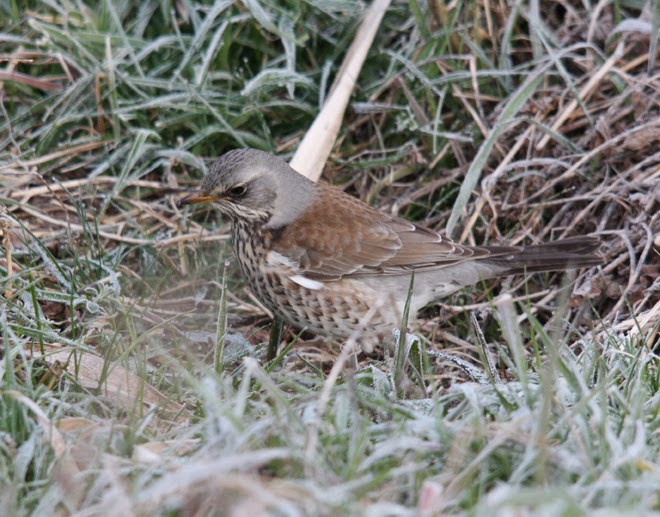
Fieldfare on the Uji River 18 February 2009. Very obvious moult contrast in the coverts. 

Song Thrush in Kanagawa 7 March 2014.

Mistle Thrush, 21 February 2014.