Showing posts with label Thrush Naumann's. Show all posts

Saturday, 28 October 2017

81 species on Hegurajima

81 species might not seem like a large total for five days birding but there are two mitigating facts: firstly five days sounds like far more than the just over 30 hours in the field that it boils down to and secondly as October progresses there isn't really the variety there was earlier in the season. It really can't compare to spring when you might be lucky enough to get that many in a day. So all told I was quite pleased with the birding, the absence of a tick being the only bugbear... after all the Siberian Accentor I still need isn't so much to ask for on Hegura at this time of year, is it?


The surprises big or small:-
   Zero Tristram's Buntings - I've never struck-out in October before, this is the 'island specialty' that isn't even so difficult to get on the mainland.


   The first trip (Oct 11-13) produced a small number of spodocephala Black-faced Buntings but no personata whereas on the two day trips (Oct 20 and 21) personata were very common and there were no spodocephala.


   Just a single Dusky Warbler but five Radde's. I don't think Radde's is nearly as rare as some people think but this tipped the scales further from general expectation as well as my own previous experience. There was also one unidentified Dusky/Radde's.


   A relatively large and growing flock of Temminck's Cormorants on rocks in the bay behind Wajima harbour, there were 26 birds when I left with more seen flying in later. There were two Great Cormorants in the harbour. I've never had this number of Temminck's along the coast here so perhaps this was a pre-typhoon gathering... the fishing boats were doing much the same the following day.


The only Radde's Warbler that stayed in the open long enough to get a couple of shots off. It seemed like I was the only person connecting with Radde's which was becoming a bit embarrassing, I don't want to get a reputation for stringing Radde's and I'm tempted to keep quite in future. I got on to all five birds (and the lone Dusky) because of the call, I was 25-30 metres past this one when I heard it. Don't other people hear them? Some birders might be too busy chatting and perhaps the photography specialist don't know the calls which could give the impression that they're a rarity.


And with a flash of undertail coverts, it was gone. Back into the depths of the undergrowth.


Black-faced Bunting E.s.spodocephala


I'd say it has to be an adult male with these underlying markings.

A nice shot of the nominate tail pattern.


Staying with buntings...


Rustic


Pine


Little


Yellow wagtails are a favourite of mine, any taxon will do... which is just as well at this time of year.


Like Dusky Thrush, Naumann's tends to perch in the open so it's much easier to assess numbers compared the other thrushes. Naumann's is definitely a very scarce bird, personally I've never seen more than one per autumn.

This first winter male spent a day hanging round the harbour.


The following birds are definitely not scarce...


There were huge numbers of Eurasian Siskin earlier in the month, slightly fewer later, and they occupied all habitats from the shoreline to woodland. Their small size in short coastal vegetation could be quite a distraction when looking for skulkers.


Eurasian Siskin


Bramblings were equally common, equally catholic in their choice of habitat and equally tame. Fortunately their larger size made them more obvious and less of a distraction... other than them being great looking birds.


Olive-backed Pipits are ever-present.


Finally some of those early morning Temminck's Cormorants congregating on inshore rocks in Wajima...


As a footnote, there's quite a lot of infrastructure work taking place on the island, it's strange to have dumper-trucks running round all over the place and to see this barge ferrying materials to the island.


The final load coming across before the typhoon was due to arrive the following day. This was the calmest I'd seen the sea all month.


And a very subjective and unscientific approach to listing all species during the sum of the observation periods:-
Japanese Quail   1
Greater White-fronted Goose   2
Mandarin Duck
Eurasian Wigeon
Mallard
Eurasian Teal
Tufted Duck
Streaked Shearwater
Grey Heron
Great White Egret   1
Temminck's Cormorant
Peregrine   3
Black Kite
Japanese Sparrowhawk   1
Eurasian Sparrowhawk   at least two, it's never easy to estimate numbers for such a mobile species but I saw two together circling with the Goshawk early one morning.
Northern Goshawk   1
Common Coot   3
Pacific Golden Plover   2
Grey-tailed Tattler   1
Common Snipe   7
'Swintail' Snipe   1
Black-tailed Gull
Vega Gull
Slaty-backed Gull
Black Woodpigeon
Oriental Turtle Dove
(one racing pigeon with full bling)
Ashy Drongo   1
Bull-headed Shrike   4
Rook   12
Large-billed Crow
Coal Tit
Skylark
Brown-eared Bulbul
Japanese Bush Warbler
Pallas's Grasshopper Warbler   1
locostella sp   1
Black-browed Reed Warbler   1
locustella/acro sp   1
Radde's Warbler   5
Dusky Warbler   1
Kamchatka Leaf Warbler   in large numbers mid-month, small numbers later
Yellow-browed Warbler   3 all heard only
Japanese White-eye   common later in the month
Goldcrest  1 mid-month became one of the commonest birds later
Eurasian Wren   1
White-cheeked Starling   2
Siberian Thrush   1
White's Thrush   2
Japanese Thrush   2
Eyebrowed Thrush
Pale Thrush
Naumann's Thrush   1
Dusky Thrush
Stejneger's Stonechat
Blue Rock Thrush
Red-flanked Bluetail
Daurian Redstart
Grey-streaked Flycatcher
Brown Flycatcher
Narcissus Flycatcher   1
Mugimaki Flycatcher   2
Taiga Flycatcher   1 heard
Taiga/Red-breasted Flycatcher   1 (possibly the same bird as above)
Yellow Wagtail   2
Grey Wagtail
White Wagtail
Olive-backed Pipit
Red-throated Pipit
Buff-bellied Pipit   2
Pechora Pipit   1
Brambling
Eurasian Siskin
Oriental Greenfinch
Hawfinch
Japanese Grosbeak
Pine Bunting   2
Meadow Bunting   2 on the 11th
Chestnut-eared Bunting   2
Little Bunting
Yellow-browed Bunting   1
Rustic Bunting
Elegant Bunting  
Black-faced Bunting
Grey Bunting   1

Wednesday, 8 October 2014

Ashy Drongo - Hegura

My incredible luck holds, another day-trip to the island and another Japan tick! Ashy Drongo, this time and it makes up for one I just missed in Osaka a couple of years ago.

I hadn't been too hopeful on the crossing out, the weather wasn't the best to bring stuff in but the island was doing quite well for numbers of birds. This time I turned north from the quay and started picking up birds in the harbour grass and bushes almost immediately, Rustic Buntings and a pipit that got away, then a Pine Bunting flew onto the wires before flying never to be relocated. Soon after that a scuffle in the weeds drew my attention to two Dusky Warblers. Dusky Thrush was already proving fairly common. I'd had a Dusky Thrush on the mainland yesterday and this could be something of a bellweather bird, vocal and conspicuous it could give an indication of how well the tip of the Noto Peninsular at Rokkozaki compares with Hegura. The evidence was indicating it wasn't even the poor-man's Hegura I had suspected. More of a last resort for the penniless.

I was trying to get views of a couple of Rustic Buntings in a bush when this Pine appeared on the wires, staying only long enough for me to get these two shots before it flew off along the harbour never to be seen again. 

Not a great view of Dusky but better than many, as often as not the call is all you get.

It wasn't long before I came across a Naumann's Thrush amongst the Duskys. Pine Bunting, Naumann's Thrush, this was typical October birding. Though a Lesser Cuckoo flashing by might be a little late, the number of Kamchatka Leaf Warblers was well down from a week ago. Other turdus thrushes seemed down too, at least there were far fewer calls. Within a Japan birding context turdus thrushes with the notable exception of Dusky seem to learn the art of how to land giving minimum exposure at an early age no matter how sparse the foliage, pre-hatching it would seem; a tantalising bill tip... or perhaps lone knee.

Naumann's Thrush perched up  nicely.

Luck plays a major part in seeing any given bird, a random choice to head in one direction rather than another equally attractive route. Being at a particular spot when the bird happened to be close to the track. Seeing the Drongo was very lucky. I thought I heard a Dusky Warbler but got distracted then retraced my steps, it turned out there were two Dusky and a Radde's in the same area and after waiting a while I continued back the way I'd originally come rather than head to the south end as I'd been doing. Because of this randomness, a single sTAC call in the pathside creeping weeds followed by another glimpsed bird ahead which drew me on then forcing me to turn back a little, I approached the harbour to catch the ferry on a route that took me past the Drongo where a photographer crouched in the grass gestured to where it was perched on a statue in the old school. Brilliant! I didn't even mind not finding such an obvious bird myself.


Just enough time to reach the ferry and back to the mainland.

Tuesday, 7 January 2014

thrushes


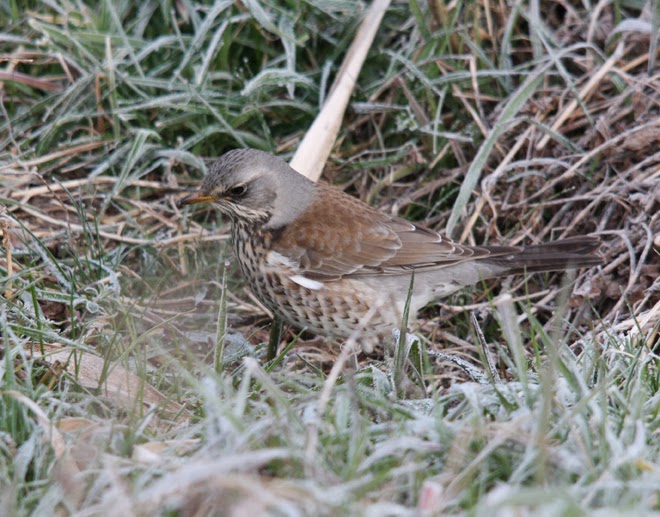
Siberian Thrush is a skulking migrant through the area, I come across them on the hills around Kyoto in late September and October but in lower numbers than the other migrant species. I can't recall ever seeing one in the city parks but they certainly turn up in the larger Osaka parks. Eye-browed is usually the first autumn migrant to arrive and can be quite common in September, as can Japanese and Brown-headed. These turdus migrants are common in the hills but can be quite easy to find in Kyoto parks too. Fruiting trees next to a pond at the northern end of the Imperial palace Park is a good place to try. Japanese is also a common breeder in the mountains of Kansai. Pale Thrush arrives in autumn too and remains a common feature of the winter birding landscape in Kyoto parks and the surrounding hills. Dusky Thrush is another winter visitor though it doesn't usually become common until mid-winter. The first birds tend to stay in the mountains, later becoming common in open country as the weather forces them down. Naumann's occurs in winter but it's very uncommon and hybrids are just as likely, if not more so. Hegura in October is a good bet for Naumann's. Coming back to zoothera, White's is widespread in low numbers in winter and can be found on hills surrounding Kyoto, sometimes they even winter in the Imperial Palace Park but tend not to linger so long in the botanical gardens. When weather is hard they can become fairly common in the open along roadsides around northern Lake Biwa. Other species are vagrants in the region, Red-throated, Black-throated and Fieldfare have all occured in Kyoto or Osaka the last 20 years. Still waiting for Redwing!

Spring passage is more urgent and though the same places are good to check more luck is required to be in the right place at the right time. Brown-headed Thrush (along with Pale and Dusky) can be particularly common in trees along the Uji River and is the only migrant I see more commonly at this time of year compared to autumn.

One of several White's Thrushes seen on this date around northern Lake Biwa, 18 February 2008.

This bird was in Kyoto botanical gardens, 3 February 2013.

Spring migrant female Japanese Thrush on Mishima.

An interesting bird which seems to be a 2CY female-type male Japanese Thrush on Mishima, 2 May 2010.

Male Eye-browed on Hegurajima, October 2007.

Eye-browed Thrush Ogura, Kyoto 3 April 2014.

Pale Thrush is common in winter and they can be very confiding in parks. This one in Kyoto botanical gardens, 7 March 2012.

Male Brown-headed Thrush on the Uji River at Ogura, April 2014.

Female Brown Thrush in the Palace Park, Kyoto. Dog walkers and joggers start early and birds soon disappear into off-limits areas.

Female Izu Thrush, 17 May 2013.

Black-throated Thrush very briefly in the botanical gardens Kyoto, 5 December 2012. I must have been the sole observer for this one.

A Naumann's Thrush on Iriomote 3 April 2013.

Naumann's Thrush, Hegurajima October 2014.

Spring male Duskys are stunning birds, this one on the Yamato River, Osaka.

Dusky Thrush Matsusaka, Mie 20 April 2014.

A more typical mid-winter bird, 17 January 2011.

Dusky (rear) and Dusky x Naumann's hybrid, Ogura 13 April 2011.

The same Dusky x Naumann's hybrid.

Fieldfare on the Uji River 18 February 2009. Very obvious moult contrast in the coverts. 

Song Thrush in Kanagawa 7 March 2014.

Mistle Thrush, 21 February 2014.