Showing posts with label Pitta Fairy. Show all posts

Wednesday, 21 June 2017

2017... how many new birds at the half way point (passerines)

I decided to split this six-month review into two sections to prevent it being overly long and this is effectively becomes the passerine section. If the non-passerines had a wintery feel, all the big stuff seems so long ago, then the passerine post is more up to date. Very up to date considering I saw the Fairy Pitta on June 20.


I already posted about the Pitta but I have so many shots of it I have to post a few more.


Another spectacular June bird, a 2CY Black-naped Oriole in Kanazawa.


The earliest bird to make it into my first half favourites was a Grey-backed Thrush. On the same day I had great views of a White's Thrush which isn't rare but can be difficult to get good views of, that bird was a bonus.


Grey-backed Thrush in an Osaka park.


White's Thrush in the same park.


Staying with thrushes, migrants can be difficult to get good views of but this Eyebrowed was great.


Flycatchers, warblers and buntings are always top of the list when it comes to less common species. I didn't see any Yellow-rumped Flycatchers this spring but I managed to catch up with a few of the commoner Mugimaki passing through. Dusky and Radde's are the most frequent of the scarce warblers and Tristram's, Yellow-browed and Black-faced spodocephala are the regular buntings that usually require a trip to one of the islands to see, to date Tristram's is the only one I sometimes see at coastal sites.


A 2CY male Mugimaki, apart from the hint of a white flare behind the eye the bird also had white flashes in the base of the tail.


Believe it or not this is a Dusky Warbler, I first got onto it by call and tracked it through the undergrowth. I like this shot because the upperparts (apart from the tail) look distinctly greenish and light shining from above appears to give it a bold crown stripe. 


Radde's Warbler a week earlier in the same clump of undergrowth. There can't be any doubts about the identity of this one.


Manchurian Bush Warbler may not be rare but its scarcity combined with secretive nature means I see far fewer than the two phylloscs. Larger males can be obvious when seen but females won't stand out on size alone and I wouldn't be surprised if I've overlooked some silent females assuming they were Japanese.


Female Tristram's Bunting, the males were more camera shy. When I first came to Japan I expected Tristram's and Yellow-browed to be on a numerical par as scarce migrants, because they were often mentioned in the same breath, but over the years Yellow-browed has proved far more difficult to see. However this spring both were fairly well represented on Hegurajima and matched my original expectations. I've seen a few Tristram's on the mainland, as many as three birds together, but I've yet to see a Yellow-browed away from islands.


Yellow-browed Bunting, for me at least this was a good year for this species.


Black-faced Bunting spodocephala. Another reasonably frequent bird off shore that I don't see on the mainland. 


Chestnut-flanked White-eye is maybe more frequent on islands further north (?), I seem to hear of fewer reports from islands off western Honshu.


I saw my first Tiger Shrike in Japan as recently as last summer. There were several on Hegurajima during my later visits this spring.


Finally I want to add two birds which in a sense are the antithesis of highlights in so much as they are so common that they don't make it into other posts. Both Oriental Greenfinch and Varied Tit are good looking birds that that suffer from being too common as far as making it onto this blog is concerned so now is as good an opportunity as they are going to get.


A bright male Oriental Greenfinch.


Varied Tit.


So, half way through 2017 and Bonaparte's Gull is the only new bird of the year. Fingers crossed there will be more on the way and that this year won't set an unwanted record of fewest new birds ever.

Tuesday, 20 June 2017

Fairy Pitta

I'd been thinking of going to look for Fairy Pitta at the weekend but decided to have a lazy couple of days at home after a string of full 48-hour Hegurajima trips recently. However I didn't have to go to work today and as the rainy season officially started in our region a week ago (blue skies ever since) I thought I'd better take the opportunity while photography is still an option and also before the forest turns into a leeches' playground. The forecast says heavy rain tomorrow but the sky has already changed from blue to a premature dusk in the last hour so I think the met office blew their second bite of the precipitation cherry.


I arrived not long after 4am to find a phalanx of photographer already in place, I was the twenty first on site. The first seated row comfortably strung across the track, the second row, also seated, had their tripods further extended at the ready and I joined the third row... not seated. In the half light it was easy to imagine ranked musketeers but the front row wouldn't need to reload so I wouldn't be stepping forward to take their place. Lucky I'm not short.


It was all well orchestrated, we first comers had taken station looking back up the track the way we'd come, only 10 metres from one of the Pittas' favourite feeding spots, and the subsequent tardy and ever-growing mob (I counted 42 vehicles when I left) camped at the top of the slope facing us, a good 100 metres from the hoped for action.


Then we waited... and waited.


We heard Pitta singing on four occasions but it wasn't until we'd been there nearly six hours that someone spotted a bird to our right coming uphill from the rear. I could hear leaf-tossing just over the ridge, it was close. Another anxious 30 minutes passed. Then there it was right in front of us, shutters clattered, the mob up the hill probably couldn't see more than a speck.


It stayed foraging then collecting nesting material for half an hour before flying off left. No sooner had it gone than someone in our group received a call that there was a Caspian Tern in Osaka. Cue a charge up the hill back to the cars as the many Osakans happy with the mornings outcome needed to get back in a hurry. The mob at the top of the slope offered little resistance as we pushed (politely) through, I must say I felt a little sorry for them. But hey, if your going for a bird, a woodland bird in particular, get there early; you don't want to arrive at half passed morning. Hmm, that's probably a bit harsh considering everyone was well behaved.


Perhaps it was the location and that a feeding spot was known but today was far more orderly than in previous years, the bird was given its space, no were recordings used and a large group behaved as well as any large group can. Splendid.


And this was the bird, just a few shots of many.


Friday, 17 June 2016

Fairy Pitta

I'm sitting here today pondering my leech bites. I've never had an adverse reaction before but a couple of these are really itchy and another very red and splodgy. At least they show I was in good quality forest!


Yesterday I was birding in both Kyoto and Shiga forests and though my day began with four hours continuous rain just below a low ceiling of cloud (as I discovered after daybreak) by 6:30 the rain was easing-off, the morning destined for clear skies and a sticky 100% humidity.


I didn't leave the shelter of the van during the hours of darkness; umbrellas and trees don't go well together in daylight let alone at night. All I heard were three Japanese Scops Owls, none of them close, and barking foxes. At first I heard the foxes snuffling, grumbling and grunting behind me and I could see two adults and at least one half-grown cub on the road. I'm unsure whether there was more than one cub as 'it' was racing back and forth mostly hidden by a bend in the road while the adults sat watching over play time.


Once light began to broaden I couldn't justify sitting any longer so pulled on waterproof bottoms (Does that sound any better than waterproof over-trousers? Didn't think so.), grabbed my umbrella and made my way along the woodland edge. It still wasn't light enough to identify many of the small birds flitting in the tree tops but a Broad-billed Roller suddenly appearing flying away for a brief second was a shock, to say the least. This isn't a bird I expect in Kansai during the breeding season, I think I've only seen one here on passage! Then I promptly began the process of talking myself out of it. "It's still pretty dark, the flight was a bit like a Jay... it must have been a Jay" It was a Jay.


I covered the nearby area as much as possible but under the trees wasn't getting much brighter and just before 7am I was back at the van for a break and some roasted almonds in lieu of breakfast. Then, unbelievably, a Fairy Pitta was singing! The rain had stopped (more or less) so I could ditch the brolly before dashing towards the sound; don't stop... don't stop! I struggled to spot it in the tree tops and after a short pause the song was another 150 metres away. And so began a Pitta chase. For a long while this pattern was repeated, it wasn't bothered by me, I could just never pick it up before it changed song perch. This time perseverance paid dividends, I finally latched onto it, this wasn't going to be one that got away; another one that got away.


I was able to watch it for several minutes before it shifted again.


When I first heard the Pitta it seemed in competition with a Ruddy Kingfisher singing from the same location. The big difference was I was able to connect with the Pitta eventually. The Kingfisher, along with several others heard that day (and countless others) remained just a voice in the forest. The Pitta was a photo tick for me, the Kingfisher will have to wait, yet again.


I heard the Pitta once more, very briefly, but it was way off across a broad valley on an entirely different hillside. A second bird? Or this one moving along?


The morning was heating up as it progressed, so was I, there wasn't a breath of air. I was thinking about a move, trying somewhere else and I'd driven a couple of hundred metres back down the access road enjoying the breeze through the open window but decided to check one last spot. A track led to a clearing through a narrow belt of trees and no sooner had I stopped to check some movement in the bushes than a Roller, living up to its name, flopped rapidly across the open space. Ha! Jays with dark rumps don't exist. No, not even in the early half-light. Note to self: don't talk yourself out of good birds in future.


My next stop was a deep, dark (leech infested) valley bottom. I've seen Japanese Night Heron here in the past, Copper Pheasant too. But not today.


Fire-bellied Salamanders are very common in old wet forest but after a lot of rain you've got watch where you put your feet, they seem to think they own the place wandering willy-nilly from puddle to puddle.
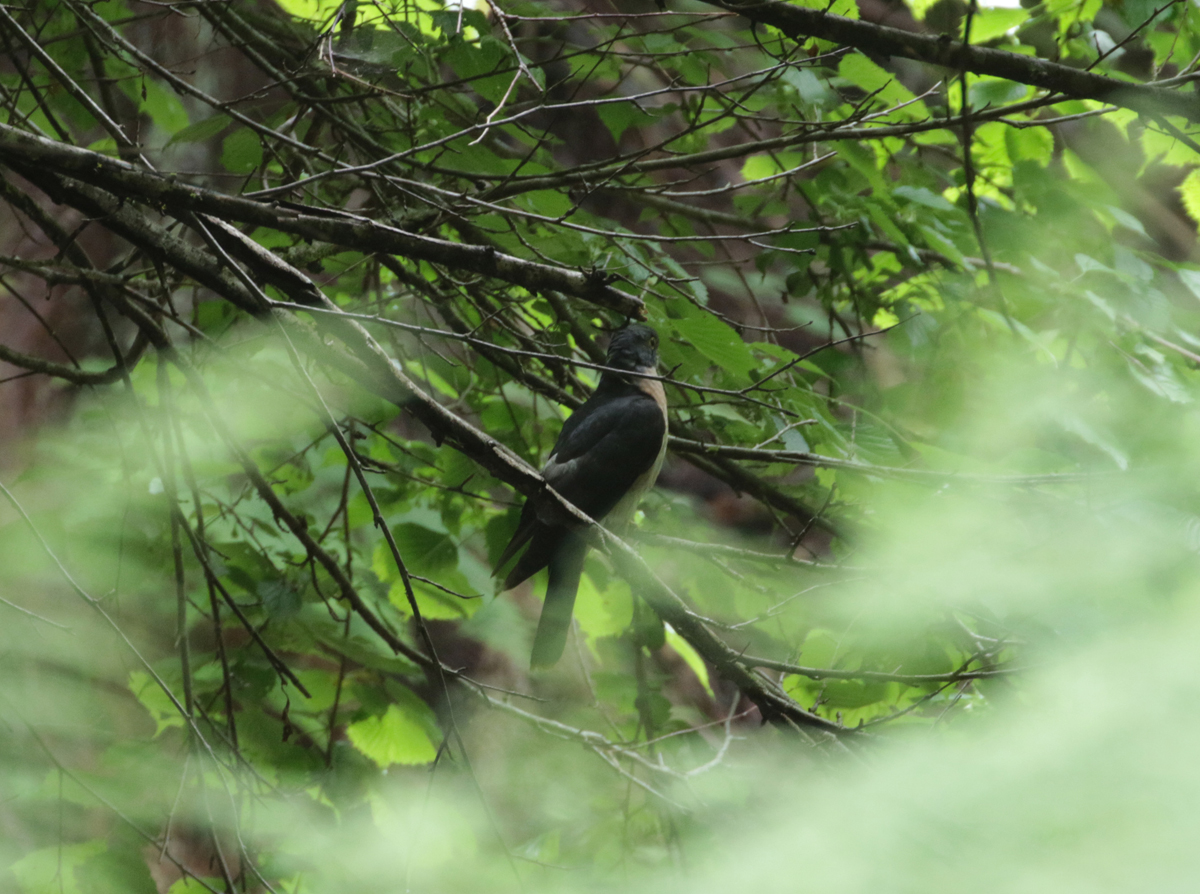
Northern Hawk Cuckoo is a fairly common bird, very vocal at night and into early, post-dawn morning before they notice night has given way they're supposed to melt away with the darkness. Where do they go? They go to dark, deep (leech infested) valley bottoms.


Another feature of dark (leech infested) valley bottoms is shredded trees. Deer rubbing off their velvet? Not going up to four or five metres I'd have thought. Bears it is then, though I've only ever seen one here. Another good bird down there was a Japanese Sparrowhawk. I heard a harsh scolding and saw something dashing towards me with a Blue and White Flycatcher in hot persuit. After a minute I'd persuaded myself that it could have been the Hawk Cuckoo, they look incredibly accipiter-like in flight. I was at it again, trying to deprive myself of a good sighting. But for the second time I had another chance to confirm its identity when after several minutes (where had they been all this time?) the Sparrowhawk and Flycatcher came back up the track. The hawk passed by at head height just a couple of metres away, I don't think I've ever been quite as close to a wild bird of prey.


Before light began to fail I took a thoughtfully place but little used road that crosses the mountain. The best bird (not that I saw it) was a singing Japanese Leaf Warbler, something I hardly ever encounter, plus the only (also unseen) Japanese Thrush. The first Grey Nightjar started 'chucking' while light was still good but it was another 40 minutes before others joined in. While I was waiting a terrific roadside White-backed Woodpecker kept me entertained.