Showing posts with label Shrike Great Grey. Show all posts

Tuesday, 3 November 2020

Another four nights on Hegurajima

 Sometimes ferry sailings align perfectly with plans, not so often in autumn it has to be said when the Japan Sea is far more restless than in spring, but last week was just such an occasion. A ferry sailed on Tuesday morning as I'd hoped then there were none until my planned return the following Saturday. That there isn't another expected until next Friday at the earliest means at least 10 days with only one sailing. As if I wasn't lucky enough, the winds that prevented further sailings were constant full-of-promise north westerlies throughout my stay.

There were no spectacular falls of migrants as there had been earlier in the month but there was a sense of expectation and an obvious daily turnover of birds. Ultimately I was very satisfied with 76 species seen at this time of year and though the total recorded by all the birders out there was higher I think Japanese Quail was the only notable bird I missed. Unlike earlier in the month when I managed to miss the Hair-crested Drongo; I'm not going to forget that in a hurry.

Because I have so many interesting images of so many birds I'll post separately for some family groups such as buntings, finches and so on, and I'll deal with some of the oddities and the total species list here.

One of the hardest birds to catch up with was a Northern Shrike which was found at the southern tip of the island one morning. The majority of birders/photographers were keen to see it so naturally the rest of the island wasn't getting much coverage so I decided my time might be better spent trying to find what else might have arrived overnight. 

As luck would have it, I was the next person to see the bird after the finder, it having moved right up to the northern tip of the island. I sent a message to the crowd down south not that I held out much hope of it sitting around waiting for them. Remarkably the bird did stay, in fact it remained as if glued to the perch until the lead birder of the now strung-out pack hove into view. Just as he rounded a bend through the last of the houses the bird took flight not to be seen again that morning. You have to be sympathetic, don't you? Really, we've all been on the receiving end at one time or another, but I confess there was a funny side I needed to suppress as the stragglers continued to trickle in. 

By evening it was back in its original area, it may have been there the whole day as far as anyone knows as it rarely showed itself even when it was definitely in that location. It was still there the following morning too though I don't know whether it was seen subsequently apart from a report that it had been spotted briefly at the northern end again.

Northern Shrike spotted from the corner of my eye while watching Crossbills.


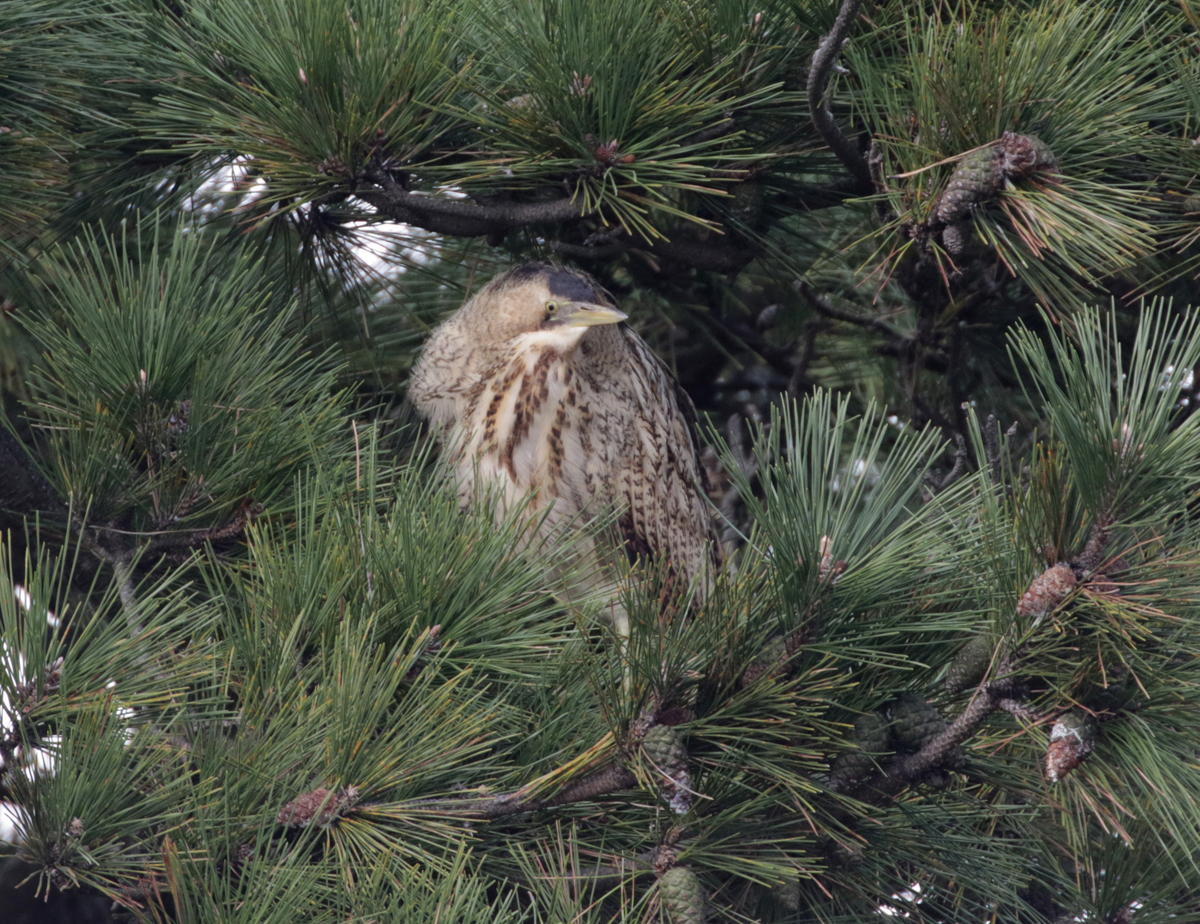
One rarity often leads to another as more pairs of eyes gather in one area. Late afternoon I received a message that a Great Bittern had been found, seemingly tired and going to roost, in a pine tree near the Shrike spot. This was an island tick for me, and my third bittern species on the island.


It's never easy to judge the health of migrant bitterns, they can be so tame and/or in odd settings, but presumably this bird was merely tired after its flight and in need of any place to roost. I believe it wasn't seen the following morning.   

One of the most outstanding memories I'll take away from this trip was Sadogashima! Yes, a different island. In all the years I've been going to Hegurajima I have never seen this 'neighbouring' island which I'd guess to be about 130km to the west, almost double the distance to the Noto Peninsular. After about an hour it had disappeared from the horizon so I'm really glad I took a couple of record shots...

Sadogashima from the northern tip of Hegurajima.

The cropped version, this is definitely an island. 

Apart from the mysteriously appearing island another highlight of the trip was the number of Siberian Accentors. For a long, long time this was a major bogey bird for me. Birders would tell me how vocal they were and that I couldn't possibly miss them. Well that may be but the fact is you can't see or hear something that isn't on the island and for some strange reason our paths simply never crossed, the timing was never right. The classic bogey bird, this went on for years... wait, this went on for (2) decades.

This time I was getting the kind of Accentor experience others must have been familiar with, the kind that led to disbelief that it was possible for a regular visitor never to have seen one. There were about three birds along the north west coastal path when I arrived and another a little further south, these birds duly left during my stay left but on the final day were replaced by about five new arrivals along the same stretch of coastal path. 

I also heard their distinctive call several times, but it was only distinctive because I already knew the Accentors were producing the sound. If I hadn't known there were Accentors present would I have realized that was their call or even that of a bird?! Might I not rather have passed it off as an unfamiliar singing cricket? 


Another bird I'd often unaccountably(?) missed in the past is Eurasian Wren. Not so this time, they were flitting about left and right, quite where they had arrived from, or were heading, I have no idea.

Eurasian Wren, great little birds giving great views for once.

If this post has been a bit of a mixed bag, this Grey-streaked Flycatcher will fit right in. A common enough species on migration but full juvenile plumage is a rare sighting in Japan, and on top of that 29 Oct is getting late for any Grey-streaked.


Juvenile Grey-streaked Flycatcher

A couple more Hegura regulars that I feel I never post images of are Rook and Eurasian Sparrowhawk, so I'll set that right now. Most of the Rooks I see on the island are immatures that are always worth checking for Carrion Crow, a much bigger prize, but this one is an obvious adult. Sparrowhawks are the commonest accipiters out there but I also saw a Japanese Sparrowhawk and a Northern Goshawk was also seen.


Rook

Eurasian Sparrowhawk

Full list of species:-

Mandarin Duck                                                            Brown-eared Bulbul

Mallard                                                                         Japanese Bush Warbler

Eastern Spot-billed Duck                                             Black-browed Reed Warbler

Eurasian Teal                                                                Yellow-browed Leaf Warbler

Tufted Duck                                                                 Warbling White-eye

Streaked Shearwater                                                    Goldcrest

Little Grebe                                                                  Eurasian Wren

Great Bittern                                                                White-cheeked Starling

Grey Heron                                                                  Common Starling

Great White Egret                                                        Eyebrowed Thrush

Pacific Reef Egret                                                        Pale Thrush

Great Cormorant                                                          Naumann's Thrush

Temminck's Cormorant                                                Dusky Thrush

Merlin                                                                          Red-flanked Bluetail

Peregrine                                                                      Daurian Redstart

Black Kite                                                                    Stejneger's Stonechat

Japanese Sparrowhawk                                                Blue Rock Thrush

Eurasian Sparrowhawk                                                 Grey-streaked Flycatcher

Northern Lapwing                                                        Siberian Accentor 

Common Sandpiper                                                      Grey Wagtail

Black-tailed Gull                                                           White Wagtail

Slaty-backed Gull                                                          Tree Pipit

Black Woodpigeon                                                        Olive-backed Pipit

Oriental Turtle Dove                                                      Red-throated Pipit

Common Kingfisher                                                      Buff-bellied Pipit

Bull-headed Shrike                                                        Brambling

Northern Shrike                                                             Oriental Greenfinch

Rook                                                                               Eurasian Siskin

Large-billed Crow                                                          Common Redpoll

Bohemian Waxwing                                                       Long-tailed Rosefinch

Japanese Waxwing                                                         Common Crossbill

Eastern Great Tit                                                            Hawfinch

Skylark                                                                           Japanese Grosbeak

                                            Chestnut-eared Bunting

                                            Little Bunting

                                            Rustic Bunting

                                            Yellow-throated Bunting

                                            Black-faced Bunting

                                            Grey Bunting

                                            Pallas's Reed Bunting

                                            Japanese Reed Bunting

                                            Common Reed Bunting

                                            Lapland Bunting


Thursday, 1 January 2015

Another try for Isabelline Shrike

I'm getting rather behind with trip posts, which is surprising considering there's only about eight hours of good birding light per day, but between overnight drives and trying to get a little sleep in the car there still just aren't enough hours in the day.

On the morning of the 30th I was at Kadogawa to the north of the Greater Spotted Eagle site but a thorough scan of the harbour and the surrounding sea failed to produce the hoped for Japanese Murrelet. There was very little on the sea in fact, just a few Great Crested and Black-necked Grebes but Black-tailed Gulls in the harbour was an addition to the trip list.

Whatever the mechanic did to the car battery seems to have done the trick, it is charging now and the engine can be safely switched off. Though I'm still a little nervous every time I come back to the car and turn the key.

After the early morning failure I headed back across the island to the east coast to give the Isabelline Shrike another try; I now had a precise location. Though I found one in October it is nevertheless the rarest  bird in Kyushu as far as I'm aware of and more difficult to see than Scaly-sided Merganser in Japan. The only other bird of interest I've heard of is a Shore Lark in Fukuoka.

The expanse of fields at Tamana is huge, but far more manageable than that at Isahaya Bay. I must say I like this place, a good estuary, the fields of course but with more scrub and trees than Isahaya, plus some natural (un-concreted) ditches. The only thing it lacks is a good reedbed.

I don't know how long ago these fields were 'reclaimed' it must have been a long while ago as the overspill village outside the defensive 'Great Wall of Tamana' is itself old.

What must once have been the sea wall, it runs several kilometres across the area, behind it is mostly residential with discontinuous pockets of arable land. It makes quite a landmark.


Shots bravely taken from the untamed side of the "Great Wall".

The place is far less manicured than Isahaya Bay, lots of scrub, more natural drainage ditches and the fields have a greater variety of crops. 'Blessed with' and 'overhead wires' aren't expressions you'll see in the same sentence too often but they provide an excellent network of perches. Just ask anyone looking for Great Grey Shrike! That white blob in the centre is a Black-faced Spoonbill, there were four in this ditch when I was here two days ago.


How are the fields here different from my local fields at Ogura? Hmmm...

I arrived at about 2pm and immediately went to the Isabelline Shrike location I'd been given. There was only one shrike on that stretch of river bank and initially to looked promising but it was both mobile and difficult to approach. I could see it when it flew onto the wires but when it dropped down it tended to be out of sight. Though it looked good at times, at others it looked far more like a female Bull-headed which ultimately I decided it must be. It would have helped if I'd known the gender or age of the Isabelline.

After a while I decided to look for the Great Grey again and see if I couldn't get any better shots while light was still good. Luckily it was in a track-side bush rather than on wires across the open fields though it meant I had to view it through the windscreen.


There wasn't time to check many other areas but I had to have a look at one or two good looking fields popular with pipits last time I was here. But was side tracked by the Lapwings, I can never resist looking at Northern Lapwings, they're such beautiful birds. They can be hard to approach but there was a flock at the edge of a field which were quite unperturbed by my presence. There was even a Grey-headed Lapwing further out, a scarce bird in Kyushu.

Just catching the last rays of the sinking sun.


Northern Lapwing; my favourite wader.

As I live in the heart of Grey-headed Lapwing country this wasn't so interesting for me but many people will visit Kyushu without seeing one.

As a postscript, I've heard that though the previous winter there was an Isabelline Shrike here it's a Brown rather than Isabelline at the site this winter.

Tuesday, 30 December 2014

Great Grey Shrike, Kyushu

I drove round from Isahaya overnight and arrived at Tamana early, very early, on the morning of the 28th and waited for dawn. I could hear Northern Lapwings calling very close to the car and as the fields came into clearer view an accipiter, probably a Northern Goshawk dashed by flushing them. Birding was under way.

The main goals here were Great Grey and Isabelline Shrike but I only had the vaguest idea of where to look and so drove round slowly to get my bearings and check all the very many Bull-headed Shrikes. There were lots of bird around which made for an interesting morning. Plenty of ducks and waders on the estuary including the first Falcated Ducks of the trip as well as several Black-faced Spoonbills and Saunder's Gulls. Three Hooded Cranes were joined by a party of 13 White-naped on the fields which were alive with passerines and Peregrine, Merlin, Common Kestrel, another accipiter briefly and Hen Harrier were all adding to the excitement. But no shrikes other than Bull-headed.

As at Isahaya Common Starling was fairly common.


 Four Common Shelducks on the fields provided much better photographic opportunities than the usual distant estuary birds.

Wagtails and pipits were common on the fields and the best birds were a leucopsis White Wagtail and a Richard's Pipit.


Finally, just before noon I connected with the Great Grey! This was my third Japan tick of the trip and as I'd only been hoping for one before leaving home things were going really well.


Things had been going really well but a flat battery in the car brought an abrupt halt to that! I asked a couple of truck drivers if they had any jumper leads, they didn't. However one of them gave me a lift to a garage to get help, it was closed. How quickly things can go south. Nevertheless my truck driving mate wasn't about to be beaten by this minor set back and after a brief spell on the phone he got someone to drive out to my aid and we parked up waiting for the cavalry to arrive. Pretty soon a pick-up came and we headed back to my stranded car. The mechanic told me the battery hadn't been charging, either it needed or replacing or it was just a problem with the negative terminal. Either way he recommended I go straight back to Kyoto and not to turn off the engine for any reason including re-fueling. Hmm. After paying him Y1,000, you can't complain can you, I was on my way again - and not back to Kyoto. I'd lost the afternoon but there were still birds to see.

List of species seen:-
Common Shelduck   4
Falcated Duck   12
Eurasian Wigeon   high 100s
Mallard   100s
Eastern Spot-billed Duck   100s
Northern Pintail   c150
Eurasian Teal   15
Little Grebe   1
Black-necked Grebe   2
Black-faced Spoonbill   8
Grey Heron   several
Great White Egret   2
Little Egret   1
Great Cormorant   several
Eurasian Kestrel   3-5
Merlin   2
Peregrine   1