Showing posts with label Sandpiper Marsh. Show all posts

Monday, 4 September 2017

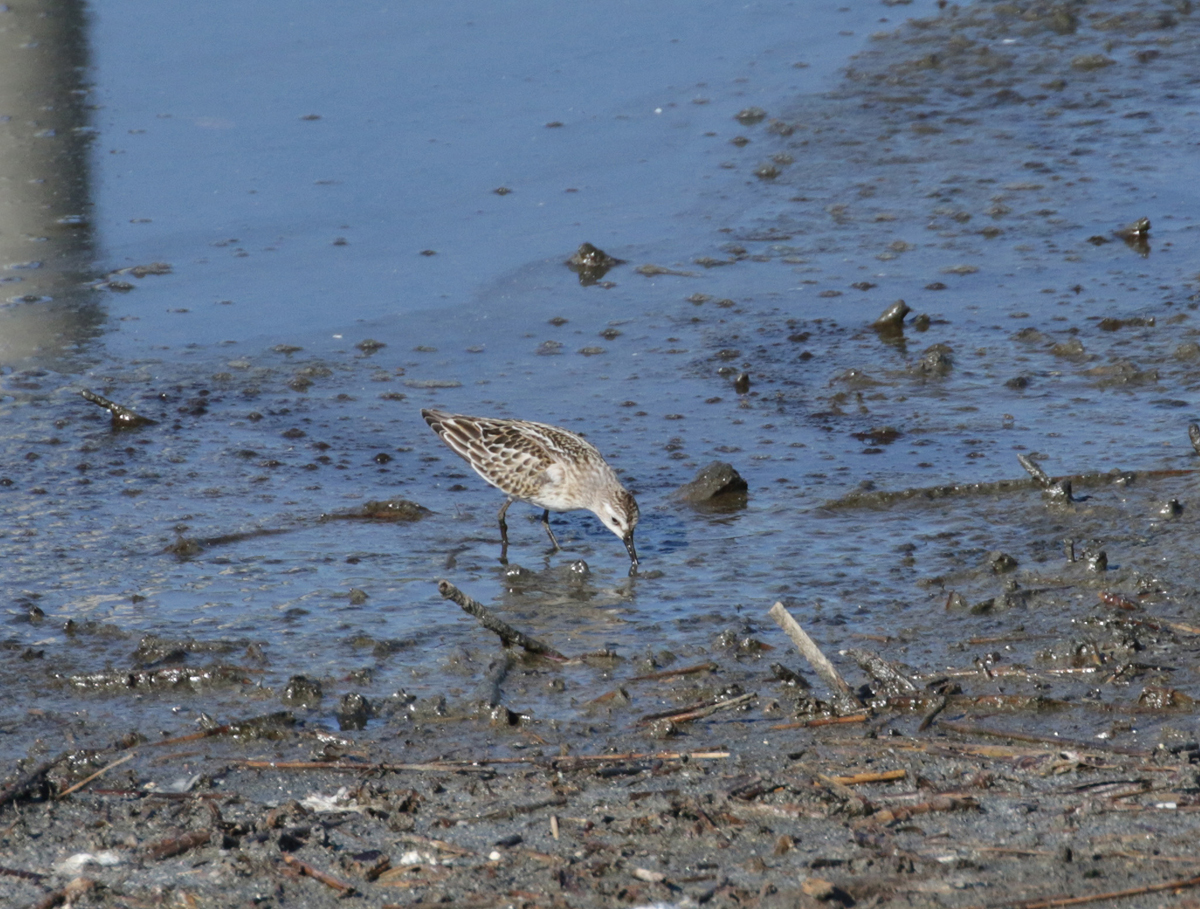
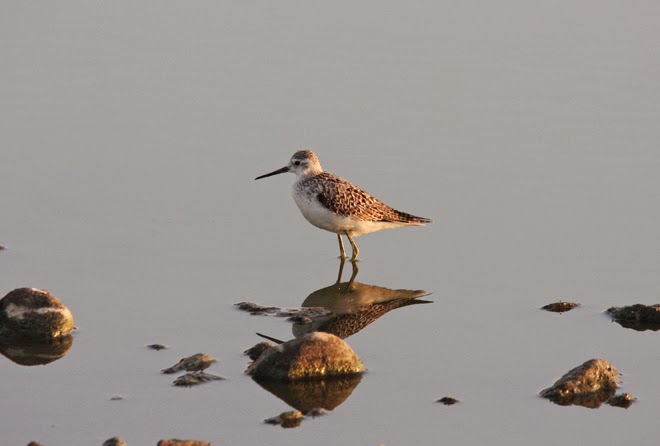
Broad-billed Sandpipers and another Little Stint

I love wader passage season, there's always the chance of something really out of the ordinary turning up, it's on a par with a seabirding on the Pacific route ferries or an off-shore island stay. Except there's no need to invest as much time or money, it's so easily doable in a spare day.


Last Friday I did the rounds of the Matsusaka / Tsu wader spots, some of them at least. Driving across overnight I was in my usual state of expectation, running through the identification features to separate tricky specks miles out on the mudflats... Baird's and White-rumped, Semi-P and Western, Eskimo and Slender-billed. I know, I know, a tad over-optimistic when you consider Semi-P isn't even on the Japan list.


In the two weeks since my previous visit the place has changed almost beyond recognition, gone is the huge expanse of flooded rice fields, all is stubble now and bone dry. Birdwise there are pros and cons to the change, it suits Skylarks just fine but what about the Zitting Cisticolas, they were so common last time I was there and they've all but disappeared. Likewise I'm split, I miss the extensive greenery on one hand but on the other I feel it might be easier to find something unusual out in the open. Not that this makes any sense as previous years don't back it up the notion of better birds on the open fields, but anyway, a Dotterel would be nice!


Tides are really important of course and their timing dictates whether you'll have the light as a help or hinderance across this estuary of that tidal flat. But also water levels on ponds and on the fields are crucial and sometimes you can drive round all day without finding the sweet spot that's pulling in the birds. This visit was lucky in that regard and it was one of the standard must-visit sites that held a selection of twelve species. The highlights were the two Broad-billed Sandpipers and Little Stint of the title. The former is a scarce passage bird and I don't expect to see more than one or two per migration season and when numbers are that low it's possible to go a long time without a decent view. The latter I always regarded as a rarity in Japan but this is the fifth I've found here in about three years so I'm coming round to the idea that it's been long overlooked rather than rare.


The birds were at a nice distance for observation, unconcerned by my presence and near enough to see well, unfortunately just a little too far for photography with my kit so most of these images had to be cropped more heavily than I'd have wished.


Little Stint. This last shot was taken at midday, the bird was a little closer but the sun was less helpful. Interestingly the 20 something Red-necked Stints I saw were altogether on a different pond.


Like the Stint the two Broad-billed Sandpipers stuck to the same small section of mud throughout the day, other waders used the whole expanse of the pond, not that it was very large.


Other wader species included...


Black-tailed Godwit


Common Redshank, one of five, with Marsh Sandpiper.


Grey-tailed Tattler with Black-tailed Godwit.


Several Marsh Sandpipers showed a good range of plumage.


Monday, 21 September 2015

The first field trip in ages!

Tuesday last week (Sept 15th) I had no work, this was only the second birding opportunity since early May! I don't think I've ever not been birding for so long and though I didn't see anything earth-shattering it was great to get into the field. It was almost as enjoyable just to have a slow overnight drive stopping for the odd coffee along the way, letting the anticipation build.

Birdwise, the day was disappointing compared to the same date a year earlier. On the 15th last year I found two Little Stints, a Japan tick for me, and other locally scarce waders included Broad-billed Sandpiper and Ruff. On this trip the only scarce migrant wader I saw was a fairly distant Greater Sand Plover on estuary sandflats with eight Lesser Sand Plovers.

My usual winter routine in this area is first to check-out a large, deeper coastal lagoon with the early light behind me but on spring and autumn wader trips the shallower pools are obviously more productive. This so often means either a distant view with the rising sun on my back or a much closer view against the light. Tuesday dawned with a screen of clouds along the horizon. Things appeared to be going my way, this was the perfect opportunity to pull right up alongside a usually productive pool without the light problem. But as is sometimes the case, appearances can be deceptive and in this case too much water meant no waders! Undeterred I headed out onto the fields looking for suitably wet or flooded fields that might hold parties of waders while the tide was still high. I tried two extensive tracts of fields a few kilometres apart but neither had any fields which to my human eye looked attractive to waders, they apparently thought likewise.

Egrets pass through the area in big numbers and if wader numbers where down on this visit, there were far more Cattle and Intermediate compared to this time last year.


A Cattle Egret trying to pass itself off as an Intermediate with that prominent black bill tip. Presumably this is a juvenile, the black tip being a remnant of the short-lived black bill phase of very young birds.

By 3pm I'd seen 23 wader species (compared to 27 on the same date last year), not great but nevertheless not bad for a first-in-ages field trip; good enough to get the juices following again. Most weren't at a photographable range, which was also disappointing, and the following were the best shots I could get.


Grey-tailed Tattler. 


Eurasian Curlew; there were 3-4 Far Eastern but the sole Eurasian was the only curlew to come within camera range. 

Common Greenshank was one of the few species in usual numbers, these showing a range of leg colour from dull greyish-green to bright yellow. 

Common Greenshank. 

Marsh Sandpiper behind Common Greenshank. 

Marsh Sandpiper. 


There were a large number of Sand Martins passing through, this a scaly juvenile. 

Spot the Garganey. I had a high count of about 15 last year but could only find three sifting through the Common Teal on the water this time round. They were much easier to pick out in flight!


Now that my busy work schedule has eased and after moving house this week, I'll hopefully have more time to get out and find some birds!

LIST OF BIRDS SEEN
Mallard   3
Eastern Spot-billed Duck   common
Northern Shoveler   7
Northern Pintail   9
Garganey   3
Eurasian Teal   c180
Common Pochard   5
Tufted Duck   1
Streaked Shearwater   common off-shore
Little Grebe   common
Black-crowned Night Heron   1
Cattle Egret   c120
Grey Heron   fairly common
Great White Egret   200+
Intermediate Egret   300+
Little Egret   15-20
Great Cormorant   very common
Osprey   5-6
Black Kite   several
Moorhen   2
Common Coot   2
Oystercatcher   12
Black-winged Stilt   14
Grey-headed Lapwing   1 plus 3 heard
Little Ringed Plover   2 plus 1 heard
Kentish Plover   common
Lesser Sand Plover   c10
Greater Sand Plover   1
Common Snipe   2
Bar-tailed Godwit   2
Whimbrel   1 plus 1 heard
Eurasian Curlew   1
Far Eastern Curlew   3
Marsh Sandpiper   4
Common Greenshank   18
Green Sandpiper   1
Wood Sandpiper   2
Grey-tailed Tattler   c20
Terek Sandpiper   c12
Common Sandpiper   c8
Great Knot   1
Red Knot   1
Sanderling   c130
Red-necked Stint   5
Dunlin   4-5
Black-tailed Gull   1000+
Slaty-backed Gull   1-2
Black-headed Gull   sevreal
Common Tern   c140
Rock Dove   2-3 parties
Oriental Turtle Dove   several
Common Kingfisher   2
Bull-headed Shrike   3 plus several heard
Carrion Crow
Large-billed Crow
Sand Martin   common throughout the day
Barn Swallow   as above
Red-rumped Swallow   2
Japanese Skylark   several
Zitting Cisticola   several (mainly heard)
Brown-eared Bulbul   only 1 heard. Where were they?
Oriental Reed Warbler   1
White-cheeked Starling   fairly common but no large flocks
Blue Rock Thrush   8-10
Eurasian Tree Sparrow   common
White Wagtail   fairly common
Japanese Wagtail   2
Meadow Bunting   3 heard


Saturday, 7 December 2013

tringa to arenarea


Spotted Redshank is uncommon and another species I've only encountered in coastal areas but there's no reason it shouldn't turn up inland but the usual problems of finding temporary suitable habitat at the appropriate time apply. Similarly Common Redshank could stop off anywhere on passage but I've yet to find one away from the usual coastal sites.

One of eight migrant Spotted Redshanks on a pool in Mie in April.

Redshanks coming into breeding plumage April 2013, Yonaguni.

Marsh Sandpiper is much easier to find than the previous two and I'd be surprised not to see any at either of my usual coastal wader sites (Nanko and Mie) during passage.


Adult 9 September, Mie. Two shots of the same bird, the upper in soft morning light and the lower at midday.

Juvenile with adult Common Greenshank 11 August 2011, Mie.

Common Greenshank is common, it's relatively easy to find inland on paddyfields as well as on estuaries. Nordmann's on the other hand is very rare in Kansai, perhaps the least likely of the big three (along with Asian Dowitcher and Spoonbilled Sandpiper) to turn up here. But it's the only one I still need for the area so that's bound to colour my impression.

A moulting adult on a flooded fallow field, Mie 17 August 2011.

A surprisingly small adult already in winter plumage, 7 August 2009.

Juvenile on the Yodo River, Osaka. 16 September 2007.

A juvenile moulting into first winter on a river in Mie, 7 January 2012. Mid-winter birds are quite rare in the region.

Green Sandpiper is reasonably common on migration and through winter but it's solitary and often in unexpected places, deep concrete drainage ditches across fields seem a favourite. There are a couple of tiny spots around Kyoto that seem very attractive to them.

There's often a mid-winter bird on a permanently waterlogged field to the north of Lake Biwa that never seems to freeze in winter. 29 December 2011.

A flood prevention area opposite Kyoto race track is good for Green Sandpiper, this one 10 April 2011. Common Snipe and Long-billed Plover are the only other species that use this site despite it looking rather good for migrant waders.

Wood Sandpiper is a common migrant on paddyfields throughout the area and can sometimes be in quite large numbers.

Two birds at Kin, Okinawa 3 August 2011. The bird above reminding me of a threadbare carpet compared to the bird below.
 
 Two spring birds Yonaguni, April 2013. Again there's a big difference in appearance with the lower bird's moult some way to go.
 

Varying moult progression in early April Wood Sandpipers on Yonaguni.

Grey-tailed Tattler is as common on the coasts as it is rare inland. I've only seen odd ones on Kyoto rivers but they're hard to avoid at the coast, particularly at rocky river mouths or where there are concrete block and tetrapod sea defences. I've never heard of a Wandering Tattler in Kansai but in theory the southern tip of the Kii Peninsular would be the place to try for them.

Grey-tailed Tattlers at a Mie river mouth, 17 August 2011.

Mie, 2 September 2012.

Juvenile Grey-tailed in Mie, August 2014.

Terek Sandpiper is another common bird in Mie and not uncommon in Osaka but I'm yet to see one inland.

Breeding adult in a paddyfield that always attracts lots of migrants on Mishima (Yamaguchi), 30 April 2009.

Terek is a very common migrant in the area, this in Mie August 2014. 

Tereks and Tattlers, a winter plumage bird stands out, 17 August 2011. 

Common Sandpiper lives up to its name, being the most widespread wader in the region. It can be seen on all the Kyoto rivers but the Katsuragawa is particularly good.

Juvenile on the Katsura River, Kyoto 20 October 2010.

2CY in heavy moult on a small river at Ogura, Kyoto, 20 March 2011.
 
A nice spring adult on Yonaguni, April 2013.

Ruddy Turnstone can be found in the Tsu city area of Mie from August throughout winter. It is fairly common but less reliably seen in Osaka.

A great looking Ruddy Turnstone in Mie in mid-August 2014.