Showing posts with label Dowitcher Long-billed. Show all posts

Tuesday, 31 October 2017

Dowitchers and Greenshanks at a high tide roost

There were a few late passage waders on October 27th and the first birds of the day, Great Knot, probably fall into that category. However most species I saw are likely to spend the winter locally.


The Great Knot were close enough to chance a couple of shots despite the poor pre-sunrise light. If I'd waited any longer they'd have been against the rising sun so it wasn't as though there was any choice. Perhaps it's just coincidence that the only Great Knot I ever get close to are very early in the morning and the resulting images are never satisfying.


Great Knot


If it isn't dim early light then it's strong midday sun, or that's how it sometimes feels. The regular Common Greenshank high water roost on the other hand is a different matter, it's simply a matter of going when high tide coincides with the sun at the right angle. This dosen't happen every day obviously but last Friday the timing was just right. The Greenshanks were expected, they're always there if they haven't been disturbed, but the Long-billed Dowitchers were not. I've never seen them on the estuaries before and they'd probably been displaced from a pond or lagoon by the high water levels caused by the last typhoon but whatever the reason for their presence they were a pleasant surprise.


Part of the wader roost on the steep concrete riverbank. The Greenshank can usually be found at this spot providing no one has disturbed them but the Dowitchers here are a first for me.


Saturday, 1 April 2017

Biwako & Matsusaka, a two-day trip

I hadn't been up to the north end of Lake Biwa in ages, all winter in fact. Which is surprising considering winter is the best time to go and as a result I haven't even seen Steller's Sea Eagle this winter. I was hoping to get (good if possible) views and maybe even photos of Copper Pheasant but in the event I didn't even hear a displaying male.


Because there's a cell tower at the top of my usual hill there is an access road, well that's why it is 'my' hill in the first place of course, and this access road has been snow-ploughed allowing anyone daft enough to drive to the top the freedom to do so. However it also meant all bar one of my usual pull-offs were blocked by snow. By day the road becomes a shallow stream as snowmelt finds the easiest route downhill between the walls of snow on either side, but at dawn a steeply-angled ice-rink would be a better description of the road as it nears the top. Going upward, be it driving or on foot, always seems safer than going down to me, so I stopped at the summit rather than drop down the final 100 metres to the car park. I nevertheless still had to walk it. If I tried to stand still on the road I began to move down the slope, slowly at first. Gingerly I had to edge my way down trying to get purchase on a litter of pine needles frozen into the paved edge before it disappeared under the snow. Trying not to pick up speed! And all the while wishing I'd actually gone and bought new boots when I'd planned to rather than keep putting it off.


Like a lot of winter woodland birding much of the ridge was, well not birdless exactly but... you know. A few invisible tits calling somewhere off the trail, occasional Grosbeaks overhead. Then, again like so often, all the birds were back at the start point, by the car. Three species of woodpecker, Nuthatch, five species of tit, Jays, Red-flanked Bluetail, three species of bunting, five species of finch and so on.


Red-flanked Bluetail.


As I said, all my usual pull-offs along the road were blocked by snow except for one, the lowest good stop on the way back down. There were two clear signs spring is here...


Bear art? I often come across conifers with huge sections of bark ripped off, it comes away in huge chunks as if it had been badly-fitted to the tree. This hardwood presents a much better canvas.


Bullfinches feasting on new buds; this male (and female below) the expected rosacea.


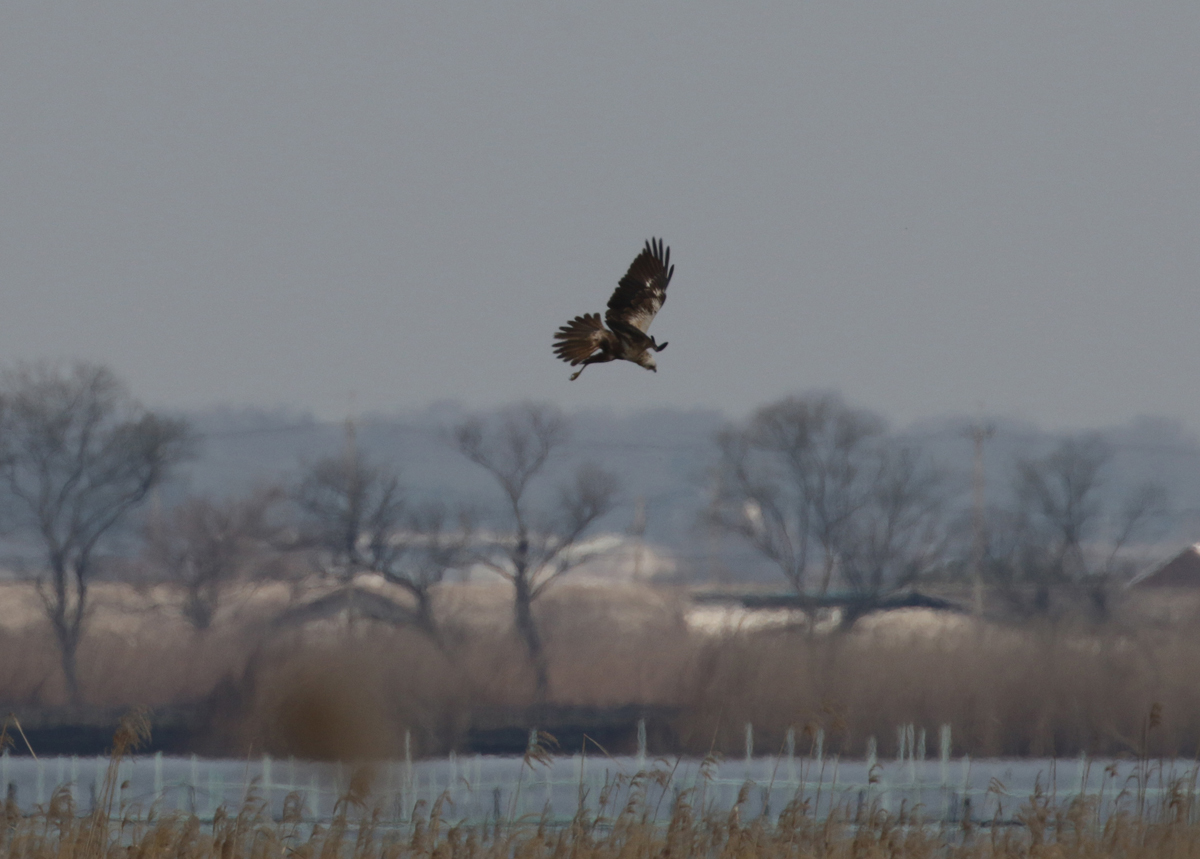
Lake Biwa itself is a vast expanse of water, the winter panorama without exception broken by countless rafts of countless ducks, as well as more modest numbers of geese and swans. But hardly surprising given the date most of the wildfowl has gone and the drive southward was consequently a rapid one despite the best efforts of some serious road works. I reached Lake Sainoko far earlier than usual. Far too early for any harriers there may be in the area coming in to roost. However I did see five different Eastern Marsh Harriers in the time I spent there. I also had my first Barn Swallow of the year and little did I realise then, that by the same time a day later they would be common.


As usual the harriers were more often than not distant, at their closest they weren't great to photograph.


After a convenience store dinner and a nap it was off to Matsusaka. The route was simple according to the map; pretty much a straight line to Route 1 and I could take it from there. A straight line on major roads but a lot of jinks and route numbers so I let the satnav take the strain. She found an even more direct route! However this involved sticking to a road atop the river embankment; sometimes single track, sometimes very rough, but it was more direct. I don't know if it was any quicker in the end, especially at that time of day as it entailed cutting across several major roads with no signals during rush hour.


The main purpose in Mie was to look for immature Taimyr Gulls but there were a few other things of interest. First and foremost was a Japanese Scops Owl calling at 04:10 in an industrial area at Matsusaka port! It was very close but I didn't see it and it quickly moved further off onto private land.


Another point of interest I'd never seen before was seaweed harvesting by boat...


A seaweed harvest boat. at first I though being in the boat might be the better option but I'm no longer sure.


Simply line the boat up at the end of the row...


...and go!


Long-billed Dowitchers were fairly close for a change but the gulls will have to wait for another post.


Thursday, 21 April 2016

A few spring migrants

I arrived in Mie yesterday hopeful of seeing a wide variety of waders; that didn't happen. In part because I spent hours trying to get good views of a couple of snipe, one clearly Swinhoe's but the other less easy to separate from the much less common Pin-tailed, but mainly because there doesn't seem to have been a massive change since my last visit 10 days ago. A few Wood Sandpipers and Whimbrel are the only signs on new arrivals apart from the migrant Swinhoe's Snipe. However the Spotted Redshanks and Long-billed Dowitchers are looking much closer to breeding plumage now.


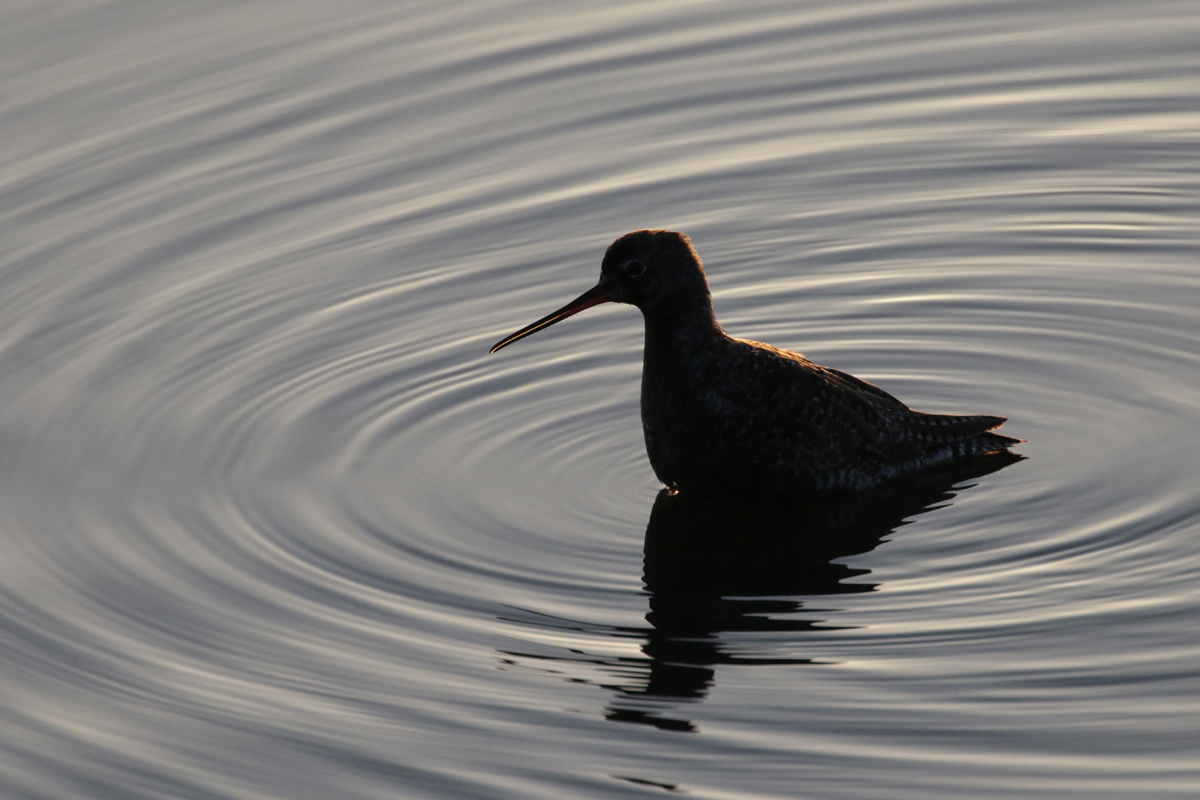
First up was a Spotted Redshank backlit by the first morning sun.


Two of seven Common Greenshank.


Long-billed Dowitcher with Wood Sandpipers.


The Long-billed Dowitcher relocating to a quieter pile of rocks away from the Wood Sandpipers.


Jousting Wood Sandpipers.

Elsewhere it was business as usual with the Wood Sands.


Spotted Redshanks with Long-billed Dowitchers and Black-winged Stilts.


Very few Sanderling were coming into breeding plumage, this was the most advanced I saw.


Grey-headed Lapwing.


List of species recorded:-

Green Pheasant   4 plus several heard Gadwall   100+
Falacted Duck   17  
Eurasian Wigeon   low 1000s
Mallard   10s
Eastern Spot-billed Duck   fairly common
Northern Shoveler   c60
Northern Pintail   c40
Eurasian Teal   100s
Common Pochard   40-50
Tufted Duck   c200
Greater Scaup   1000+
Red-breasted Merganser   c20
Little Grebe   common
Great Crested Grebe   5
Black-necked Grebe   7
Black-crowned Night Heron   1 heard
Cattle Egret   1
Grey Heron   common
Great White Egret   common, numbers clearly up
Little Egret   c20
Great Cormorant   common
Peregrine   1
Osprey   2
Black Kite   2-3
Ruddy-breasted Crake   1 heard
Common Moorhen   1
Common Coot   c40
Eurasian Oystercatcher   49
Black-winged Stilt   4
Grey-headed Lapwing   c10
Grey Plover   c40
Little Ringed Plover   3-4 plus several heard
Swinhoe's Snipe   2
Common Snipe   8
Long-billed Dowitcher   3
Bar-tailed Godwit   c15
Whimbrel   3
Far Eastern Curlew   2
Far Eastern or Eurasian Curlew   1
Common Greenshank   7
Spotted Redshank   7
Wood Sandpiper   8
Sanderling   60+
Dunlin   100s
Black-tailed Gull   1
Common Gull   4
Vega Gull   c40
Taimyr Gull   6-7  
Black-headed Gull   c400
Rock Dove   c8
Oriental Turtle Dove   several
Japanese Pygmy Woodpecker   1 heard on drive to Ishikawa
Bull-headed Shrike   5
Jay   1 on the drive
Carrion Crow   common
Large-billed Crow   a few
Varied Tit   several heard on drive
Long-tailed Tit   several heard on drive
Barn Swallow   only a few passing through
Japanese (Eurasian) Skylark   common
Zitting Cisticola   3 plus 4-5 heard
Japanese Bush Warbler   2-3 heard on drive
Oriental Reed Warbler   2 heard
Japanese White-eye   several on the drive
Wren   1 heard on the drive
Chestnut-cheeked Starling   1
White-cheeked Starling   widespread in low numbers
Dusky Thrush   still common
Blue Rock Thrush   1
Brown Dipper   1 on the drive
Eurasian Tree Sparrow   common
Grey Wagtail   2 on the drive
White Wagtail   c6
Japanese Wagtail   1 on the drive
Oriental Greenfinch   fairly common
Japanese Grosbeak   1 on the drive
Meadow Bunting   several
Chestnut-eard Bunting   several
Common Reed Bunting   4

On the way there:-
racoon dog   1
Sika Deer   2