Showing posts with label Plover Grey. Show all posts

Thursday, 9 August 2018

Common Ringed Plover and Red-necked Stints

I've only been out a handful of times during the last two or three months, mostly in Kyoto and Shiga forests but with a couple of trips to Mie recently now that the potential for good shorebirds is on the rise.


Yesterday's undoubted highlight was a Common Ringed Plover before the rising tide finally covered the last feeding areas for most wader species and they flew off to roost somewhere. I suppose Ringed Plover isn't rare enough to make a fuss of but I'm still way down in single digit sightings in Japan after all these years. So it's not to be sneezed at either. It was well worth getting sandblasted on the beach to get the shots as a new-sprung wind was being pulled ever more urgently to the south by yet another approaching typhoon.


I'd been at the same spot for the falling tide in the morning as the sun edged above the horizon, hoping to catch some waders in the softer morning light. It's surprising how infrequently optimal tides coincide with both my free time and, crucially of course, any birds actually being present at any suitable location; too many of the good wader spots will have you looking directly into a rising sun. Unfortunately this Terek Sand was the only bird that came close enough to allow any decent shots.


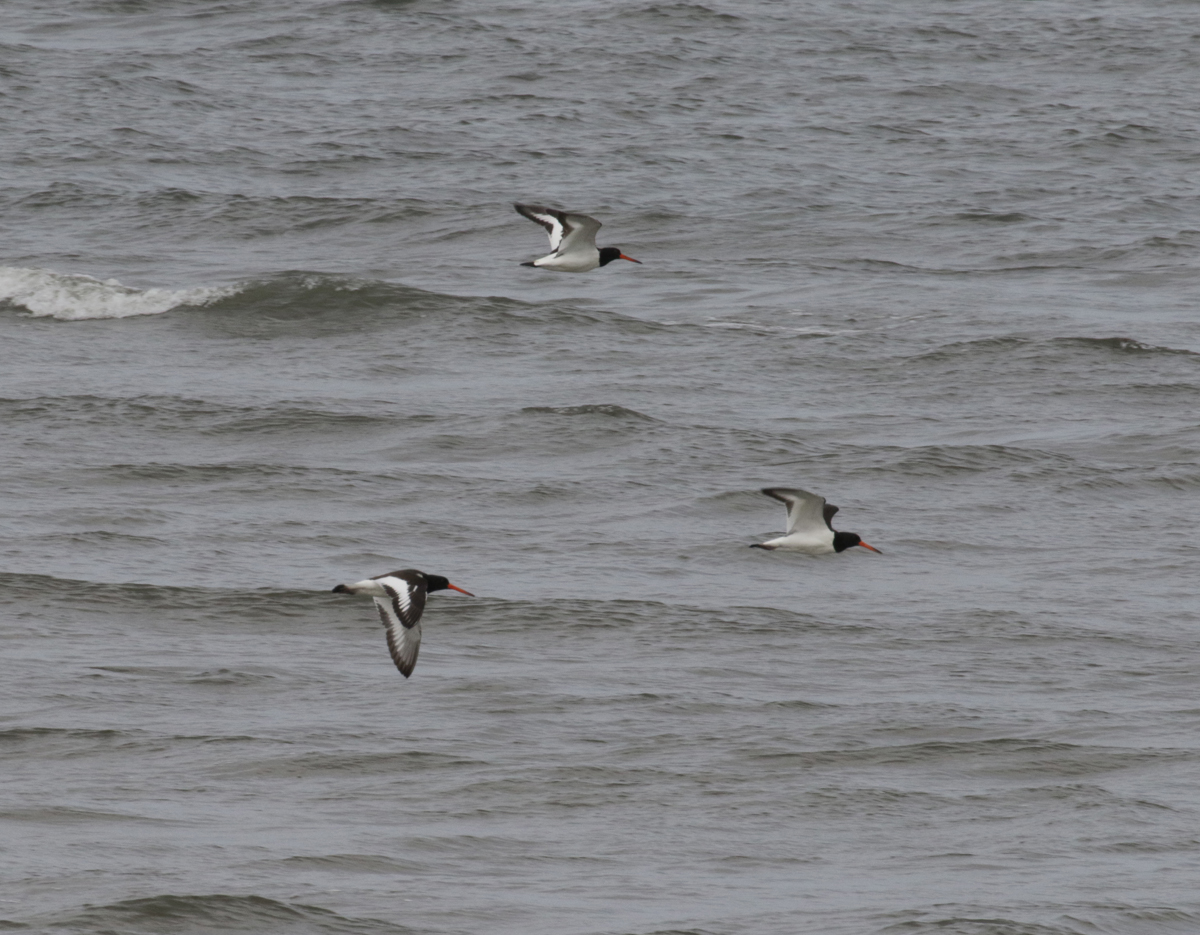
It was already quite hot so sitting on the wet sand didn't bother me in the least, the only problem was a small flock of Red-necked Stints were the only other birds using this area. There was a flock of Oystercatchers just behind me but they were barely recognisable even as birds against the glare of the horizon.


All the Stints were adults, juveniles haven't arrived yet, and getting reasonable shots of them was quite difficult for me (you'd think I'd be used to the camera by now) with half the bird in bright light, the other in deep shade.


This was by far the most advanced bird in terms of moult.


That's quite a stout bill on this one. A few feathers dropped but nothing new as yet, the only visible grey is from exposed feather bases rather than seasonal replacements. 


It should be obligatory for all stints/peeps to turn and show their feet like this...


...this one is a fail.


Same Stints, different beach. Not being a mad dog I could sit in the car here rather than go out in the midday sun. Quite prominent but not exceptional braces on this bird.


When Sanderling is mistaken for Red-necked it must always be when there are zero other waders around for comparison. The three Sanderling on the beach looked absolutely huge compared to the Stints.


After spending my time birding a few kilometres to the south I returned to the original estuary before the next high tide and immediately picked out my star-of-the-day Ringed Plover about 150m off the seawall. As I mentioned earlier the wind was really blowing now and many waders were sheltering below a steep sand ridge. while I, in search of cover, had to make do with the windward side of the ridge.


There were only about 20 Red-necked Stints here but no matter what I tried to photograph the Stints always contrived to get in the picture. I have Sand Plovers with Stints, Tattlers with Stints, Grey Plovers... Ruddy Turnstones... and here, bird-of-the-day, Common Ringed Plover.


The wing-bar just about shows through here.


The Ruddy Turnstones really loved this wash-up tree stump and were still probing into all those small bore holes when I left.


Just to tag on a few extra shots from a week earlier. These are of Grey Plovers on a beach about 20km to the south and again taken as the sun was just coming up.


Grey Plovers are quite common at the moment but they tend to stay way out on sand bars. I was able to catch these birds at high tide when most off-shore areas are under water.


And the sun is up!


This looks a very standard sort of GP to my eyes; hefty, deep-bodied, big-billed... dumpy but huge with it. It may not be as ungainly as a Greater Sand Plover but there's something a tad off about it. Were it a horse I dare say it would be more at home between the shafts of an old cart (rag'n'bone) than on the track. That said, take a look at the next bird on a different beach...


I think this bird has species issues; it probably feels it should have been hatched a Pacific Goldie (or American).


Tuesday, 5 September 2017

A few left over images of Mie birds from last week

Grey Plover at sunrise.


Garganey; a regular migrant at this time of year.


Little Grebe; this nest is bigger and stronger every time I see it.


Juvenile Little Ringed Plover.


Adult Little Ringed Plover.


Whimbrel.


Saturday, 19 August 2017

Common Ringed Plover and other waders on the beach

Waders have been on the move for a while but by mid-August things should be hotting up a little so I made my first autumn passage trip to Mie earlier this week and though I managed to see about 24 species numbers were low. In fact it took 12 hours before I found my first Dunlin.


The biggest surprise was finding a Common Ringed Plover. Or should it be that the biggest surprise is that it's taken so many years to find my first Mie Ringed Plover.


The Common Ringed Plover with Ruddy Turnstone, Terek Sandpiper and Lesser Sand Plover.


The Plover was very loyal to the same tiny spot on this short rocky stretch of beach (actually lumps of old concrete I think) but for some reason it was highly unpopular with the Lesser Sand Plovers which would often make a run at it as they passed by. There didn't seem to be any other interspecific harassment so I've no idea why it attracted so much hostility other than being the stranger in town.


Ruddy Turnstones are probably my favourite shoreline wader, still even more striking and attractively marked birds at this time of year.


This was the only Lesser Sand Plover more or less in full breeding plumage. Many still have varying amounts of reddish across the breast but the forehead markings are early lost to moult. So there's never much chance of finding an easy to identify atrifrons.


There were plenty of Grey Plover in the area but they tend to stay further out on sandbars as the tide drops. This was the only bird I saw that offered any kind of photographic opportunity.


Other tidal species I saw included Kentish Plover, Whimbrel, Eurasian Curlew, Eurasian Oystercatcher, Sanderling and Red-necked Stint but none were close to get any decent shots. It's always something of a lottery birding along this coast as some spots tend to be better at different stages of the changing tides, unfortunately it isn't a linear progression along the coast as might be expected and inevitably means many areas are covered under less than optimal conditions. Personally I'm not the sit-and-wait type which, depending on the day, could be more productive. Of course at high tide there are also other habitats to check.


Wednesday, 26 October 2016

Green-legged Red-necked Stint and other surprises in Mie

It's a funny old time of year, isn't it? An odd mix of summer visitors, migrants and winter visitors. At dusk a couple of days ago, when I was just about to start the long drive home from Mie, I picked out a couple of large waders I hadn't noticed on the estuary. They turned out to be Northern Lapwings and the earliest I've seen in Kansai. The fact that I was watching them sitting comfortably on the riverbank in just a T-shirt attested to that, spring birds linger into warm weather but I'm always wrapped up well before the first Lapwings turn up at the back end of the year.


But if that was a surprise, the day had begun with a far bigger one. One that doesn't fit into any of those seasonal bird boxes I mentioned. Who would expect a Turkey Vulture at a river mouth in Japan! No doubt it could swap a few yarns of life on the lam with Percy the pelican if it ever made its way to Kanto.


Not a bad Red-faced Cormorant impersonation.


The biggest surprise on my previous visit (Oct 8) had been a party of four Whiskered Terns, birds that I'm sure had made it here under their own steam.


That same day while checking through a flock of White Wagtails I came across this first autumn. First autumns invariably have a yellowish cast to the face but I thought this bird was yellower than many. Not just about the face either, the grey of the crown, nape and to a lesser extent mantle were yellowish- or even greenish-tinted.


White Wagtail with a yellower face and crown than many first winters.


The nape and mantle had a yellowish or greenish cast, though the mantle colour doesn't show too well here. 


Sticking to the yellowish / greenish theme; the Red-necked Stint in the title really took me by surprise. I can't find any reference to Red-necked Stint or any other 'black-legged' stint or peep having yellowish or greenish legs. Brownish or greyish yes, and there were more than a couple that fell into that category. However two birds within a flock of about 25 I was able to view at close range had noticeable 'colour'. The first I found had just a slight greenish tint to the tarsus which unfortunately was a bit too distant to get reasonable images of, however the second was yellower and the colour extended from the tibia to the feet. The following four images suffer from heavy cropping but apart from slight sharpening they are otherwise unaltered and I think they still show the legs have a yellow rather than brown element. 


A regular Red-necked, in the same place and light, showing the expected black legs. 


Then there was the other stuff, less surprising but nevertheless great to see...


Oystercatchers


Black-winged Stilts


Grey-tailed Tattlers


Grey Plovers


Green Sandpiper


Common Greenshanks


Dunlin


Terek Sandpiper