Showing posts with label Curlew Eurasian. Show all posts

Saturday, 22 October 2016

curlews... Far Eastern and Eurasian in Mie

I remember having difficulty separating the two large curlews at long range when I first came to Japan. I focused too much on the front end thinking Far Eastern was longer-billed. Probably only adult females actually stand out from Eurasian as freakishly long-billed; immatures can look surprisingly short-billed. I now know the back end is a far more reliable guide no matter how distant the bird may be.


I picked up a line of nine curlews on a distant sandbar in Mie yesterday, effectively they were tiny dots against the last narrow strip of sand the incoming tide hadn't washed over. Even through the scope no details could be made out but one of them seemed white on the lower belly. Surely a Eurasian with eight Far Eastern. Some Far Eastern are paler than others but I've yet to see a white one and after waiting till the water pushed them off the white rump confirmed what I'd expected.


Later in a different area, as the tide began to drop again, I was sifting through a flock of Red-necked Stints when heard curlew flighting in across the submerged flats. A party of 13 curlew circled several times before settling right in front of me. Presumably the previous group had picked up a couple more birds along the way, there were now 12 Far Eastern and a Eurasian.


Even head-on there's a hint of the white flanks on the Eurasian, off-setting the flank streaks.

Monday, 21 September 2015

The first field trip in ages!

Tuesday last week (Sept 15th) I had no work, this was only the second birding opportunity since early May! I don't think I've ever not been birding for so long and though I didn't see anything earth-shattering it was great to get into the field. It was almost as enjoyable just to have a slow overnight drive stopping for the odd coffee along the way, letting the anticipation build.

Birdwise, the day was disappointing compared to the same date a year earlier. On the 15th last year I found two Little Stints, a Japan tick for me, and other locally scarce waders included Broad-billed Sandpiper and Ruff. On this trip the only scarce migrant wader I saw was a fairly distant Greater Sand Plover on estuary sandflats with eight Lesser Sand Plovers.

My usual winter routine in this area is first to check-out a large, deeper coastal lagoon with the early light behind me but on spring and autumn wader trips the shallower pools are obviously more productive. This so often means either a distant view with the rising sun on my back or a much closer view against the light. Tuesday dawned with a screen of clouds along the horizon. Things appeared to be going my way, this was the perfect opportunity to pull right up alongside a usually productive pool without the light problem. But as is sometimes the case, appearances can be deceptive and in this case too much water meant no waders! Undeterred I headed out onto the fields looking for suitably wet or flooded fields that might hold parties of waders while the tide was still high. I tried two extensive tracts of fields a few kilometres apart but neither had any fields which to my human eye looked attractive to waders, they apparently thought likewise.

Egrets pass through the area in big numbers and if wader numbers where down on this visit, there were far more Cattle and Intermediate compared to this time last year.


A Cattle Egret trying to pass itself off as an Intermediate with that prominent black bill tip. Presumably this is a juvenile, the black tip being a remnant of the short-lived black bill phase of very young birds.

By 3pm I'd seen 23 wader species (compared to 27 on the same date last year), not great but nevertheless not bad for a first-in-ages field trip; good enough to get the juices following again. Most weren't at a photographable range, which was also disappointing, and the following were the best shots I could get.


Grey-tailed Tattler. 


Eurasian Curlew; there were 3-4 Far Eastern but the sole Eurasian was the only curlew to come within camera range. 

Common Greenshank was one of the few species in usual numbers, these showing a range of leg colour from dull greyish-green to bright yellow. 

Common Greenshank. 

Marsh Sandpiper behind Common Greenshank. 

Marsh Sandpiper. 


There were a large number of Sand Martins passing through, this a scaly juvenile. 

Spot the Garganey. I had a high count of about 15 last year but could only find three sifting through the Common Teal on the water this time round. They were much easier to pick out in flight!


Now that my busy work schedule has eased and after moving house this week, I'll hopefully have more time to get out and find some birds!

LIST OF BIRDS SEEN
Mallard   3
Eastern Spot-billed Duck   common
Northern Shoveler   7
Northern Pintail   9
Garganey   3
Eurasian Teal   c180
Common Pochard   5
Tufted Duck   1
Streaked Shearwater   common off-shore
Little Grebe   common
Black-crowned Night Heron   1
Cattle Egret   c120
Grey Heron   fairly common
Great White Egret   200+
Intermediate Egret   300+
Little Egret   15-20
Great Cormorant   very common
Osprey   5-6
Black Kite   several
Moorhen   2
Common Coot   2
Oystercatcher   12
Black-winged Stilt   14
Grey-headed Lapwing   1 plus 3 heard
Little Ringed Plover   2 plus 1 heard
Kentish Plover   common
Lesser Sand Plover   c10
Greater Sand Plover   1
Common Snipe   2
Bar-tailed Godwit   2
Whimbrel   1 plus 1 heard
Eurasian Curlew   1
Far Eastern Curlew   3
Marsh Sandpiper   4
Common Greenshank   18
Green Sandpiper   1
Wood Sandpiper   2
Grey-tailed Tattler   c20
Terek Sandpiper   c12
Common Sandpiper   c8
Great Knot   1
Red Knot   1
Sanderling   c130
Red-necked Stint   5
Dunlin   4-5
Black-tailed Gull   1000+
Slaty-backed Gull   1-2
Black-headed Gull   sevreal
Common Tern   c140
Rock Dove   2-3 parties
Oriental Turtle Dove   several
Common Kingfisher   2
Bull-headed Shrike   3 plus several heard
Carrion Crow
Large-billed Crow
Sand Martin   common throughout the day
Barn Swallow   as above
Red-rumped Swallow   2
Japanese Skylark   several
Zitting Cisticola   several (mainly heard)
Brown-eared Bulbul   only 1 heard. Where were they?
Oriental Reed Warbler   1
White-cheeked Starling   fairly common but no large flocks
Blue Rock Thrush   8-10
Eurasian Tree Sparrow   common
White Wagtail   fairly common
Japanese Wagtail   2
Meadow Bunting   3 heard


Tuesday, 26 August 2014

Garganey and 26 wader species!


Trying to find anything interesting around Kansai in August effectively means looking for waders and though the 17 species I saw in the Matsusaka/Tsu area of Mie last week was disappointing there weren't many alternatives to giving it another shot at the weekend. I drove across on Saturday night and spent about nine hours from dawn patrolling the seafront, estuaries and fields clocking up a really impressive 26 species, possibly my highest ever day-total. It may well be that such a wide range isn't unusual but having the luck to be in the right place at the right time to connect with what might be the lone this or that species in the area is the trick. Plus, there'll invariably be one or two usually common species which are mystifyingly absent whenever a very good total seems on the cards. To put it into perspective I very much doubt it would be possible to hit 30 in a day here, even if finding a major national rarity.

Though I didn't get the hoped for major national rare I did manage three species that are scarce or irregular visitors, Greater Sand Plover (1), Latham's Snipe (5) and Broad-billed Sandpiper (2). But the bird that got the day going was a female Garganey. I always get a buzz from finding Garganey, they are a spring and autumn passage migrant in very low numbers, I don't see them every year and rarely if ever in the same place twice so it's a species that can't be actively looked for. A great start to the day. Ridiculous optimism dictates any female (or eclipse male) has to be checked for Blue-winged Teal but there's no deflation when it turns out not to be one; Garganey really is that good. If it had been a passerine, I'd have said it was a new arrival it was feeding with such intent, almost frantically. It seemed just to lift its head from the water long enough for a gulp of air before submerging again. Getting a good view of the head was dependent on some disturbance putting all the birds on edge. When I passed by this pond again later in the day it was nowhere to be seen, either it must have moved on or was taking a siesta in a reedy bay.


I'd thought about settling on the beach before dawn to wait for waders being pushed in by the tide but the very high tide due today was already up to the normal high water mark before then and in any case there were too many people fishing from shore. The fishing website I check for tides predicted today as very good and not only were there a large number of people casting into the sea but the inshore fishing fleet was out in force, many boats had nets down right in the mouths of the broader rivers. Later in the day corresponding extremely low tide meant it was a bumper day for shellfish digging too, it was an altogether bad day to be something edible in the water.

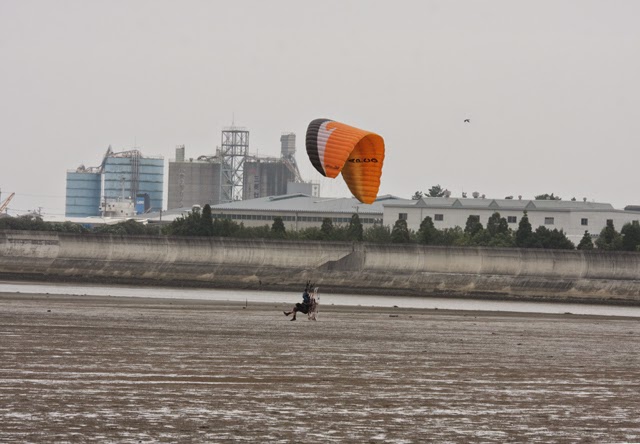
Livelihood or hobby fishermen I can take, but a guy overflying the mudflats with his paramotor was another matter. If his aim was to flush all the waders he did an excellent job, around the edges, up and down the centre, a harrier couldn't have quartered the area more thoroughly. I really can't imagine any purpose to this other than flushing the waders and once they were gone he cranked up the power and gained height over the sea.

 
And, the Prat-of-the-Day award goes to...

It isn't only wader numbers that fluctuate dramatically, last week there was a single Intermediate Egret, no Cattle and just a few Little but today there were 200+ Intermediate, 20+ Cattle, Little were common and Great White, which had been common last week were in even greater numbers today. Additionally there were flocks of distant unidentified egrets across the fields where ever rice was being harvested.

This adult Cattle Egret showed little sign of breeding plumage, unlike many which were still extensively orange. 

The black-tipped yellow bill of Intermediate is usually visible even at quite long range. 

The very thin neck is also distinctive. 


None of the three least common waders were close enough to get decent photos of, it's always a matter of luck which species might be closer or to distant. Every trip seems different so trying to get reasonable shots of the waders adds another entertaining variable to Matsusaka visits. Below are a few of the closer birds from this trip.

Far Eastern Curlew. 

Eurasian Curlew. 

Far Eastern and Eurasian Curlews.

Terek Sandpiper, the second most common species of the day. 

Grey Plover, a few were still in full breeding plumage but this was the only bird to come reasonably close. 

Grey-tailed Tattler, by far the most numerous wader today.

List of species seen

Green Pheasant   1 plus 1 heard
Mallard   3
Eastern Spot-billed Duck   common
Garganey   1
Common Pochard   3
Greater Scaup   2
Little Grebe   common
Black-crowned Night Heron   1 heard
Cattle Egret   20+
Grey Heron   widespread
Great White Egret   150+
Intermediate Egret   200+
Little Egret   50+
Great Cormorant   very common
Osprey   2
Black Kite   15-20
Moorhen   2
(Eastern) Oystercatcher   10
Black-winged Stilt   33
Grey-headed Lapwing   2
Grey Plover   17
Little Ringed Plover   2
Kentish Plover   fairly common
Lesser Sand Plover   1  This was the most numerous waders only a week ago.
Greater Sand Plover   1
Latham's Snipe   5
Common Snipe   2-3
Whimbrel   2
Eurasian Curlew   1
Far Eastern Curlew   2
Marsh Sandpiper   12-14
Common Greenshank   20-30
Green Sandpiper   1
Wood Sandpiper   1
Grey-tailed Tattler   1000+
Terek Sandpiper   150+
Common Sandpiper   10-15
Ruddy Turnstone   8-12
Great Knot   3
Sanderling   fairly common
Red-necked Stint   3
Dunlin   2
Broad-billed Sandpiper   2
Black-tailed Gull   very common
Feral Rock Dove
Oriental Turtle Dove   very common
Common Kingfisher   2 plus 1 heard
Bull-headed Shrike   1 plus 1 heard
Carrion Crow
Large-billed Crow
Sand Martin   c10
Barn Swallow   common
Japanese Skylark   fairly common
Zitting Cisticola   still many birds singing
Brown-eared Bullbul   fairly common
Oriental Reed Warbler   2
White-cheeked Starling   very common
Blue Rock Thrush   2
Eurasian Tree Sparrow   common
White Wagtail   15-20
Japanese Wagtail   1
Oriental Greenfinch   1
Meadow Bunting   several

Mammals (all on the overnight drive)

Sika Deer   1
Racoon Dog   1
Japanese Marten   1

Monday, 9 December 2013

rostratula to numenius

Greater Painted Snipe can be found throughout the year in the south of Kansai, there can be post-breeding groups of 20-30 at Ogura. Though they may take some finding. During the breeding season they can be even trickier, very easily overlooked when scanning down the rows in the paddyfields.

A very typical view of a pair in the paddyfields at Ogura, 8 August 2013.

The gallinago snipe can all be found in the Kyoto area. Common can be found year round but is a common migrant and wintering species in the region, occurs in all wet areas from concrete lined drainage ditches to wet paddies and muddy river banks. As for the strictly migrant species, I usually look for them from the beginning of April to the first week of May so I'll limit my comments to that period. Pin-tailed is the least common and number seem very variable, there have been a couple of years when I saw good numbers but normally I'd be happy to see just one and I've had many blank years. Even though migrants can turn up anywhere, they seem to prefer flat riverside areas with varied, mainly low but patchy vegetation and wet spots, this is actually a very scarce and temporary habitat, dependant on how the riverside has been "managed". It's hard to generalise when there are so few moving through but they seem the fussiest when it comes to habitat. Swinhoe's and Latham's are both more common and they can be found on flooded fields but they are often in drier areas, grassy levee banks are good, any riparian habitat which isn't too overgrown. Whether the local authorities cut back any areas of riparian vegetation and the timing of the cutting plays a crucial role in how many snipe can be found along the rivers. Presumably they just pass straight over if they don't see suitable habitat.
These species pass through in autumn too but I'm usually focused on other areas at that time so don't know the best time to look, I did have a Swinhoe's in October (2013) this year which is probably later than most pass through.
Solitary Snipe is the other species which could possibly be seen in Kansai, there have been some well known returning birds each winter in the past. But there are also blank years, though it's quite possible birds go unnoticed on out of the way small rivers in the hills or even that information is suppressed. This definitely isn't the best part of the country to look for this one and more are seen further north.

I'm almost loathe to put photos up as I'm well aware of how much more difficult they are to identify from images than in the field where views from various angles, underwing pattern (from Common) and calls all help. But here are a few shots anyway.

Solitary Snipe.

An awful shot of a Pintail, Yonaguni April 2013. The wind was buffeting the car to such an extent it wasn't possible to improve on it even though the bird had been sitting in the middle of the road as I came along and was reluctant to move off onto the verge.

Pintail in a flooded Mie field, September 2014. This bird was longer-billed than many but the short tail, extensive flank barring and rusty fringe to the inner web of the lower scapulars are all pointers. It also had dark-barred underwing and very slight trailing edge to the secondaries.

Common in the same field, note the much longer tail and less extensive flank barring. This bird has more Pintail-like narrow and even width white edge to the outer webs of the lower scapulars as many far from all do. 

Common Snipe with broad and tapering fringe on the outer web of the lower scapulars with pale distally on the inner. Many Common don't show this pattern but I've never noticed any of the other species with this bold pattern.

Latham's April 2007 Yodo River Kyoto. Typical recently cut riparian habitat.

Swinhoe's (much small Common on right) 3 October 2013, Uji River, Kyoto. Like Latham's, it has a pale coverts panel but this doesn't contrast markedly with the scapulars, whereas Latham's is much blacker above producing a more obvious contrast.

Swinhoe's tend to be large-headed and are rather uniform brownish without strongly contrasting features. The orange tail patch is usually the only colourful plumage mark.

Latham's (right) and Swinhoe's April 2007 Yodo River, Kyoto.

Long-billed Dowitcher is a scarce migrant through Osaka but I've seen wintering parties not far away at the north end of Ise Bay. There are many rivers running into the Ise Bay so it's hardly surprising not all are built up, there's extensive agriculture abutting some creating a greater diversity of habitat  which can attract and support far more birds than the urbanised Yodo River, the only large waterway running through my area. Asian Dowitcher has occurred in Osaka a couple of times while I've lived here but it's a major rarity.

An awful videograb of Asiatic Dowitcher at Nanko, Osaka. As it's the only one I've ever seen I can resist posting it.

A wintering Long-billed Dowitcher near Nagoya. 

Long-billed Dowitcher coming into breeding plumage, Mie April 2014.

The two godwits, Eastern Black-tailed and Bar-tailed, are both reasonably common migrants and Bar-tailed can be present in large numbers in April along the banks of the lower Yodo River in Osaka. It's quite common in spring and autumn on the tidal flats in Mie. Black-tailed is far less numerous and seems very much a bird of pools near the coast - and there aren't many of them in the Osaka area. However I see Black-tailed quite often, in low numbers, in Mie.

Juvenile Eastern Black-tailed 1 September 2007, Matsusaka, Mie.

Winter plumage adults Yonaguni, 9 April 2013. Presumably females judging by those massive bills, even without direct comparison they have the feel of very large waders.

A 2CY male coming into breeding plumage, far more delicate than the birds above. 30 April 2009 Mishima, Nagasaki.

Juvenile Barwit at Pheonix, Hyogo, saddly this formerly great area has been fully reclaimed and lost as a top local site. 16 September 2007.
 
 Ok, cheating here, this shot is in Australia, but it's interesting to see the moulting adults and sharper juvenile, November 2012.


An small Bar-tailed Godwit with a down-kinked bill.

Breeding Bar-tailed Godwits in Mie, April.

Ogura isn't great for curlews. Whimbrel is the only one regularly passing through, flocks of 20 or so can stop off briefly, usually on levee banks if the grass is short enough. Otherwise their calls might draw attention to birds flying straight over. I once saw a group of three Far Eastern Curlew on flooded fields at Ogura but they didn't linger and also once a Little Whimbrel on dry fields.
Nanko in Osaka gets Eurasian Curlew and Far Eastern Curlew on a more regular basis but they aren't predictable. Mie, with much more suitable habitat, is better but even here there's no guarantee of seeing even one let alone both on any given day. Nevertheless there's a reasonable chance of seeing one or both in low numbers on the estuaries or mudflats.

Little Whimbrel is fairly rare in Japan. This one was on Tsushima, Nagasaki 29 April 2012.

A second bird joined it a day later and there was another on 1 May.

Whimbrel on Mishima, 2 May 2011.

Whimbrels with Eurasian Curlew, Mie 8 September 2008.

Eurasian Curlew, Mie 8 September 2009.
 
A good flight comparison of Eurasian and Far Eastern Curlew. Mie, 31 August 2014.

Far Eastern Curlew on Mishima, Nagasaki 3 May 2009. They are often distant on mudflats so it was great to see one so close.

As above.

Two shots showing upper- and underwing patterns, the bill of this bird is distinctly short. Mie 8 September 2013.

One of several birds with their famously enormous bills, 1 September 2013.

An immature Far Eastern on the same date to illustrate how vastly different bill size can be.