I'm sitting here today pondering my leech bites. I've never had an adverse reaction before but a couple of these are really itchy and another very red and splodgy. At least they show I was in good quality forest!
Yesterday I was birding in both Kyoto and Shiga forests and though my day began with four hours continuous rain just below a low ceiling of cloud (as I discovered after daybreak) by 6:30 the rain was easing-off, the morning destined for clear skies and a sticky 100% humidity.
I didn't leave the shelter of the van during the hours of darkness; umbrellas and trees don't go well together in daylight let alone at night. All I heard were three Japanese Scops Owls, none of them close, and barking foxes. At first I heard the foxes snuffling, grumbling and grunting behind me and I could see two adults and at least one half-grown cub on the road. I'm unsure whether there was more than one cub as 'it' was racing back and forth mostly hidden by a bend in the road while the adults sat watching over play time.
Once light began to broaden I couldn't justify sitting any longer so pulled on waterproof bottoms (Does that sound any better than waterproof over-trousers? Didn't think so.), grabbed my umbrella and made my way along the woodland edge. It still wasn't light enough to identify many of the small birds flitting in the tree tops but a Broad-billed Roller suddenly appearing flying away for a brief second was a shock, to say the least. This isn't a bird I expect in Kansai during the breeding season, I think I've only seen one here on passage! Then I promptly began the process of talking myself out of it. "It's still pretty dark, the flight was a bit like a Jay... it must have been a Jay" It was a Jay.
I covered the nearby area as much as possible but under the trees wasn't getting much brighter and just before 7am I was back at the van for a break and some roasted almonds in lieu of breakfast. Then, unbelievably, a Fairy Pitta was singing! The rain had stopped (more or less) so I could ditch the brolly before dashing towards the sound; don't stop...
don't stop! I struggled to spot it in the tree tops and after a short pause the song was another 150 metres away. And so began a Pitta chase. For a long while this pattern was repeated, it wasn't bothered by me, I could just never pick it up before it changed song perch. This time perseverance paid dividends, I finally latched onto it, this wasn't going to be one that got away; another one that got away.
I was able to watch it for several minutes before it shifted again.
When I first heard the Pitta it seemed in competition with a Ruddy Kingfisher singing from the same location. The big difference was I was able to connect with the Pitta eventually. The Kingfisher, along with several others heard that day (and countless others) remained just a voice in the forest. The Pitta was a photo tick for me, the Kingfisher will have to wait, yet again.
I heard the Pitta once more, very briefly, but it was way off across a broad valley on an entirely different hillside. A second bird? Or this one moving along?
The morning was heating up as it progressed, so was I, there wasn't a breath of air. I was thinking about a move, trying somewhere else and I'd driven a couple of hundred metres back down the access road enjoying the breeze through the open window but decided to check one last spot. A track led to a clearing through a narrow belt of trees and no sooner had I stopped to check some movement in the bushes than a Roller, living up to its name, flopped rapidly across the open space. Ha! Jays with dark rumps don't exist. No, not even in the early half-light. Note to self: don't talk yourself out of good birds in future.
My next stop was a deep, dark (leech infested) valley bottom. I've seen Japanese Night Heron here in the past, Copper Pheasant too. But not today.
 |
| Fire-bellied Salamanders are very common in old wet forest but after a lot of rain you've got watch where you put your feet, they seem to think they own the place wandering willy-nilly from puddle to puddle. |
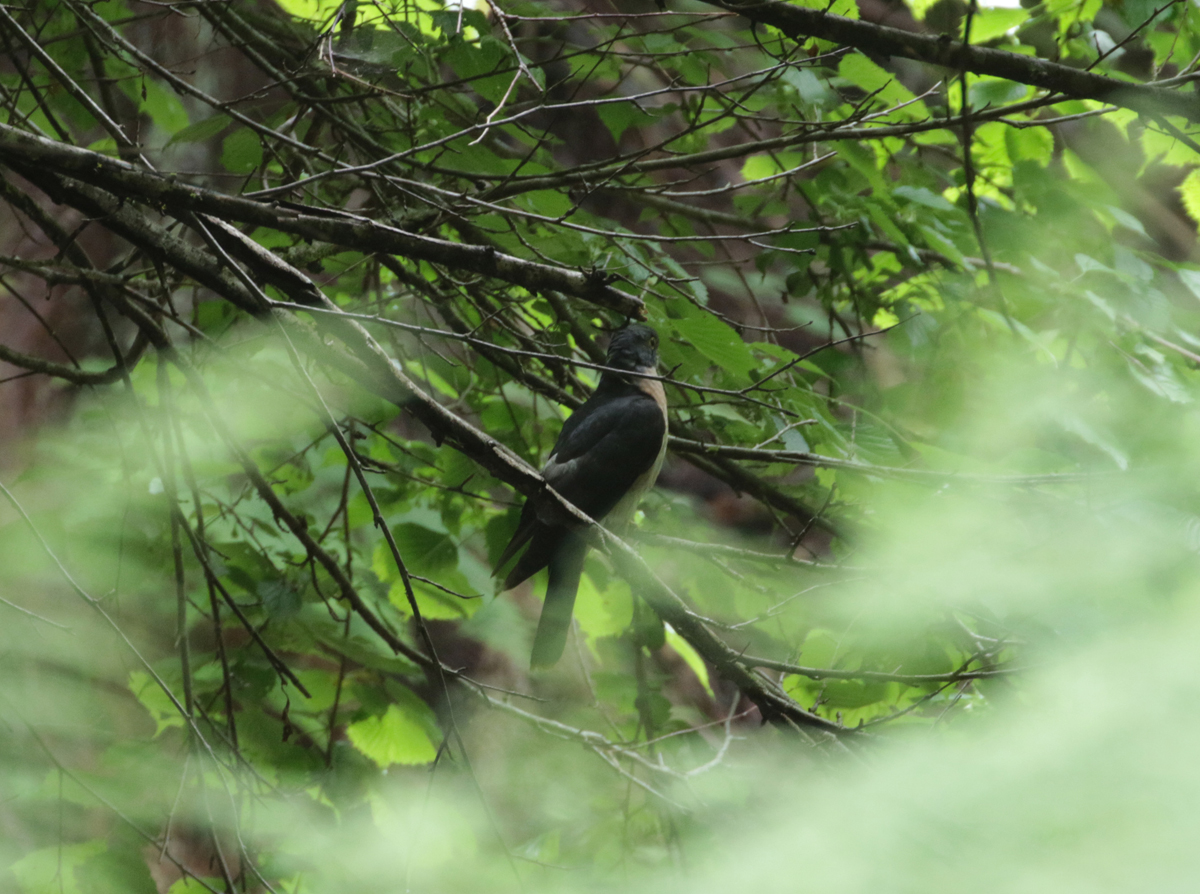
Northern Hawk Cuckoo is a fairly common bird, very vocal at night and into early, post-dawn morning before they notice night has given way they're supposed to melt away with the darkness. Where do they go? They go to dark, deep (leech infested) valley bottoms.
 |
|
 |
|
 |
|
Another feature of dark (leech infested) valley bottoms is shredded trees. Deer rubbing off their velvet? Not going up to four or five metres I'd have thought. Bears it is then, though I've only ever seen one here. Another good bird down there was a Japanese Sparrowhawk. I heard a harsh scolding and saw something dashing towards me with a Blue and White Flycatcher in hot persuit. After a minute I'd persuaded myself that it could have been the Hawk Cuckoo, they look incredibly accipiter-like in flight. I was at it again, trying to deprive myself of a good sighting. But for the second time I had another chance to confirm its identity when after several minutes (where had they been all this time?) the Sparrowhawk and Flycatcher came back up the track. The hawk passed by at head height just a couple of metres away, I don't think I've ever been quite as close to a wild bird of prey.
 |
|
 |
|
 |
|
Before light began to fail I took a thoughtfully place but little used road that crosses the mountain. The best bird (not that I saw it) was a singing Japanese Leaf Warbler, something I hardly ever encounter, plus the only (also unseen) Japanese Thrush. The first Grey Nightjar started 'chucking' while light was still good but it was another 40 minutes before others joined in. While I was waiting a terrific roadside White-backed Woodpecker kept me entertained.