Showing posts with label Red-flanked Bluetail. Show all posts

Saturday, 1 April 2017

Biwako & Matsusaka, a two-day trip

I hadn't been up to the north end of Lake Biwa in ages, all winter in fact. Which is surprising considering winter is the best time to go and as a result I haven't even seen Steller's Sea Eagle this winter. I was hoping to get (good if possible) views and maybe even photos of Copper Pheasant but in the event I didn't even hear a displaying male.


Because there's a cell tower at the top of my usual hill there is an access road, well that's why it is 'my' hill in the first place of course, and this access road has been snow-ploughed allowing anyone daft enough to drive to the top the freedom to do so. However it also meant all bar one of my usual pull-offs were blocked by snow. By day the road becomes a shallow stream as snowmelt finds the easiest route downhill between the walls of snow on either side, but at dawn a steeply-angled ice-rink would be a better description of the road as it nears the top. Going upward, be it driving or on foot, always seems safer than going down to me, so I stopped at the summit rather than drop down the final 100 metres to the car park. I nevertheless still had to walk it. If I tried to stand still on the road I began to move down the slope, slowly at first. Gingerly I had to edge my way down trying to get purchase on a litter of pine needles frozen into the paved edge before it disappeared under the snow. Trying not to pick up speed! And all the while wishing I'd actually gone and bought new boots when I'd planned to rather than keep putting it off.


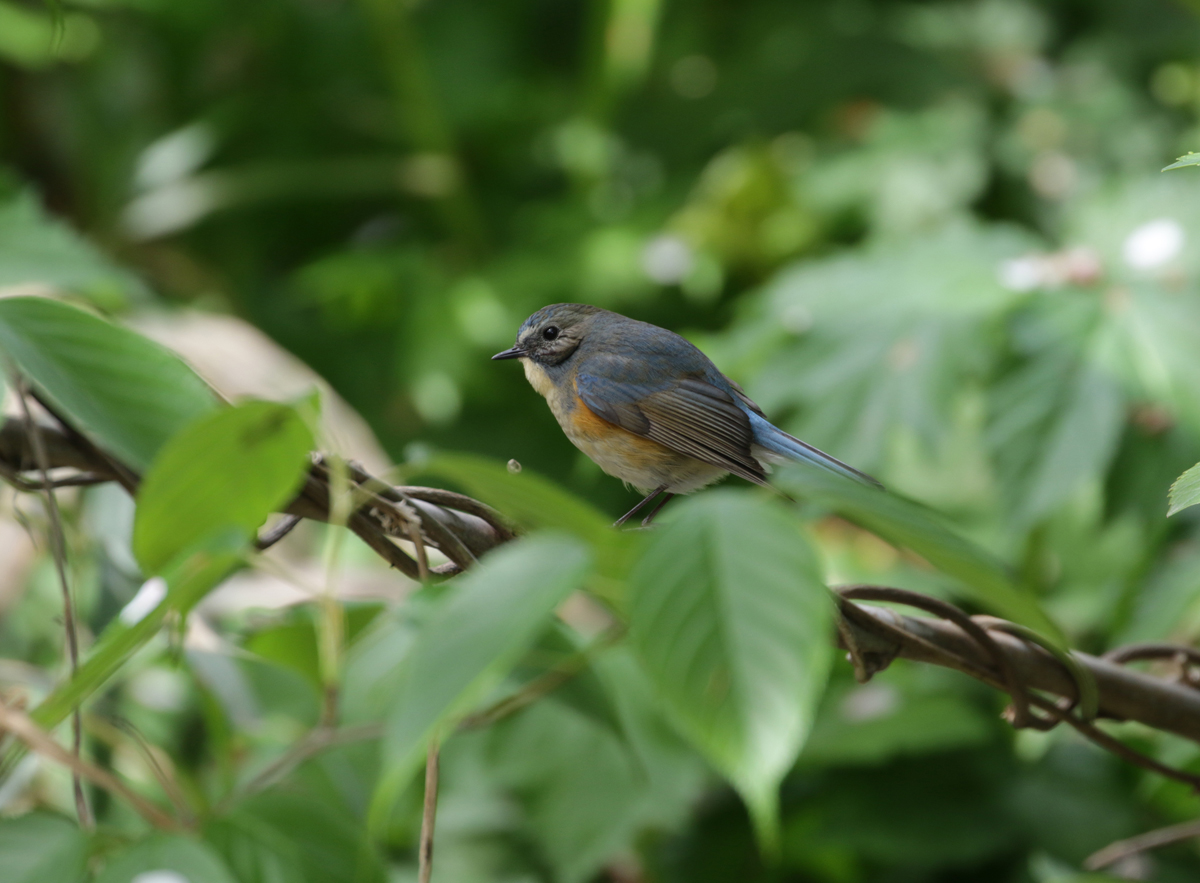
Like a lot of winter woodland birding much of the ridge was, well not birdless exactly but... you know. A few invisible tits calling somewhere off the trail, occasional Grosbeaks overhead. Then, again like so often, all the birds were back at the start point, by the car. Three species of woodpecker, Nuthatch, five species of tit, Jays, Red-flanked Bluetail, three species of bunting, five species of finch and so on.


Red-flanked Bluetail.


As I said, all my usual pull-offs along the road were blocked by snow except for one, the lowest good stop on the way back down. There were two clear signs spring is here...


Bear art? I often come across conifers with huge sections of bark ripped off, it comes away in huge chunks as if it had been badly-fitted to the tree. This hardwood presents a much better canvas.


Bullfinches feasting on new buds; this male (and female below) the expected rosacea.


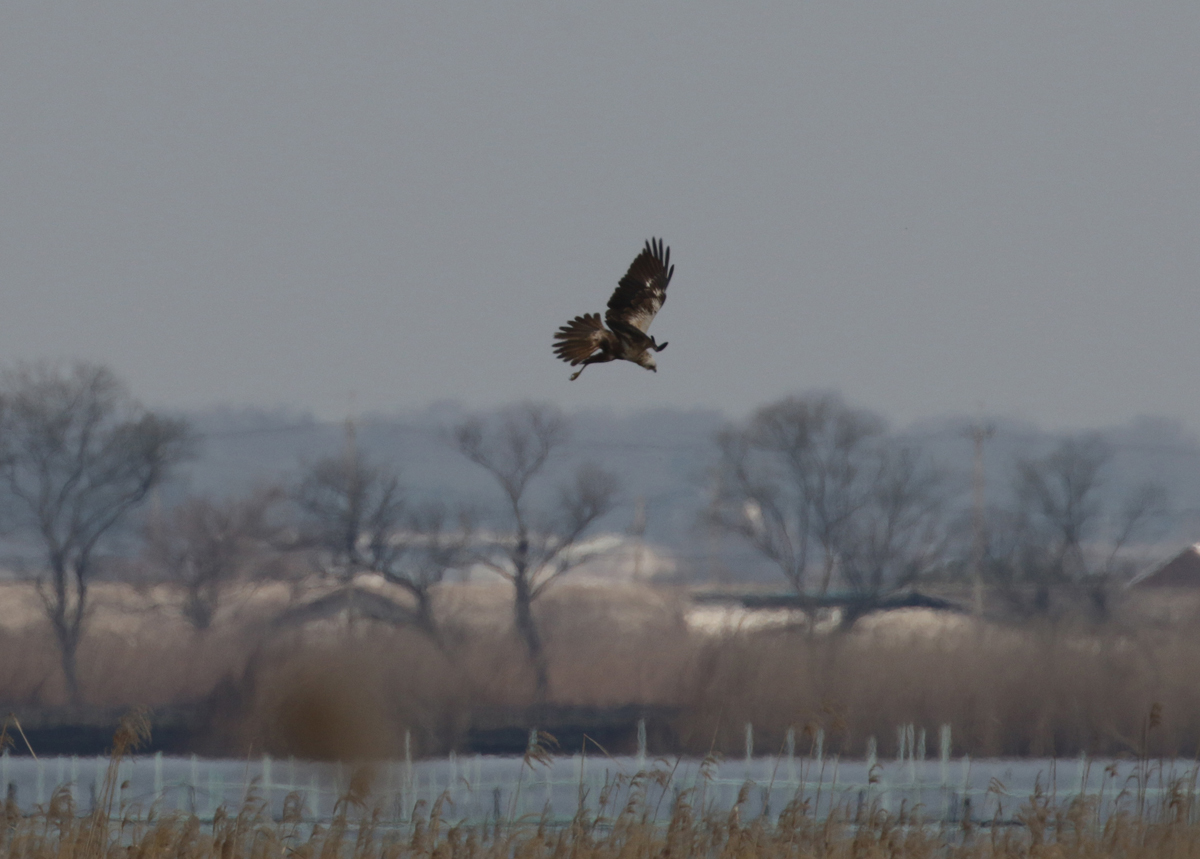
Lake Biwa itself is a vast expanse of water, the winter panorama without exception broken by countless rafts of countless ducks, as well as more modest numbers of geese and swans. But hardly surprising given the date most of the wildfowl has gone and the drive southward was consequently a rapid one despite the best efforts of some serious road works. I reached Lake Sainoko far earlier than usual. Far too early for any harriers there may be in the area coming in to roost. However I did see five different Eastern Marsh Harriers in the time I spent there. I also had my first Barn Swallow of the year and little did I realise then, that by the same time a day later they would be common.


As usual the harriers were more often than not distant, at their closest they weren't great to photograph.


After a convenience store dinner and a nap it was off to Matsusaka. The route was simple according to the map; pretty much a straight line to Route 1 and I could take it from there. A straight line on major roads but a lot of jinks and route numbers so I let the satnav take the strain. She found an even more direct route! However this involved sticking to a road atop the river embankment; sometimes single track, sometimes very rough, but it was more direct. I don't know if it was any quicker in the end, especially at that time of day as it entailed cutting across several major roads with no signals during rush hour.


The main purpose in Mie was to look for immature Taimyr Gulls but there were a few other things of interest. First and foremost was a Japanese Scops Owl calling at 04:10 in an industrial area at Matsusaka port! It was very close but I didn't see it and it quickly moved further off onto private land.


Another point of interest I'd never seen before was seaweed harvesting by boat...


A seaweed harvest boat. at first I though being in the boat might be the better option but I'm no longer sure.


Simply line the boat up at the end of the row...


...and go!


Long-billed Dowitchers were fairly close for a change but the gulls will have to wait for another post.


Wednesday, 23 November 2016

Rotten weather at Biwako

I had a good day out in Mie last Friday and had planned on staying the night to get a bit more gulling in the following day, however that evening the forecast promised an unremitting 80% - 90% chance of rain throughout Saturday so I decided to give up and head home. In the event there wasn't a drop of rain all day in Kyoto which had been due exactly the same weather as Mie according to my 'friends' at the Met Office. Thanks guys. So Saturday night I went up to the northern end of Lake Biwa, after all with only a 10% chance of rain limited to late afternoon the weather would be fine to check out the wildfowl situation. A ten percent chance; maybe the their forecasting ability is fine, it's just their math that's off.


I began the day in the mountains north of the lake and at 6:30 the clouds overhead weren't yet heavy but with fog lower down and ominous clouds approaching from the north things didn't look too good for the rest of the day. The mountains were fairly quite, reasonable numbers of the commoner finches and buntings, a good few Red-flanked Bluetails but surprisingly little evidence of woodpeckers, only the odd Jay, and definitely no Copper Pheasants. A stiff-winged Peregrine soaring high above was the only unexpected sighting. By 7:30 the opening spots of rain were signaling what was to come and I made my way down into the deepening fog below, and then on to the lake.


"And here's one I made earlier", which ought to strike a chord with Brits, I took this shot of Bluetail a week earlier on Mt Ibuki.
 It proved difficult to check the more distant ducks through the grey filter draining the lowlands of colour so I spent most of my time driving slowly round the fields and managed to track down two flocks of Tundra Swans (bewickii) by following birds flying 'inland' away from the lake.


A flock of Tundra Swans feeding on the fields.


Those Swans were close to the lake but another flock was two or three kilometres away and included a presumed columbianus. Going for the second flock really paid dividends as I came across two Common Starlings for the second time this weekend. I think I'd only previously seen one Common Starling in Kansai, so four in three days is good going.


A presumed Whistling Swan with the Bewick's.


Bewick's Swans.


Common Starlings with White-cheeked.


Another bird that caught my eye while slowly checking the fields was a strikingly large heron that flew up from a ditch and settled in a field. It 'felt' too large for the local modesta Great Egret the moment I saw it and sure enough, when I caught up with it, it had telltale yellow on the tibiae. There was a second modesta on the lake in front of the wild bird center at Kohoku, this seems a favourite spot for them, but the views are never great even when the weather is.


'Western' Great Egret on the fields.


Another with more obviously yellow legs.


Surprises through the murk weren't quite over; two Whiskered Terns hawking over a roadside pond stopped me in my tracks. I seem to be seeing more of this species nowadays, that's at least 10 this autumn, I don't know if that's down to luck or whether more are turning up here. Unsurprisingly however, it wasn't possible to get an even half decent shot of them.


Grey on grey: Whiskered Terns.


Now you'd be forgiven for thinking images of birds can't get much worse than those... but they can. As proof I'd offer the following image of four Eastern Marsh Harriers coming in to roost.


Four a group of five Eastern Marsh Harriers high over their roost site as the last of the poor light was giving up.


Saturday, 23 April 2016

Hegurajima: April 22 day trip

After spending a day and a half in Mie I made my way slowly to Ishikawa. The weather was dreadful, heavy rain throughout and a diversion due to a bad traffic accident didn't help. Of course I didn't mind in the slightest what the conditions were like on a relocation day and all that rain followed by forecast patchy fog over the sea the following morning had me rubbing my hands at the thought of all the migrants that might have made landfall on Hegurajima.


I picked up a few birds on the way, Brown Dipper was the only one I was unlikely to see elsewhere. I was curious what kind of bird list I could build driving round compared to my usual week spent on an off-shore island at this time of year. I was confident I could do better with numbers but could I get the quality?


The ferry to the island is usually an anticlimax, I rarely see much on this route, however there were a few things this time. An Arctic Skua was a first for me on this stretch of water, though I did once have a South Polar. Two groups of presumed Japanese Murrelets I saw turned out to be Ancient when I looked more closely. Two very distant parties of waders flying in close proximity, birds in one group slightly larger, were probably Red-necked and Grey Phalarope as both parties settled on the sea. Streaked Shearwaters were as common as ever.


Morphing murrelets; these expected Japanese turned out to be Ancient.
 

One of the second group of four which was closer.


A Streaked Shearwater letting its inner Colonectris really shine through; it could almost be a Cory's.


Approaching the island Pelagic Cormorant became common, I only saw one Temminck's out there.


Once on the island it didn't take long to see there were plenty of birds around. There were two or three Daurian Redstarts in the harbour, it's about three weeks since I saw my last around Kyoto, and Bramblings were everywhere, some looking very smart now. They've already disappeared from my usual haunts too. On the incoming side of the balance, Stejneger's Stonechats were very common on the island. Surprisingly I hadn't seen any prior to these this spring, they're usually one of the earlier passage birds on a broad front through my region.


A smart looking Brambling.


Stejneger's Stonechat was possibly the commonest migrant on the island, certainly the most conspicuous.
It didn't take long to find the first non-common bird, well Hoopoe is hardly rare, on the lawn behind the doc's. I bumped into it again later and heard it several times on my for-hour dash to cover as much of the island as practical before the ferry went back. In fact I hardly scratched the surface.


Hoopoe isn't a big rarity but they're always nice to see.
From there I quickly had a look at the coast and found a Swinhoe's Snipe on the grassy path to one of the headland shrines, then into the woodland where I flushed a Woodcock. There were plenty of Great and Coal Tits about, the odd Eastern Crowned Warbler, a Goldcrest and three or four Japanese Robins, heard only of course. A Long-tailed Rosefinch was a surprise, I've seen far more Common Rosefinch on islands in this season over the years.


No mega then; time to move on. Just as I was coming out of the trees I noticed a Japanese Sparrowhawk mobbing a Goshawk, or so it seemed at first glance judging by size but when I got the bins on them I was surprised to see a Northern Sparrowhawk mobbing a smallish harrier. Was this going to be the mega?! No, a Hen. I should have guessed, why do I get so excited over every bird? Because it's Hegura I suppose, it could have been a Pallid...


A mega approaches?


It's almost as if it sees me watching so closes its fingers to keep me guessing.


I wasn't fooled for a moment.

Next stop the harbour edge, it always holds something of interest. On the way I noticed there were no photographers at the hide, platform I should say, overlooking a shallow pool constructed to attract whatever is lurking in the undergrowth. It's funny really, two other people had taken the same ferry out in the morning and I only saw two others on the island. Great season, great weather, loads of birds and the place is all but deserted. Yet in a week, the Golden Week holiday, I bet the place will be packed to the gills. It's so difficult to book accommodation then which is fair enough with so many birders having inflexible work schedules but a good few of the visitors are retired. Why aren't they there now? The birding is fantastic and I very much doubt the Japanese national holiday will loom large in the birds' migration strategy. But as I was saying, the observation platform, I'm glad I stopped to take a peek. There was nothing rare but there were tons of birds flitting around, the best for me was an Asian Stubtail. Stubtails were singing all over the place, they're a common summer visitor around Kyoto, but they aren't the easiest thing to photograph.


Asian Stubtail: a photo tick.


One of 12 Blue and White Flycatchers I saw on the island (nine were males).


Red-flanked Bluetail.


Presumably a 2CY by the look of it.

I finally got down to the harbour area where the highlight was a party of three Greater Short-toed Larks. I see this species every spring, but three, I've never seen a flock of them before!


Red-throated Pipit with Greater Short-toed Lark.


A "flock" of Greater Short-toed Larks.


Then it was ferry back, a bite to eat behind the wheel and check out some fields further up the coast for waders to make use of the remaining day light. This wader checking idea was on the strength of having heard a Greenshank's chu-chu-chu behind Wajima that morning but apart from a snipe (I suspected Latham's) that crept off through the grass and into thicker cover before I could get down to the serious business of identification there was nothing.


So the wader idea was a bust but it had been an enjoyable day. In terms of quality I'd come up with a few species I don't see very often and in the numbers game, after 2.5 days in the field, I was on 123. This was definitely better than being based on an off-shore island. One more day to go.


List of species recorded today:-
Green Pheasant   2 plus 2 heard
Eurasian Wigeon   2 NP (Noto Peninsular)
Eastern Spot-billed Duck   7 NP
Eurasian Teal   c40 NP
Streaked Shearwater   100s
Little Grebe   1 NP
Grey Heron   3-4
Great White Egret   5 plus 7 NP
Little Egret   1 plus 4 NP
Great Cormorant   2 Wajima harbour
Temminck's Cormorant   1
Pelagic Cormorant   c50
Osprey   1 NP
Black Kite   2
Hen Harrier   1
Northern Sparrowhawk   1
Woodcock   1
Swinhoe's Snipe   1
snipe sp   1 NP
Common Greenshank   1 Wajima
phalarope sp   two small flocks seemed to be one of Red-necked, the other Grey
Black-tailed Gull   common, c1000 on flooded fields NP
Vega Gull   5
Slaty-backed Gull   1
Arctic Skua   1
Ancient Murrelet   8
racing pigeon   1 the pigeons on Hegura are always kitted out in racing legwear
Rock Dove   several NP
Oriental Turtle Dove   several
Common Kingfisher   1 NP
Hoopoe   1
Bull-headed Shrike   1 heard NP
Carrion Crow   c50 NP
Large-billed Crow   1
Great Tit   several
Coal Tit   several
Barn Swallow   3-4, several NP
Asian House Martin   c20 NP
Greater Short-toed Lark   3
Brown-eared Bulbul   fairly common NP
Asian Stubtail   2 plus many heard
Japanese Bush Warbler   common
Arctic Warbler complex   1
Eastern Crowned Warbler   c10
Japanese White-eye   common
Goldcrest   1
Chestnut-cheeked Starling   3 NP
White-cheeked Starling   1
White's Thrush   1
Japanese Thrush   1 plus 1 heard
Eyebrowed Thrush   1
Pale Thrush   common
Dusky Thrush   common
Japanese Robin   5 heard
Red-flanked Bluetail   1
Daurian Redstart   8
Stejneger's Stonechat   common
Blue Rock Thrush   1
Dark-sided Flycatcher   1
Asian Brown Flycatcher   1
Narcissus Flycatcher   1
Blue and White Flycatcher   12
Eurasian Tree Sparrow   several NP
Grey Wagtail   1 plus 2 NP
White Wagtail   several
Japanese Wagtail   several NP including a juvenile
Olive-backed Pipit   2
Red-throated Pipit   2
Buff-bellied Pipit   1 plus c10 NP
Brambling   30+
Oriental Greenfinch   common
Eurasian Siskin   1
Long-tailed Rosefinch   1
Hawfinch   1
Meadow Bunting   sev NP
Elegant Bunting   1
Japanese Yellow Bunting   1
Black-faced Bunting   common plus 1 spodocephala and 1 possible sordida (this isn't on the Japan list according to the most recent OSJ list, more of this later)