Showing posts with label Sandpiper Green. Show all posts

Tuesday, 17 January 2017

First trip to Mie 2017

I haven't had so much time to get out birding since the Kyushu trip but I managed a short visit to Mie last week, just before winter finally arrived.


Early in the day, in fact for most of it, the wind was strong which made checking the sea difficult and the stubble and overgrown fields next to impossible. Coupled with very bright sun and not quite catching the tides as I'd like birding was anticlimactic by the area's very high standards. It wasn't until late afternoon that the wind dropped and some clouds gathered making looking at the gull flocks worth a punt. The most notable thing being not a single Taimyr Gull was to be found.


The day will stick in the memory for two things though. Firstly I finally got good flight views of our local Turkey Vulture and secondly the very un-Japanese scene of a dead bull lying in a dusty unmetalled company parking area! This was so jarring that I had to stop and take a photo.


Not something you see everyday in Japan, not something I've ever seen in Japan actually. It doesn't look freshly dead either and the crows seem to have been at the eyes.


With wintering Steller's Sea Eagle in the region we're no strangers to the spectacular but this bird definitely adds to the Mie experience.


On the wader front, I saw a single Ruddy Turnstone, a couple of Eurasian Curlews and a handful of Common Greenshank, as well as the more numerous Kentish Plover, Sanderling and Dunlin. On the landward side of the seawall were Common (3), Wood (2) and Green (4) sandpipers. With so many waterlogged fields it isn't surprising there weren't any concentrations of Common Snipe and I only saw four.


Wood Sandpiper


Green Sandpiper


Common Snipe


Early in the morning a white-winged gull flew over the car and directly away from me along the seawall. Whether this was an immature Glaucous or a leucistic Vega I wasn't able to tell, though I later learnt a first winter has turned up in the area. Later in the day the adult Glaucous that's taken up seasonal residence here was out on a distant sandbar off one of the estuaries. As well as the absence of Taimyr Gulls I already mentioned there were no Black-tailed either, perhaps they have already returned to their breeding colonies, certainly numbers dwindle to almost zero at this time after having been common till about the turn of the year. On the other hand Common Gull numbers have begun to increase, I don't know why they are relatively scarce in early winter as there are always good numbers through the latter part of the year in Osaka, just across the peninsula.


The small flocks of gulls scattered along the beach north of Tsu were Vega almost to a bird, there was one probable Mongolian which disappeared before I could get confirmation and what appeared to be a Vega x Slaty-backed hybrid. Adult gulls that show obvious signs of hybrid origin, particularly the Vega x Slaty-backed combination, aren't common. Hybridization seems far less frequent on this side of the Pacific, or at least so I gather, I don't have first-hand experience.


The dark-saddled gull stood out among the Vegas on the beach but only because of the shade, structurally it was a good fit with the others so I wanted a better view.


Coming at it from the other side it was no less eye-catching. In fact I might have taken it for a Slaty-backed on this view alone.


Dark-eyed Slaty-backs do occur but they're very thin on the ground, this bird has heavily peppered irids. The primary projection gives the impression of being on the long and narrow side for a Slaty-backed too. While the saddle is too dark for Vega, a typical Slaty-backed would look a little darker in this light. 


This typical Slaty-backed just off the beach didn't come ashore with the other gulls so there was no chance of direct comparison.


Saturday, 7 January 2017

Brown Booby, Taimyr Gull, Daurian Jackdaw and a few other birds in Arasaki

After leaving Isahaya I drove round the bay overnight. My satnav insisted I take the Shimabara - Kumamoto ferry even though the last sailing was at 5:30pm; this is so irritating. It doesn't matter how often I explain to her something can't be done she just won't budge. Another example, my final evening I wanted to drive from Miyazaki to Kyoto she stubbornly held that the only way to go was ferry to Shikoku, drive across the island and use the Nishi Akashi bridge; again if I could have connected with a ferry this may have been the quickest way but there simply wasn't a ferry to catch.


I thought about dropping in to the reclaimed land at Tamana but checking the tide tables I decided to give it a miss and head straight to Yatsushiro. High tide was due at 10:30 so I thought this would provide an excellent opportunity to watch the birds getting pushed closer while the light wasn't too strong from directly across the estuary. As it things transpired there was an exceptionally high tide that morning and by just after 8am the mudflats were drowned and the birds gone. Before everything flew off there were good numbers of waders, plenty of Saunder's Gulls of course but the highlight was a Caspian Tern that dropped in very briefly. I saw three Caspians here last winter but this one was closer and still with an almost full black cap. Unfortunately I didn't get any shots of it due to photographer incompetence; he's gone just as soon as I can find a replacement.


The next stop was Arasaki with a plan to cover the whole area and the luxury of three nights in a hotel while doing it.


One of the highlights was a Brown Booby in Akune harbour. Though they are to be expected along this coast in winter this is the first time I've seen one here, it was great to watch it plunge diving in the harbour.


One of only two adult Daurian Jackdaws I saw at Arasaki and only three on the whole trip compared to 30-40 first winters.


Another bird in the same flock has a very prominent neck patch recalling Eastern Jackdaw. Pity it's dark-eyed!


First winter Daurian Jackdaw.


First winter Daurian Jackdaw.


A bird with much greyer underparts (more like juvenile plumage but presumably first winter unless some second winters don't look full adult?) and again with a prominent pale collar.


I only saw two first winter Taimyr Gulls in the area, this one lingered just long enough to get a few images.


These images are slightly lightened to show more plumage detail so the actual colour fidelity shouldn't be relied on. The primary window was darker when the wing was spread compared to the birds I typically see in Kansai. I have no idea whether it's possible to separate Taimyr and Heuglin's at this age or whether the darker window would have any significance. It's a pity this gull didn't hang around, I'd have loved to get a better view than just the couple of fly-bys before it wandered off from the river mouth.


Early each morning there were 13 Eurasian and three Black-faced Spoonbills in the same spot before they dispersed for the day.


Long-billed Plovers were easy to find inland along rivers but on the Arasaki fields, as you'd expect, Little Ringed was the only plover present. Eight was the biggest group I saw but they were dotted around the large expanse of fields.


Common Snipe.


Green Sandpiper.


Bull-headed Shrike.


Wednesday, 26 October 2016

Green-legged Red-necked Stint and other surprises in Mie

It's a funny old time of year, isn't it? An odd mix of summer visitors, migrants and winter visitors. At dusk a couple of days ago, when I was just about to start the long drive home from Mie, I picked out a couple of large waders I hadn't noticed on the estuary. They turned out to be Northern Lapwings and the earliest I've seen in Kansai. The fact that I was watching them sitting comfortably on the riverbank in just a T-shirt attested to that, spring birds linger into warm weather but I'm always wrapped up well before the first Lapwings turn up at the back end of the year.


But if that was a surprise, the day had begun with a far bigger one. One that doesn't fit into any of those seasonal bird boxes I mentioned. Who would expect a Turkey Vulture at a river mouth in Japan! No doubt it could swap a few yarns of life on the lam with Percy the pelican if it ever made its way to Kanto.


Not a bad Red-faced Cormorant impersonation.


The biggest surprise on my previous visit (Oct 8) had been a party of four Whiskered Terns, birds that I'm sure had made it here under their own steam.


That same day while checking through a flock of White Wagtails I came across this first autumn. First autumns invariably have a yellowish cast to the face but I thought this bird was yellower than many. Not just about the face either, the grey of the crown, nape and to a lesser extent mantle were yellowish- or even greenish-tinted.


White Wagtail with a yellower face and crown than many first winters.


The nape and mantle had a yellowish or greenish cast, though the mantle colour doesn't show too well here. 


Sticking to the yellowish / greenish theme; the Red-necked Stint in the title really took me by surprise. I can't find any reference to Red-necked Stint or any other 'black-legged' stint or peep having yellowish or greenish legs. Brownish or greyish yes, and there were more than a couple that fell into that category. However two birds within a flock of about 25 I was able to view at close range had noticeable 'colour'. The first I found had just a slight greenish tint to the tarsus which unfortunately was a bit too distant to get reasonable images of, however the second was yellower and the colour extended from the tibia to the feet. The following four images suffer from heavy cropping but apart from slight sharpening they are otherwise unaltered and I think they still show the legs have a yellow rather than brown element. 


A regular Red-necked, in the same place and light, showing the expected black legs. 


Then there was the other stuff, less surprising but nevertheless great to see...


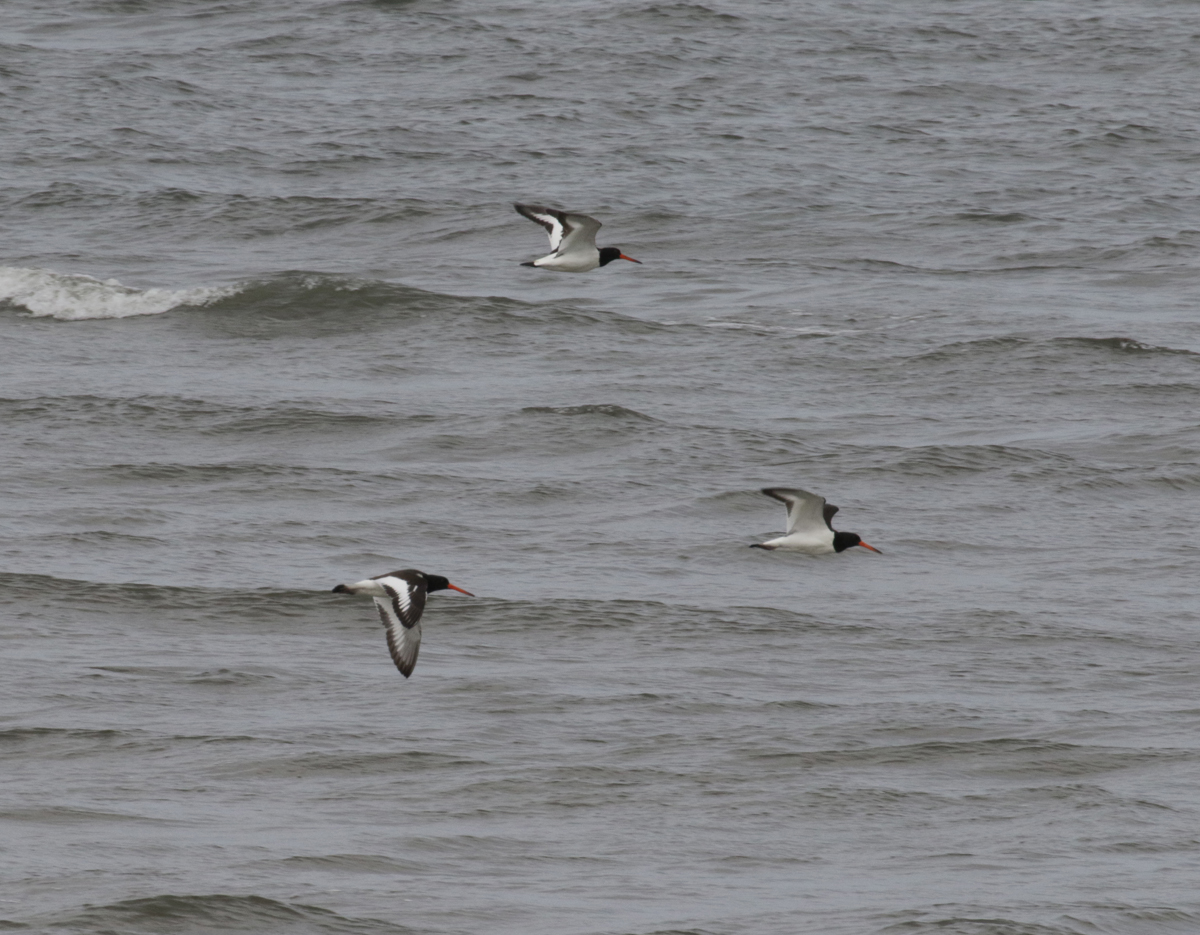
Oystercatchers


Black-winged Stilts


Grey-tailed Tattlers


Grey Plovers


Green Sandpiper


Common Greenshanks


Dunlin


Terek Sandpiper