Showing posts with label Snipe Pintail. Show all posts

Thursday, 24 November 2022

Latham's, Swinhoe's and Pintail... a good month for snipe.

September was very much a staying local month, covering a small stretch of my old patch at Ogura. Mainly because I didn't have the time to do otherwise, and not seeing that much for my efforts if truth be told. I've seen some quite spectacular wader passages here over the years but 2022 won't be going down as one to remember.

I covered a relatively small part of the overall area on nine dates through the month, seeing snipe other than Common on eight of them; this after making several visits throughout August when no migrant snipe were recorded. Actually, my first non-Common snipe were two birds (probably Swinhoe's) in Mie on 2 Sept though I had already seen a party of three Latham's there in August.

As far as confirming ID was concerned, all the following birds were 'tail-checked'. I saw a total of six Latham's, four Swinhoe's, one probable Pintail and a few swintail. As I only covered a relatively small area, it's reasonable to infer numbers passing through would have been much greater. There were also many Common, up to 10 per visit but even these disappeared in October suggesting all were migrants rather than birds that will winter here.

LATHAM'S SNIPE

(5 Aug - three adults together)


(8 Sept - two adults together)


(20 Sept - single adult)


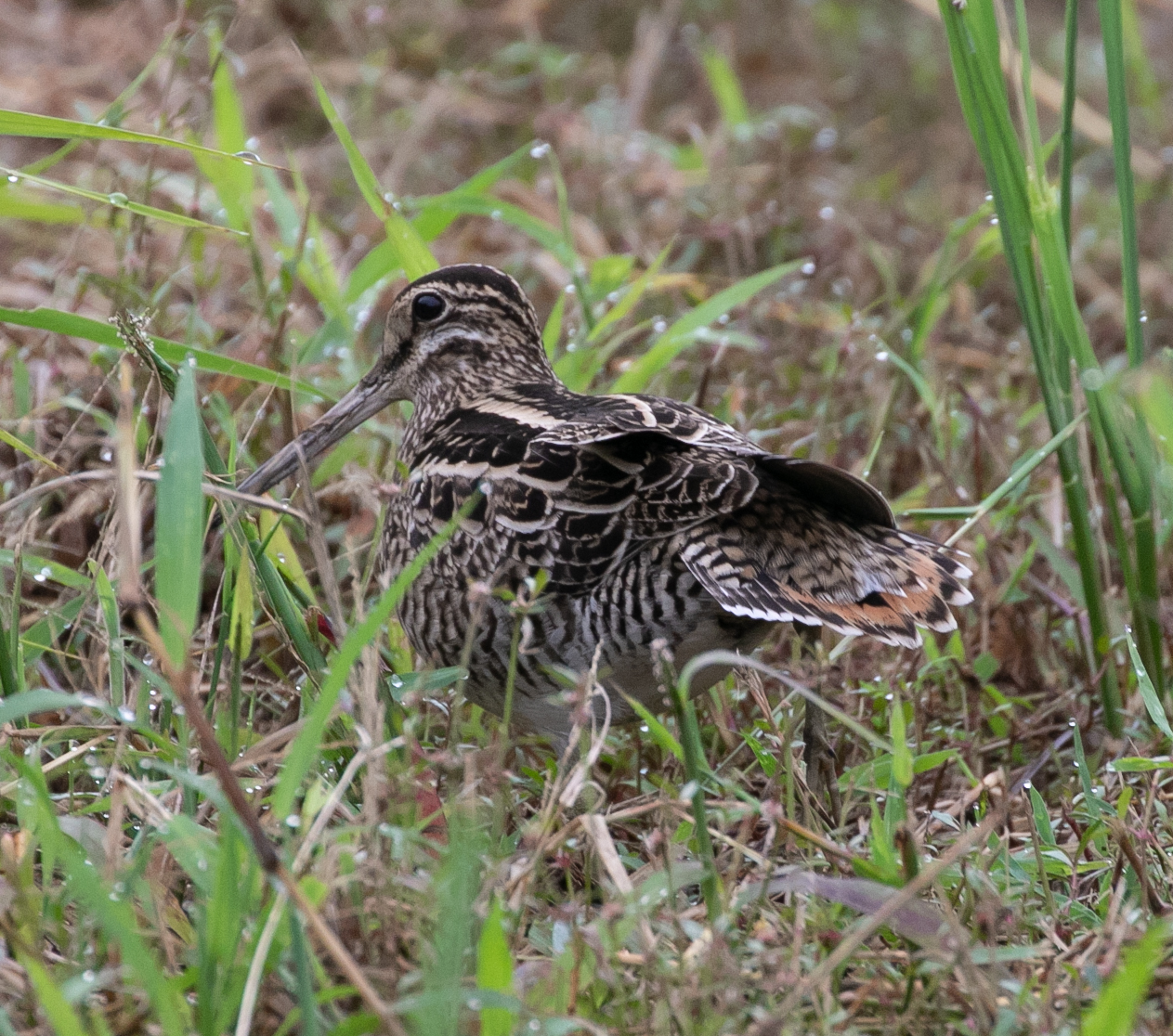
PINTAIL SNIPE

(21 Sept) Flushed by a Siberian weasel soon after I found it. I already suspected this could prove to be a Pintail and this image taken just before it takes flight appears to show pins in the spread tail. The weasel's ears are visible in the grass just to the left of the tail.


SWINHOE'S SNIPE

(22 Sept)


(28 Sept) The only juvenile/first winter.


(28 Sept) Adult


(30 Sept)


COMMON SNIPE

(20 Sept) They did exist!


Finally, I can't resist throwing this in just because it has 'snipe' in the name. These are local breeders and there were males with tiny chicks running round in September.

Greater Painted Snipe


Sunday, 5 September 2021

Swinhoe's, Pintail and Latham's Snipe this autumn

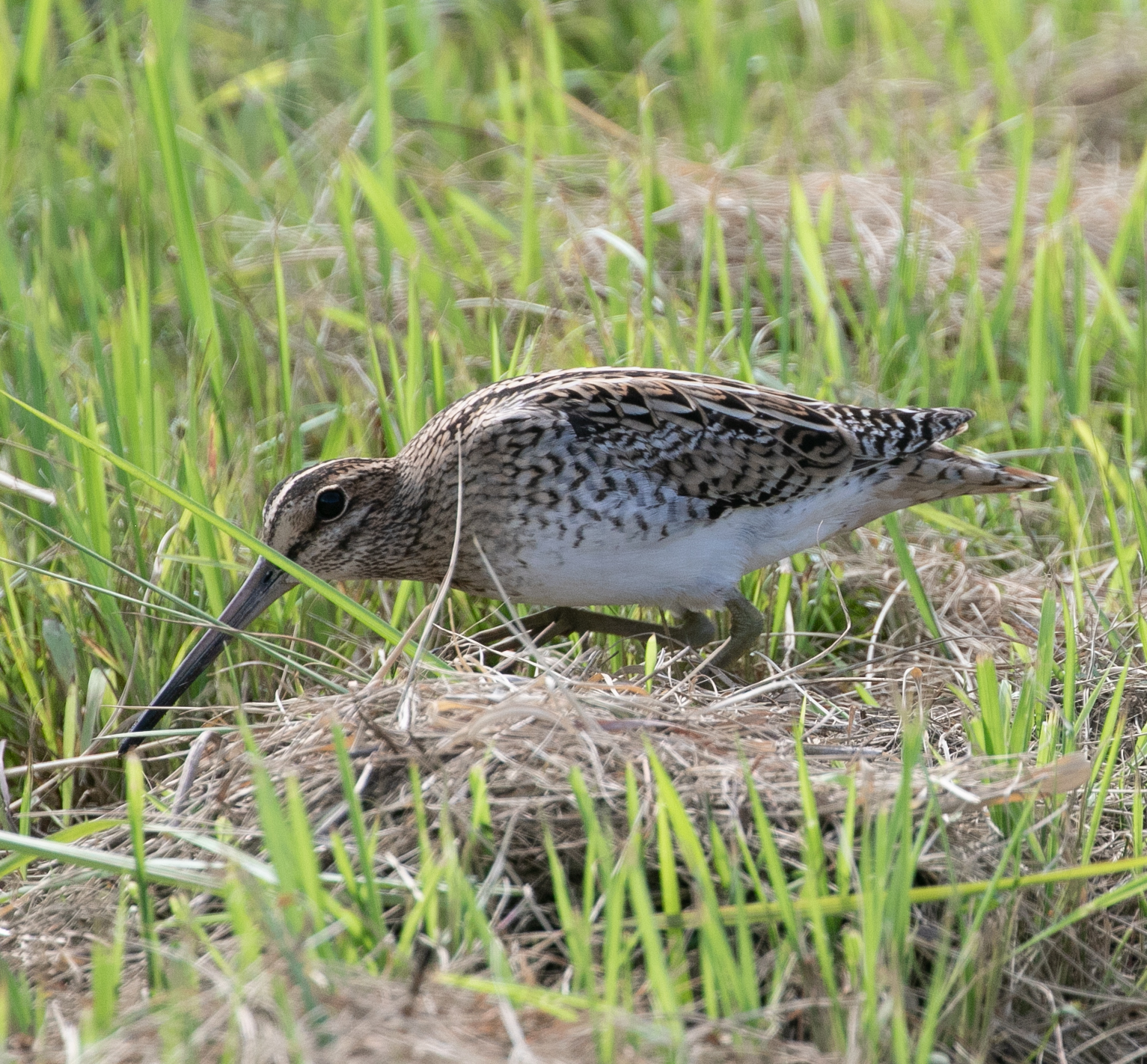
Of the three snipe species in the title, Latham's and Swinhoe's are clearly the commoner migrants passing through the Kansai region. However, much further south, on a recent trip to Ishigaki, six of the seven identified snipe were Pintail, suggesting they're mainly entering (and exiting) Japan to the south of Honshu. I feel fortunate to have had so many good views of all three species within a short period of time, it's been an important refresher on migrant snipe identification; there can never be too much time spent watching snipe. 

I already posted shots of a Latham's seen well a couple of weeks ago, the only one of the trio passing through the region that breeds in Japan. A couple of weeks later I managed some great shots of a Swinhoe's, also in Mie Prefecture, in another of the few fields that offer both good habitat for snipe and viewing conditions.

The Swinhoe's scurried away along a muddy furrow, below the grassy bund, before I'd even pulled up to scan the field, but after 40 metres it crouched, mostly hidden, under the overhanging grass. From the views I'd had of it disappearing along the field edge it was clearly a swintail, and it had a distinct Swinhoe's feel. Knowing it was bound to re-emerge to feed before too long, I settled down to wait. Not only did it soon re-emerge but, to my surprise, made a beline back towards its original position, right where I was waiting. Ultimately it disappeared beneath the grassy field edge three metres to my right. I walked over the spot, I'd have been less than a metre from the bird, along the entire edge of the field and back, but it didn't show itself again.

After coming out hiding, it made straight towards me, I couldn't believe my luck. But views became much, much better.


It never ceases to amaze me how much the head shape can change from one second to the next. 


It doesn't get much better than this; zero doubt about the identity now. Not the upward, warning tail flash (which it had done earlier in response to a low-flying crow), but this spread seemed to signal caution because of my close proximity, without being an overt threat. Not something I've seen before.


The freshly moulted brownish-buff coverts seem to blend seamlessly with the similarly hued scapular fringes and the ground colour of the flanks, creating a very uniform impression. As the feathers age they become much whiter but the lack of contrast remains. 

Next, a couple of juvenile Pintail (pins seen) on Ishigaki.


A classic-looking juvenile Pintail; this is the kind of bird responsible for the notion all Pintails look short-billed, short-tailed, are dumpy, round-headed and have skinny legs. Like the bird below, the lateral crown stripes are densely flecked rusty, note the narrow, white (juvenile) scapular fringes and the very narrow parallel black 'inner fringe' between the largely rusty feather centre and the even white fringe. 


The next bird is an adult Pintail which, though not seen as well, is of interest, showing the extent of post-breeding moult before migration.

This bird spent a lot of time sunbathing, in fact I never saw it feed all afternoon, the upshot being the pins were frequently on view.

It's another classically short-billed bird, and note how the adult also shows extensive and obvious rusty flecks in the lateral crown stripes. I've yet to see a Swinhoe's that can match this appearance. 

Still happily sunbathing and giving the opportunity to see the extent of primary moult. There are five replaced inner primaries and three retained outers, there's a corresponding degree of moult in the primary coverts. The secondaries are unmoulted. I suppose there must be a benefit in this moult strategy, though I'd have thought a long distance migration with full flight feathers would be more energy efficient.

The following bird (in the same field as the above adult Pintail) is a Swinhoe's in my opinion, but I wasn't able to get confirmatory views of the outer tail feathers. This would be the only Swinhoe's I saw on Ishigaki, all others seen well enough to identify were Pintail.

Compared to the first Swinhoe's, this is a more faded bird, the flanks through coverts to scapular fringes are equally lacking in contrast, just paler overall. 

Almost caught the outer tail feathers here; almost but not quite. Don't be fooled by the misplaced uppertail covert masquerading as an outmost Latham's-type tail feather. What I can see of this seems to be three narrower outermost feathers, a prominent white corner (and tips to central feathers), but also a relatively broad area of white extending towards the base. There seems altogether far too much white in the outertail for a Pintail. I could be wrong, but also I could be wrong about this and it still be a Swinhoe's. 
 
I followed the snipe into the next field, where it, fortunately, hadn't ventured too far into the more luxuriant veg. This and the following shot are another good example of how the apparent head shape can change in the blink of an eye, and how unreliable judging structure from photographs can be. Notice how few rusty flecks there are in the lateral crown stripes, another pointer towards Swinhoe's.

Thick, yellow legs are another point in favour of Swinhoe's.

The aggregation of singly inconclusive features in favour of a Swinhoe's identification is making a strong case when, by way of contrast nothing is leaning towards Pintail. 


Monday, 21 September 2020

Pintail, swintail and Latham's; a decent snipe haul

This autumn has somehow got away from me on the wader front, it wasn't until last weekend I made my first trip across the Kii Peninsula to my favourite wader haunts in Mie. The first area of small fields I visited, about 500m x 300m in total, was in excellent wader condition so, apart from a couple of convenience store runs and three circuits of the good nearby sites, I ended up spending the whole day there. It's possible to drive miles without finding a suitable field so I considered myself lucky.

There were two or three Little as well as the two commoner stints, a couple of Broad-billed Sands which aren't that common round this way, as well as a number snipe. So plenty to keep me occupied especially as the latter are my favourite time drain.

I've no idea how many snipe there may have been on the patchwork of small fields, I focused on just one as far as the snipe were concerned. Or to be more precise, I focused on just one edge of one small field. The only Common Snipe I saw were the occasional disturbed birds that flew round overhead calling before settling back into the vegetation. There was even a calling swintail at one point that rose from no more than 20 metres away in my own small field when it was flushed by a family boisterously enjoying their Saturday morning walk around the fields.

There were usually three snipe along this edge, they never disappeared for long and I never saw more than three at any one time. I suspect that they really were the same three birds remaining loyal to the same spot. Presumably all the other snipe across the fields were doing exactly the same.

Even though a good view the outer rectrices is considered the only way to identify a swintail, there are a number of morphological 'tendencies' and generally speaking it's possible to have anything from an idea which species it is, to being willing to bet the house on which one you're viewing without seeing those pesky outer tail feathers. By 'tendencies' I mean features that one species exhibits more often than the other without being conclusive in itself. I said generally speaking because there are times when a bird which is looking a really good contender for one species will suddenly shock by revealing the wrong outer tail feathers.

Getting a good view of the incontovertible outer tail feathers can be easier said than done as Pintails' pins can remain tucked in when sunbathing and thus give the impression of not having any. Of course the sunbathing snipe may actually be a Swinhoe's (which seems far commoner than Pintail in this region) and you can spend no end of time trying to see non-existent pins. Bearing in mind that Swinhoe's and Pintail have about the same number of tail feathers if the pins are discounted, there isn't a noticeable difference in tail size or overall shape. Seeing the pins when a tail is flashed in some interaction is next to impossible so it really comes down to seeing a bird preening in the open at the right angle.

Last Saturday I saw one of the three birds preen twice, once in the open (though not at an ideal angle) early in the morning and again in the afternoon when largely hidden in the rice. I didn't see the other two birds preen at all and never got clear views of their outer tail feathers. Snipe really are a time drain.

Pintail in the foreground, then Latham's and finally swintail at the rear. They spent much of their feeding time probing into the side of the bund.

Latham's with swintail behind.


I'll start with images of the Pintail, the only bird that let me see its outer tail feathers clearly.

This bird was easily separated from the other dark juvenile its heavy barring extending well down the flanks.


One of only two shots I was able to get that gave any indication of pins.

The next bird is a Latham's but before I saw the juvenile primaries I thought it might actually be an adult Swinhoe's.


Finally some images of the swintail.