Showing posts with label Crow Carrion. Show all posts

Saturday, 30 May 2015

A new camera and a few minutes in the field

After I'd bought my first cheap digiscoping set-up a birder laughingly told me that I'd never be satisfied with it and one day I'd be hooked on taking bird photographs. Utter stuff and nonsense I told him, my digi-gear was purely for gulling and that was the limit of my photographic aspirations. However in 2008 I saw a Eurasian Crag Martin out on one of the islands during spring migration, I believe this would have been the first record for Japan if I'd had a camera to document its occurrence, so I felt investing in some hand-holdable photographic gear was necessary and I bought in a D40 and and Sigma lens. This in no way compromised my previous stand, it was a perfectly practical step. How else could I support claims of any future rares I might find? The recent upgrade to a 7Dii and Canon lens is less easy to justify, in fact I have to confess it's impossible. Ingo was right all along, that digiscoping set-up was no more than the top of a slippery and expensive slope.

I had hoped to get my hands on this kit before my Mishima trip at the end of April but it wasn't to be, even the major Japanese retailer I bought it from doesn't stock the gear. I finally got notification from the shop on Thursday the week before last and my hands on it the following day.

March and April had been pretty quiet months for me work-wise but from mid-May I hardly have a spare moment, nothing surprising about the timing of the camera's arrival I suppose. During the first two frustrating weeks of ownership the only free day I've had corresponded with the one and only day of serious rain, nothing surprising there either really. But I did manage to get out for a couple of hours at lunch time last Friday and along with a painfully sunburned head I got a few shots of the only summer visitor it's easy to see in Kyoto; Oriental Reed Warbler.

I have an awful long way to go getting the hang of this camera, of how to keep my glasses handy to change settings and of using unfamiliar processing software. But these are my first results...


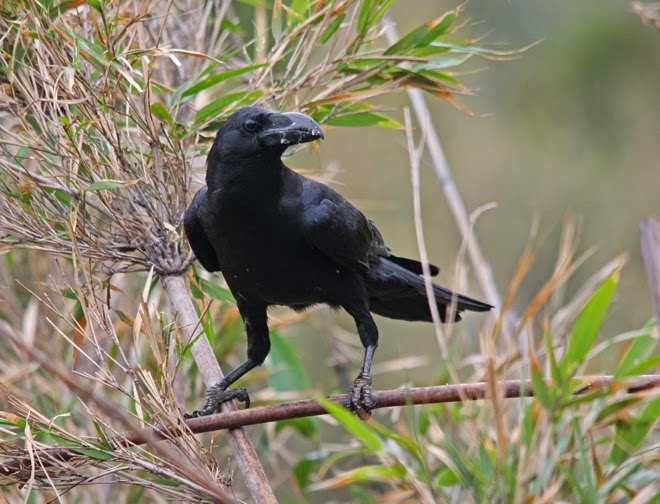
Other shots I liked were of the Carrion Crow at the bottom and this Barn Swallow gathering mud, the rear flank patch is so bold and extensive that the underparts remind me of a White-bellied Storm Petrel!


Tuesday, 10 March 2015

Ishikawa trip last weekend

While the Hoopoe I wrote about a couple of days ago was the highlight of the trip to Ishikawa last weekend, the aim was to see the Scaly-sided Merganser on the Saigawa in Kanazawa. And just like last winter I failed miserably.

I started on the Saigawa at the usual (?) spot and though there were 11 Goosanders on the river at first light there was no sign of the Merganser. Here we go again I thought, but hey, there was plenty of river still to check, still plenty of optimism... still plenty of misplaced optimism as it turned out. The Goosanders were expected here but a Bohemian Waxwing wasn't. A splendid adult hanging on the fringe a group of about 20 Hawfinches, not quiet sure if it should join those seed eaters. I suppose if you're a Waxwing being on your own is an odd experience.

I gave up on the spot far more quickly than last winter, no more walking up and down, and drove up river stopping everywhere the road touched the river, at every vantage point giving a view along an unreachable stretch. There were no more Goosanders, nothing to keep my hopes up, where does it go? Or maybe it had gone, it is March after all.

I saw no more sawbills up river, but a couple of Crested Kingfishers in riverside trees and a Brown Dipper were reward enough. Or at least that's what I told myself, I could maybe have seen them without the four-hour drive. Returning for a quick look back at the starting point where there were now only four Goosanders convinced me to give up and trawl the fields to the north of the city for anyhting else of interest.


Two of the Goosanders just after dawn. 


The lonely Bohemian Waxwing, a cracking adult.

It seemed a day for disappearing birds so it was somehow appropriate that I could hear invisible Tundra Swans calling on the fields. They didn't sound too far away but I couldn't find them, they weren't overhead either. Fail to find a Scaly-sided Merganser on a long and difficult river is one thing but audible Tundra Swans on open fields is an entirely different matter. The fields weren't a total bust though, I did find three Daurian Jackdaws in one of the Rook flocks, all dark birds though one had ghosted white underparts. I have a soft spot for Daurians and these were really were worth the trip as there haven't been any close to home this winter. Or none that I've seen anyway. Unfortunately, unlike many I've seen, I couldn't get creep up on them as the flock wasn't settled enough. The muddy fields they were feeding in resulted in many of the Carrion Crows having whiter-based bills than I'd expect from Rooks in Europe let alone the less white-based eastern birds.

White-billed Carrion Crow. 

The real deal, an obvious Rook.

The Daurians weren't the only good crows in the area. This is Azure-winged Magpie country, a fairly common species along the coast near Kanazawa but one I can't see in Kansai. The first ones I came across were in a tiny scrubby area in the docks and for a change I was able to get a couple of shots off before they managed melt away into what little undergrowth there was. Another disappearing bird.


Two of half a dozen Azure-winged Magpies.

I intended to go down to Katano Kamo-ike and almost didn't drop into Kenmin Kaihin Park before heading south. Fortunately I did and hence ran into the Hoopoe, suddenly things were really looking up and Merg or no Merg coming to Kanazawa now seemed a smart choice.

Baikal Teal and Taiga Bean Geese always leave early and I wasn't surprised there were none at Katano Kamo-ike. Nevertheless it was worth dropping in to connect with the only Falcated Ducks of the day. Then it was just a short trip to the coast in the hope of seeing a few divers and auks. There weren't any auks but three species of diver were excellent and on rocks off Kasano Misaki were Temminck's and Pelagic Cormorants.


A breeding Great Cormorant in the harbour.

Nearby, in the harbour were hundreds of gulls. Sadly the light was going and and most gulls were out on the breakwater. I was torn; stay here overnight and check the gulls in the morning or keep heading south and start Sunday at Biwako. A small harbour on a Sunday? I doubted there'd be much gull action in the morning so down to Biwako it was. It was on the dive south I paused in a convenience store car park I posted the Hoopoe shots.

Saturday, 18 October 2014

A few early winter birds at Ogura

I didn't get down to Mukaijima station until 10am, a really lazy start, but my main target today was to check out the autumn White Wagtails. More of that later. Just outside the station, coffee in hand I found the first winter bird, a male Daurian Redstart.


Daurians are usually one of the first winter visitors to arrive and I expect to get my first between the 16th and 20th so this one's par. No soon had I left it than I noticed a distant Eurasian Kestrel across the fields cutting through a swarm of Red-rumped Swallows but much closer an accipiter was gliding between the high school and station. No doubt a Eurasian Sparrowhawk... but no, when I got the bins on it there was my first Northern Goshawk of the winter. It landed briefly on a pylon but three Large-billed Crows soon put it to flight again. Though against the sun, I managed a few poor shots as the Crows swooped at it and as I followed it there was suddenly a Northern Sparrowhawk along side. No sooner had it claimed my attention than an Eastern Buzzard drifted into the frame. I was thinking I may as well go home, it was hardly likely to get better than this! Raptor migration here is mainly in September when large numbers of Grey-faced Buzzards and Oriental Honey Buzzards pass through but October sees the arrival of species that can be anticipated throughout winter. Even if these individuals may be headed further south.


Textbook stuff, no doubt about this ID...


... and the perfect comparison.


My first local Eastern Buzzard of the season.

While none of these birds was much of a surprise a Rook most ceratinly was. I often get my first Rook on Hegurajima at about this time but it's normally much later before any filter down to Kyoto.

Carrion Crow, a year round bird out on the fields here. 


An adult Rook, by far the biggest surprise of the day.

Coming back to birds of prey, I was able to get much better views of the/a Kestrel later. Now that they breed in the area it's no surprise to see them at Ogura at this time of year, not that it was necessarily a local bird. While Black Kites are a fixture.


I always think that habitually hovering birds are continental migrants as the local birds almost always chase down birds Merlin-style. Note the single adult male feather in the tail as well as a little grey in the rump.


Black Kite is a bird that will always be cruising the fields at Ogura.


Monday, 23 December 2013

crows

When I first arrived in Kyoto Rooks weren't supposed to be wintering in this part of Japan so it came as quite a surprise to find large numbers at Ogura. I have seen as many as 2000 flying from hill roosts out onto the fields at dawn but numbers vary from year to year and are usually much smaller. In any case it's the Daurian Jackdaws that may be with them which will be of more interest to most visiting birders. Daurians occur at Ogura almost every year and when they do they are easy to find because of the limited area. They seem to be annual in Shiga east of Lake Biwa but the area is vast and finding Rook flocks there is more a matter of luck.
Large-billed and Carrion Crows are both common in Kyoto and throughout the region.
Jay is common on the surrounding hills and in forests throughout the region, an easy place to see them in Kyoto is Takaragaiike.
Two species that don't quite make it into Kansai are Azure-winged Magpie and Spotted Nutcracker, though the latter can wander into Shiga in winter. The nearest place I regularly see Azure-winged is along the Ishikawa coast.

The glaring-eyed japonicus Jay can be found in the hills around Kyoto but is more numerous in winter, this one at Takaragaiike, Kyoto, 24 November 2012. It's likely this will be split from the continental forms including brandtii found in Hokkaido.

Brandtii, he race found in Hokkaido, is an altogether softer, more gentle looking bird.

Nutcracker does wander into the mountains of northern Kansai, just. I've never seen one there, but I have been looking in the wrong direction when one came by! These birds are in Akita, August 2013.

Daurian Jackdaws in northern Shiga, December 2013.

Rook at Ogura, 8 January 2011.

Adult Rook, the bill shape may be distinctive but the darker base is perhaps odd to European eyes. Shiga, December 2013.

Immature Rook, they can look very much like Carrion Crow. Shiga, December 2013.

Immature Rook in moult, Tsushima, 30 April 2012.

Carrion Crow on the Katsura River, Kyoto city, 1 March 2012.

Carrion Crow on the Katsura River, 6 February 2009.

Large-billed Crow on the Katsura River, Kyoto city, 7 October 2010.

Large-billed Crow on Mishima, Yamaguchi, 4 May 2009. This bill is bordering on the ridiculous.

Subspecies Osai on Ishikagi, April 2014. An awful shot but with limited time there are bigger fish to fry down there.

Subspecies connectens in Okinawa, August 2011.

Northern Raven is a Hokkaido winter speciality. Probably the best place to see them has always been the Shiretoko Peninsular but apparently more birds are stopping off in central Hokkaido nowadays due to an increase in food courtesy of hunters. The Peninsular is still likely to be the best place to try despite the lower numbers.

This Northern Raven dropped down to the river mouth very briefly in Rausu before heading back into the hills. 29 December 2012.