Greater Painted Snipe can be found throughout the year in the south of Kansai, there can be post-breeding groups of 20-30 at Ogura. Though they may take some finding. During the breeding season they can be even trickier, very easily overlooked when scanning down the rows in the paddyfields.
A very typical view of a pair in the paddyfields at Ogura, 8 August 2013.
The
gallinago snipe can all be found in the Kyoto area. Common can be found year round but is a common migrant and wintering species in the region, occurs in all wet areas from concrete lined drainage ditches to wet paddies and muddy river banks. As for the strictly migrant species, I usually look for them from the beginning of April to the first week of May so I'll limit my comments to that period. Pin-tailed is the least common and number seem very variable, there have been a couple of years when I saw good numbers but normally I'd be happy to see just one and I've had many blank years. Even though migrants can turn up anywhere, they seem to prefer flat riverside areas with varied, mainly low but patchy vegetation and wet spots, this is actually a very scarce and temporary habitat, dependant on how the riverside has been "managed". It's hard to generalise when there are so few moving through but they seem the fussiest when it comes to habitat. Swinhoe's and Latham's are both more common and they can be found on flooded fields but they are often in drier areas, grassy levee banks are good, any riparian habitat which isn't too overgrown. Whether the local authorities cut back any areas of riparian vegetation and the timing of the cutting plays a crucial role in how many snipe can be found along the rivers. Presumably they just pass straight over if they don't see suitable habitat.
These species pass through in autumn too but I'm usually focused on other areas at that time so don't know the best time to look, I did have a Swinhoe's in October (2013) this year which is probably later than most pass through.
Solitary Snipe is the other species which could possibly be seen in Kansai, there have been some well known returning birds each winter in the past. But there are also blank years, though it's quite possible birds go unnoticed on out of the way small rivers in the hills or even that information is suppressed. This definitely isn't the best part of the country to look for this one and more are seen further north.
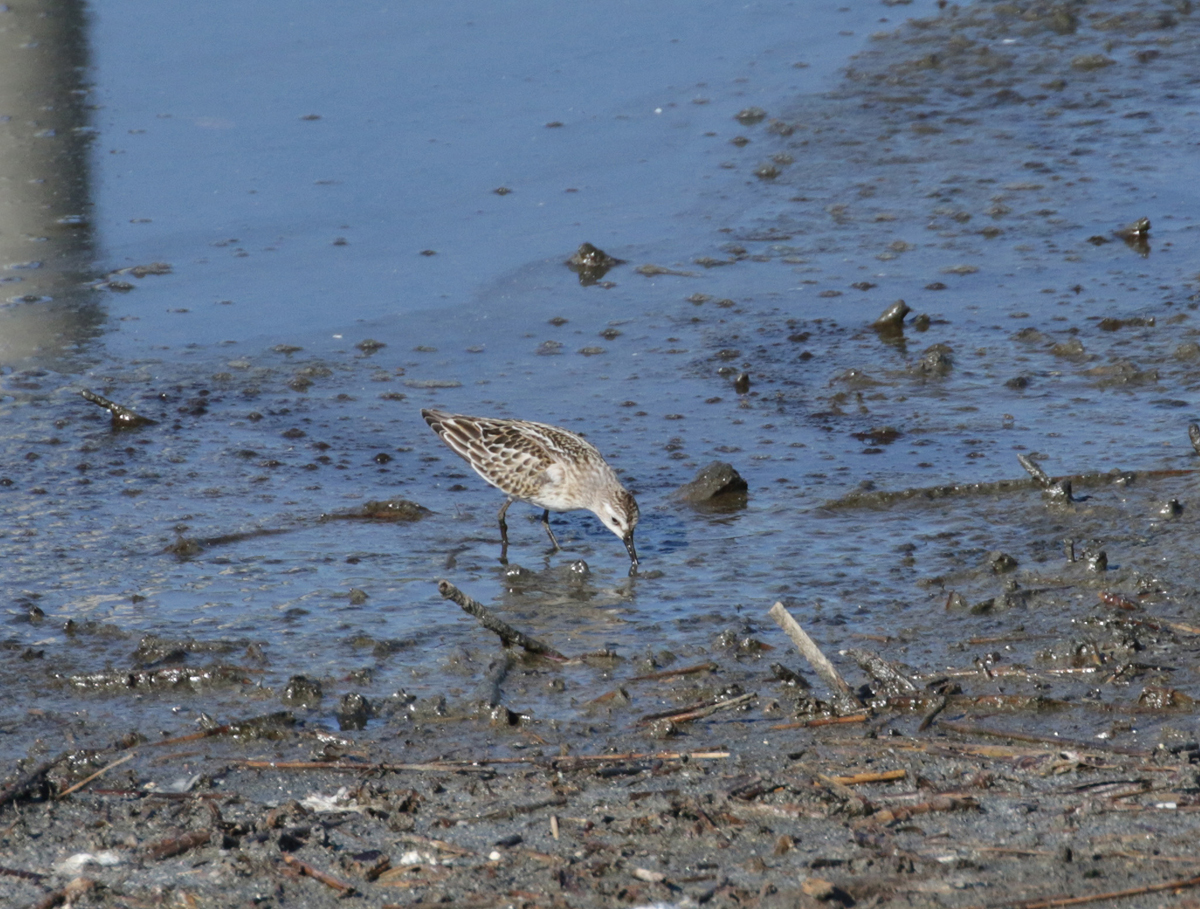
I'm almost loathe to put photos up as I'm well aware of how much more difficult they are to identify from images than in the field where views from various angles, underwing pattern (from Common) and calls all help. But here are a few shots anyway.
Solitary Snipe.
An awful shot of a Pintail, Yonaguni April 2013. The wind was buffeting the car to such an extent it wasn't possible to improve on it even though the bird had been sitting in the middle of the road as I came along and was reluctant to move off onto the verge.
Pintail in a flooded Mie field, September 2014. This bird was longer-billed than many but the short tail, extensive flank barring and rusty fringe to the inner web of the lower scapulars are all pointers. It also had dark-barred underwing and very slight trailing edge to the secondaries.
 Common in the same field, note the much longer tail and less extensive flank barring. This bird has more Pintail-like narrow and even width white edge to the outer webs of the lower scapulars as many far from all do.
 Common Snipe with broad and tapering fringe on the outer web of the lower scapulars with pale distally on the inner. Many Common don't show this pattern but I've never noticed any of the other species with this bold pattern.
Latham's April 2007 Yodo River Kyoto. Typical recently cut riparian habitat.
Swinhoe's (much small Common on right) 3 October 2013, Uji River, Kyoto. Like Latham's, it has a pale coverts panel but this doesn't contrast markedly with the scapulars, whereas Latham's is much blacker above producing a more obvious contrast.
 Swinhoe's tend to be large-headed and are rather uniform brownish without strongly contrasting features. The orange tail patch is usually the only colourful plumage mark.
Latham's (right) and Swinhoe's April 2007 Yodo River, Kyoto.
Long-billed Dowitcher is a scarce migrant through Osaka but I've seen wintering parties not far away at the north end of Ise Bay. There are many rivers running into the Ise Bay so it's hardly surprising not all are built up, there's extensive agriculture abutting some creating a greater diversity of habitat which can attract and support far more birds than the urbanised Yodo River, the only large waterway running through my area. Asian Dowitcher has occurred in Osaka a couple of times while I've lived here but it's a major rarity.
An awful videograb of Asiatic Dowitcher at Nanko, Osaka. As it's the only one I've ever seen I can resist posting it.
A wintering Long-billed Dowitcher near Nagoya.
Long-billed Dowitcher coming into breeding plumage, Mie April 2014.
The two godwits, Eastern Black-tailed and Bar-tailed, are both reasonably common migrants and Bar-tailed can be present in large numbers in April along the banks of the lower Yodo River in Osaka. It's quite common in spring and autumn on the tidal flats in Mie. Black-tailed is far less numerous and seems very much a bird of pools near the coast - and there aren't many of them in the Osaka area. However I see Black-tailed quite often, in low numbers, in Mie.
Juvenile Eastern Black-tailed 1 September 2007, Matsusaka, Mie.
Winter plumage adults Yonaguni, 9 April 2013. Presumably females judging by those massive bills, even without direct comparison they have the feel of very large waders.
A 2CY male coming into breeding plumage, far more delicate than the birds above. 30 April 2009 Mishima, Nagasaki.
Juvenile Barwit at Pheonix, Hyogo, saddly this formerly great area has been fully reclaimed and lost as a top local site. 16 September 2007.
Ok, cheating here, this shot is in Australia, but it's interesting to see the moulting adults and sharper juvenile, November 2012.
 An small Bar-tailed Godwit with a down-kinked bill.
 Breeding Bar-tailed Godwits in Mie, April.
Ogura isn't great for curlews. Whimbrel is the only one regularly passing through, flocks of 20 or so can stop off briefly, usually on levee banks if the grass is short enough. Otherwise their calls might draw attention to birds flying straight over. I once saw a group of three Far Eastern Curlew on flooded fields at Ogura but they didn't linger and also once a Little Whimbrel on dry fields.
Nanko in Osaka gets Eurasian Curlew and Far Eastern Curlew on a more regular basis but they aren't predictable. Mie, with much more suitable habitat, is better but even here there's no guarantee of seeing even one let alone both on any given day. Nevertheless there's a reasonable chance of seeing one or both in low numbers on the estuaries or mudflats.
 Little Whimbrel is fairly rare in Japan. This one was on Tsushima, Nagasaki 29 April 2012.
 A second bird joined it a day later and there was another on 1 May.
 Whimbrel on Mishima, 2 May 2011.
 Whimbrels with Eurasian Curlew, Mie 8 September 2008.
 Eurasian Curlew, Mie 8 September 2009.
 A good flight comparison of Eurasian and Far Eastern Curlew. Mie, 31 August 2014.
 Far Eastern Curlew on Mishima, Nagasaki 3 May 2009. They are often distant on mudflats so it was great to see one so close.
 As above.
 Two shots showing upper- and underwing patterns, the bill of this bird is distinctly short. Mie 8 September 2013.
 One of several birds with their famously enormous bills, 1 September 2013.
 An immature Far Eastern on the same date to illustrate how vastly different bill size can be.