Showing posts with label Booby Red-footed. Show all posts

Monday, 25 September 2017

Volcano Island boobies... and the one that got away

Boobies attach themselves to any ship, with all the flying fish zipping out from the bow wake the chance of a relatively easy meal is way to good to pass up. In doing so they inadvertently provide a spectacular and photogenic escort through their oceanic territory. It was noticeable that when, after many miles, the Volcano Is Brown and Red-footed Boobies left us there was a brief period the fish could fly in safety before the more northerly Ogasawara Brown Boobies joined us. This was repeated further north the following day when there was another stretch of booby-free ocean after the Ogasawara escort peeled off and before the Izu Is birds came along side.


Brown Booby is a widespread species throughout the warmer waters of Japan and can even be seen in Kyushu coastal waters in winter... in harbours if you're lucky. Masked and Red-footed, unless storm-blown, require visits to more remote island groups. Red-footed is a common breeder in the Volcano Islands and Masked in the Yaeyama Islands.


Now you could say, 'when you've seen one Brown Booby you've seen them all'. You could; but it turns out you'd be wise not to, as I was to find out. Apart from females being significantly larger than males the sexes look alike, nor is there any readily apparent individual variation. On this trip I was interested in getting some shots of immature Brown Booby partly because I've seen very few and there seems very little variation in appearance compared to the immature Northern Gannets I used to see in the UK, with their gradual progression to adult plumage. Also partly because I remember in my teens the late Richard Richardson chasing me up for notes on an 'immature Gannet' we'd seen a few months earlier, Richard had a nagging doubt that it might have been an immature booby.


In that light it's all the more galling that the potential bird of the trip, a Brewster's Brown Booby Sula leucogaster brewsteri, was one that got away. It simply wasn't on my radar. According to the notoriously out-of-date OSJ list there's only been one Japanese record, however with a growing number of records in Hawaii, including breeding, this has to be a taxon to look out for in the Volcano Islands. The amazing occurrence of Nazca Boobies in Hawaii would also make any Masked Booby (which I've yet to see in the Volcano Is) worth more than the passing glance I allowed this bird.


I saw it approaching from the rear at about eye level, as boobies so often do, while we were slowly circumnavigating the southern island of the group. It was strikingly white about the forehead and fore-crown and the bill looked more reflective and colourless unlike the usual bright yellow. In fact it actually suggested an approaching Brown Noddy but as it was plainly a booby I lost interest before I'd had time to actually process what I was looking at. At that moment there was so much activity with Red-tailed Tropicbirds, White Terns, Brown Noddies and the potential for who knows what that the ship's daily escort simply wasn't a priority and I didn't even attempt to get any shots of it. It was only later as normalcy returned that the idea of a white-headed Brown Booby caused the cogs to slowly creak into action. The pain of this particular loss may diminish with passing time but at present the opposite seems to be the case.


Anyway... few images of the ones that didn't get away.


Juvenile Brown Booby


An April immature Brown Booby from the Yaeyama Is. I expect with the similar latitude the breeding timing will also be similar and this appearance with moult in the remiges and body fits a 2CY.


Juvenile Red-footed Booby


The same bird as above, the upperparts look strikingly grey at a distance.


Red-footed Booby in early November. So how old is this one? The potential for a very protracted breeding season could mean this is also a 1CY but perhaps 2CY seems more likely. If so then Red-footed must show a greater plumage variation between Juvenile and adult compared to Brown. 


Flight feather moult apparent here; I can only see nine primaries and the outermost is half grown. This must make it a 2CY.


The same bird as above; upperparts for comparison with next bird.


Compared to the previous bird this has slightly more white on the upperparts and white-spotted outer wing coverts. There doesn't seem a vast difference between this and the previous bird but this is a July bird, a full eight months later... or four months earlier. 


Same bird as above.


A far more advanced immature this month, just north of Ogasawara.


The same bird as above.


July immature with stepped wing moult, much brown in tail but breeding adult facial pattern.


Same bird as above. Two moult loci in both primaries and secondaries.


Adult Brown Booby


Male Brown Booby


Female Brown Booby


Adult Red-footed Booby September, facial area without intense breeding colouration.


July adult red-footed Booby with more intense facial colouration.


April Masked Booby


Even though I was really hoping to find rare seabirds on the trip, it was really difficult not to be distracted by the boobies putting on a great show alongside the ship. Particularly where the less often seen Red-footed was concerned.


The plunge...


The pursuit...


Thursday, 12 November 2015

A short-billed Long-billed Dowitcher

There have been a couple of basic plumage Long-billed Dowitchers around for a while but there was a new comer when I last visited their favourite pond. A strikingly short-billed bird and not only that but the only autumn bird I've seen with colour. Have I never seen a juvenile before?


The short-billed bird on the right; even head-on it looks different to the other two. 


The typical basic Long-billed Dowitcher I'm used to seeing here at this time of year. 


Juvenile male (?) Long-billed Dowitcher with a distinctly short bill.


There were fewer Common Sandpipers around this visit but following bird did its very best to attract attention. The fourth shot, a bird in the early morning sun, shows probably the brightest yellow legs I've seen on a Common Sand.


This Peregrine went after anything that flew, Cormorant, Kite, Carrion Crow but the outstanding chase of the day was across a large pond on the tail of a Red-footed Booby. What was the Booby even doing the wrong side of the seawall?


On the lookout for the next aerial fun. 


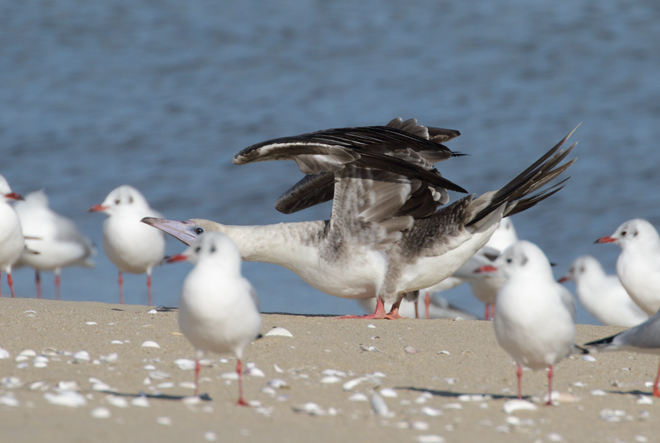
The Red-footed Booby on the landward side of the seawall.


In the afternoon I headed to the north of town to have a look at the gulls, my main reason for being there if truth be told was to look for juvenile Taimyr Gull. There was only a single gull of that age group which was disappointing. Whether this was coincidence or due to conditions during the last breeding season resulting in a lower number of offspring I don't know but autumn juveniles are usually more numerous. Hopefully numbers will pick up.


Vega Gulls showing off their variable eye colour; neither extreme is unusual.


One of many adult Taimyr Gulls around at the moment.


Juvenile Taimyr Gull.


Juvenile Taimyr Gull.


Tuesday, 3 November 2015

Great (?) Frigatebird and Red-footed Booby - the tropics come to Mie

It was really good to get back to birding in Mie when I took Stig Madsen there four days ago. That trip had a heavy bias towards ducks and waders, plus it's impossible to cover all the good areas in a day, so I was keen to get back and see whether Taimyr Gulls are moving through. I'd like to get some decent images of crisp juvenile plumage.


I arrived pre-dawn as usual but abandoned my normal set of early morning tide-dependant routes and headed more or less straight down to the Kushida estuary. This is usually as far south as I get and today I wanted to make sure I had plenty of time to cover some of the northern sites that Stig and I had missed last time. I planned a straight south to north drive without double-checking any sites.


There are thousands of bamboo poles supporting nets in the shallow waters of Ise Bay, forests of them in places, and they're always worth checking.


Some early cloud cover meant the light wasn't too bad scanning from the north side of the estuary and as I was checking the hundreds of bamboo poles planted in the shallow waters for Crested Terns I noticed a melee of gulls to the south, presumably over a shoal of fish. No sooner had I refocused the scope on the flock than a frigatebird came swooping through them... that's not supposed to happen in Japan! Whenever I find a rare bird doing a quick mental run through the common species I could be tripping up over is automatic; I suppose everyone is the same. But, common species a frigatebird could be confused with... ? If a non-birder gave a potted description of something as obvious as a mollymawk in a European setting (or even eastern North America) Greater Black-backed Gull would probably be the first thing that springs to the birders mind. But a frigatebird? It can't really be confused with anything other than another frigatebird. Of course that's when the fun starts.


The bird was on view for 20 minutes but was never closer than a kilometre. It wasn't far off-shore, quite close at times in fact, but it was to the south of my position. After chasing through the gulls a couple of times it began patrolling the coast gaining and losing height effortlessly, it must have simply been hanging in the air for much of the time as it could have covered an enormous distance. Looking south down the coast from my position it was mainly tail- or head-on depending on which direction it was moving giving side views as it swung round. I guessed it would take 20 minutes to drive inland, over the bridges and find my way back to the coast through a maze of unfamiliar roads. It made far more sense to view the bird while I had the chance especially as it might head north to where I was was standing. After 20 minutes I was kicking myself for not having left immediately but who would have guessed it would hang around so long. It seemed to be gradually drifting further south and at that point I drove off after it. It did indeed take 20 minutes to reach the location but had I known the way I could easily have done it in 10; the bird would have been close enough to get acceptable record shots at the very least. Spilt milk.


I believe it was an immature Great rather than the more often recorded Lesser because of the underparts pattern. When turning, and originally when chasing gulls, the white belly patch looked centre-heavy. That is it bulged evenly fore and aft up the mid-flanks and was visible at times as the bird was flying away as almost a white rear flanks patch. It was never obvious from a frontal view. The leading edge of the belly patch was convex but I couldn't say whether rounded or more pointed. The rear edge was quite broad and well rounded on the lower belly. The white mid-flank bulge didn't reach the axilliaries nor was there any spur. At that range the head never struck me as paler in any way no matter what angle so if buff it must have been dull.


This is my second frigatebird in Japan, the first flying high on Minami Io-to (South Iwojima) was left unidentified and the fate of this bird may be the same which is rather annoying; 20 minutes land-based viewing should be ample to clinch an identification.


Heading north again I stopped to tell a crowd of photographers at the Kumozu River estuary. Someone suggested it could have been a tern; I confess that hadn't cropped up when I did my mental run through of potential confusion species.


After that courtesy call I pressed on to the north of Tsu city, to the long sweeping beach popular with loafing gulls. Just before getting there I bought a bite to eat and large coffee at a nearby convenience store,  planning a five-minute break before checking the gulls. As the coffee was still a tad hot when I parked and I didn't know how many gulls there might be this early in the season I decided to poke my head over the seawall before my well earned break. The Red-footed Booby was standing on the sand right in front of me! Unbelievable - two tropical seabirds just a few kilometres apart.


I was a bit nervous about how close I could approach, it was in with a crowd of Black-headed Gulls. They're always skittish, fly up and immediately re-settle at the drop of a hat. The large gulls always ignore them and stay put but what would the Booby do? It turned out to be no more bothered by the Black-headed antics than the large gulls and it took someone taking a tideline constitutional to flush it off. Some people will always try to avoid flushing birds if they see you're looking at them, others couldn't give a hoot. This gentleman was clearly one of the latter.


My luck really was in. It was so warm inside my car the coffee was still drinkable when I got back - bliss! After that, a final trip onto the beach to get a few adult Taimyr shots and there was the Booby, still just off-shore putting on a plunge diving performance. I couldn't have asked for better.