Showing posts with label Swan Tundra columbianus. Show all posts

Tuesday, 23 January 2018

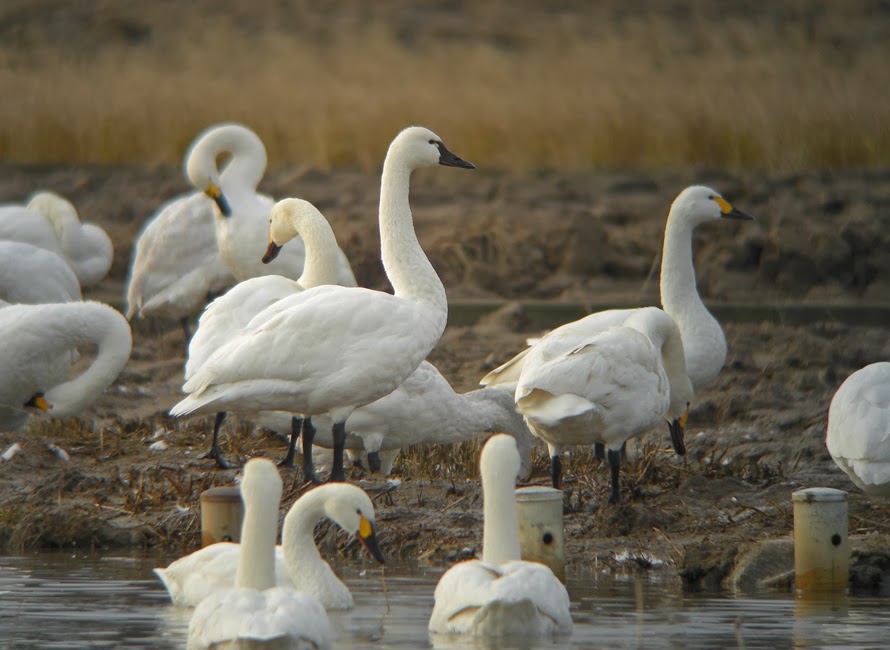
Bewick's, Whistling and Whooper Swans at Lake Biwa

I visited Lake Biwa for the first time this year at the weekend, twice in fact. Friday was sunny and Sunday was not, which is why the nominate columbianus images are so much duller.


A lot of people were on the fields (not just the Steller's Sea Eagle spot) because of the two local rares; both Whooper Swan and Cackling Goose were new Kansai birds for me. The Cackling Goose was the bigger draw and this made finding it relatively easy. Flocks of swans were dotted over a huge area but the Cackling Goose flock always had a line of roadside birders flagging the spot across the flat expanse between the Lake and the mountains.


I'd normally try to creep the car towards the flock hoping not to disturb the birds but it seems I've always erred on the side of caution because the swans simply don't give a hoot. The birds were even closer on Friday and actually walked towards the line of photographers with the closest coming to only 10 metres.


The main draw for me was the Cackling Goose and in fact I hadn't known about the Whooper Swans. It was only when the Cackler moved slightly back into the flock that I checked the birds in the next field down the road and discovered two of the white shapes were Whoopers. Whooper Swans are never common this far south in Japan, I've seen one further west in Shimane Prefecture and another at Arasaki in southern Kyushu(!) but this pair were a real surprise. I walked along and could get reasonably good shots, probably the best I've ever had of Whooper, despite all the geese and swans in this field being less close to the road.


After looking at large numbers of close range Tundra I was surprised how strikingly pale-eyed this bird was. According to Brazil (who ought to know) paler blue-grey eyes are not uncommon in Whooper Swans so this was a nice example.


This, dare I say rather smug-looking, Tundra's eye is also blue-grey though much duller.


So if I'm already anthropomorphising then it's safe to say I'd rather buy a used car from this bird. Oh, and this has the more usual dark eye. 


Sunday was much duller and colder with an increasing wind; the beginning of the end of a few days mild weather. I didn't hang around long enough to see if this Whistling Swan would come any closer so these are the best shots I could manage.


The above bird in the foreground and there's another possible columbianus behind it. I suppose this extent of yellow on the bill falls within the range of the nominate subspecies and I sometimes see birds like this paired with classic-looking columbianus, never with bewickii, which tends to support they are also Whistling Swans but eliminating the possibility of hybrid ancestry is impossible.


I suspect it's more likely to be Whistling than Bewick's. As I said I've seen such birds paired with clear-cut columbianus, with young, but never with bewickii.


Thanks to there being numerous small flocks dotted around a large area there was relatively frequent coming and going and plenty of opportunity for getting the prefect flight shots. I was far more interested in the two rarities but couldn't resist trying my hand at flying swans. The shot below was my best effort.


The other swans of interest were two birds with solar powered geolocators; I saw one on Friday, two on Sunday. Add those sightings to only seeing the Whoopers on Friday and Whistling Swans on Monday and it shows how difficult it is to see everything on a single visit. There must still be additional fields I've yet to find that are attracting flocks.


The 'Friday swan' getting a power boost.


Wednesday, 23 November 2016

Rotten weather at Biwako

I had a good day out in Mie last Friday and had planned on staying the night to get a bit more gulling in the following day, however that evening the forecast promised an unremitting 80% - 90% chance of rain throughout Saturday so I decided to give up and head home. In the event there wasn't a drop of rain all day in Kyoto which had been due exactly the same weather as Mie according to my 'friends' at the Met Office. Thanks guys. So Saturday night I went up to the northern end of Lake Biwa, after all with only a 10% chance of rain limited to late afternoon the weather would be fine to check out the wildfowl situation. A ten percent chance; maybe the their forecasting ability is fine, it's just their math that's off.


I began the day in the mountains north of the lake and at 6:30 the clouds overhead weren't yet heavy but with fog lower down and ominous clouds approaching from the north things didn't look too good for the rest of the day. The mountains were fairly quite, reasonable numbers of the commoner finches and buntings, a good few Red-flanked Bluetails but surprisingly little evidence of woodpeckers, only the odd Jay, and definitely no Copper Pheasants. A stiff-winged Peregrine soaring high above was the only unexpected sighting. By 7:30 the opening spots of rain were signaling what was to come and I made my way down into the deepening fog below, and then on to the lake.


"And here's one I made earlier", which ought to strike a chord with Brits, I took this shot of Bluetail a week earlier on Mt Ibuki.
 It proved difficult to check the more distant ducks through the grey filter draining the lowlands of colour so I spent most of my time driving slowly round the fields and managed to track down two flocks of Tundra Swans (bewickii) by following birds flying 'inland' away from the lake.


A flock of Tundra Swans feeding on the fields.


Those Swans were close to the lake but another flock was two or three kilometres away and included a presumed columbianus. Going for the second flock really paid dividends as I came across two Common Starlings for the second time this weekend. I think I'd only previously seen one Common Starling in Kansai, so four in three days is good going.


A presumed Whistling Swan with the Bewick's.


Bewick's Swans.


Common Starlings with White-cheeked.


Another bird that caught my eye while slowly checking the fields was a strikingly large heron that flew up from a ditch and settled in a field. It 'felt' too large for the local modesta Great Egret the moment I saw it and sure enough, when I caught up with it, it had telltale yellow on the tibiae. There was a second modesta on the lake in front of the wild bird center at Kohoku, this seems a favourite spot for them, but the views are never great even when the weather is.


'Western' Great Egret on the fields.


Another with more obviously yellow legs.


Surprises through the murk weren't quite over; two Whiskered Terns hawking over a roadside pond stopped me in my tracks. I seem to be seeing more of this species nowadays, that's at least 10 this autumn, I don't know if that's down to luck or whether more are turning up here. Unsurprisingly however, it wasn't possible to get an even half decent shot of them.


Grey on grey: Whiskered Terns.


Now you'd be forgiven for thinking images of birds can't get much worse than those... but they can. As proof I'd offer the following image of four Eastern Marsh Harriers coming in to roost.


Four a group of five Eastern Marsh Harriers high over their roost site as the last of the poor light was giving up.


Friday, 26 February 2016

Tundra Swan: hybrid columbianus x bewickii pair?

Last weekend (Feb 21) I came across what I was certain must be a Whistling Swan Cygnus columbianus columbianus in a flock of about 80 Bewick's Swans C c bewickii; a fairly rare find in Japan. Interestingly it gave the impression of being paired with a dark-billed type (a "darky"; after Scott, 1966) Bewick's Swan C c bewickii. I have to say at the outset that they weren't part of a family group (there were surprisingly few first winters in a flock of about 80 swans), so the only indication that they might have been a pair is that they seemed to have a close affinity. They grazed together, which may have been coincidental, and on one occasion walked a about 20m through the flock as if a pair - so nothing conclusive, just an unsubstantiated hunch.


The second bird had very limited yellow in the bill by bewickii standards, far less than any other bewickii in the flock or that I'm used to seeing, however according to Evans and Sladen (1980) it is within the range of extremely 'dark' bewickii but outside that of an extremely yellow columbianus.


The two swans in question, columbianus on the left, the 'darky' bewickii on the right and a 'yellowneb' between them.


I can't help wondering whether it's possible for some western columbianus to show this extent of yellow or if extreme 'darky' bewickii might select the darkest possible mate? Mikami (1989) mentions three of four mixed pairings he recorded, three of the bewickii were 'darky'. An alternative might be the bird I saw is a hybrid which "recognizes itself" as columbianus, so its choice of mate would be no surprise.


The closest I came to getting both in profile. The 'pennyface' in the centre was the only one I noticed in the flock though I wasn't searching too hard in the rain.


The most convincing Whistling Swan I've seen was Shimane seven years ago. Not only was the bill pattern perfect but it was clearly larger than the accompanying Bewick's despite there being so much overlap in size between the two races.


No doubt about this one; my only "classic". This not only had the perfect teardrop but was distinctly larger than the bewickii. The bill seems deeper-based, as I've read it can be, but it's hard to know for sure how much of this might be an illusion caused by the different colouration. I've also read the head shape can look slightly different, something I'm always wary of, and all the birds I've seen do seem to have more of a forehead, a slight coiffure whereas the bewickii have a straighter profile.


My only other columbianus were eight years ago when I had a pair with a single young bird, again at Lake Biwa, and again one looked good while the other had a lot of yellow on the bill. However the yellower-billed bird does seem to be within the range of columbianus.


Wednesday, 30 October 2013

swans

Tundra Swan Columbianus bewickii bewickii is the common swan of the region but is restricted to the Japan Sea side of the country therefore Lake Biwa (Biwako) is the closest to Kyoto it occurs. Some make it down towards the southern end of the lake but most remain at the northern end. It can be found at many other wetlands in the north of Kansai.


                                                                      Two adults.

                                                        Dark-billed immature, 18 January.

                                                 Immatures still lighter-billed, 2 December.

Tundra Swan C.c.columbianus also occurs in the region in small numbers and can be found at Lake Biwa or elsewhere but I don't find birds every year even though it might be expected that birds would return to the same location in successive winters, particularly where family groups are concerned.


Classic columbianus, a large individual with a tiny yellow tear drop in front of the eye.

Not all birds are as obviously columbianus, the following shots are of a family party at Kokoku, Biwako. The first bird would be a good contender in its own right but the second has quite extensive yellow on the bill. The immature has very limited pale areas on the bill and again looks good. Collectively they are quite convincing.

The adult with limited yellow on the bill.

The adult with more extensive yellow.

The young bird, Lake Biwa February 2008.

I've never encountered Whooper Swan at Lake Biwa and their appearance in the region seems unpredictable but it's possible to bump into singles mixed in with flocks of Tundra Swan.

Whooper Swan in southern Hokkaido.

Trumpeter Swan is a rarity in Japan and those that do occur would be expected in the north, so a bird at Lake Shinji (Shinjiko), Shimane prefecture came as a huge surprise and was really popular with birders, particularly as other birds at this location during the winter included Ruddy Shelduck, Pied Avocet, Common and Arctic redpolls and Snow Bunting.


                                              Trumpeter Swan with Tundra Swans.