Showing posts with label Coot. Show all posts

Tuesday, 18 February 2014

Green-winged Teal, Nagoya and albus Great White Egret, Lake Biwa


I tried to plug a couple of prominent gaps on my Japan list last weekend. Firstly Solitary Snipe on Saturday afternoon after work, then a night drive to Nagoya for Green-winged Teal.

Who knows how many Snipe may winter on streams and rivers in the pathless hills, birders probably only find a small percentage. Nevertheless they are recorded far less frequently in Kansai than further north in the country. This bird had been found on a river in the hills just south of Kyoto mid-week but by the time I was able to get there heavy snow followed by rain had caused the water level to rise drowning the area. It may not have moved far but I couldn't find it along accessible stretches of the river. So, not a great start to gap-filling.

I've since heard that it is still around and sometimes comes back to the same spot.

After a couple of hours sleep that night I set off for target number two and arrived on the Yadagawa in Nagoya before dawn. As soon as it was light enough I began walking along the river bank and after only 300m there it was. I wouldn't like all new birds to be this easy but it was a relief to connect quickly after the disappointment of... well, just 14 hours earlier.

At this angle it bears a striking resemblance to Baikal Teal!  


Buoyed by this success I made my way to the expressway and was at Kohoku on northern Lake Biwa by 10:30. It was unusually windy which seemed to have an invigorating influence on the local Steller's Sea Eagle (after all these years it ought to be Georg's by now), which repeatedly inched its way into the wind along the hill on part folded wings only to flip and catching the wind rush back to its starting point. Quite a change to watching it in a pine tree doing its dead parrot impersonation. The wind wasn't so helpful on the lake though, it looked and sounded more like the ocean. The geese had a bit more spark about them too, about 30% weren't asleep! None of the White-fronts, nor the Swan, were there so quite a few more must have been out on the fields somewhere. There were relatively few waterbirds out on the lake but rivers, harbours and ponds had good numbers of sheltering birds.

Redhead Smew.


An interesting find was an albus Great White Egret. I was bumping along a rough track beside a pond and must have flushed it, even flying away it looked unusually large and definitely worth following up. When I scoped it the yellow tibia were outstanding way across the pond but it wouldn't let me get closer than about 150m and I wasn't able to get more than one semi-decent shot of it. The odd thing is I saw another presumed albus only 1km away two weeks earlier, unlike this bird it already had some full length plumes so clearly a different individual. There were about 20 modestus sheltering at the north west corner of the lake but none in this area for comparison.

Today's albus.

This presumed albus, on 2 February as light was failing, was just too far to be 100% sure about.

By late afternoon afternoon I'd made my way to Lake Sainoko to wait for Eastern Marsh Harriers coming to roost. Numbers were surprising low but I wasn't complaining. It had been a pretty good day afterall, another gap on the list plugged.


Hen Harrier above and Eastern Marsh below.


Saturday, 1 February 2014

Common Starling

This year I finish work at lunchtime rather tham late afternoon on Saturdays, which gives me an excellent opportunity to visit the Yodo River at Hirakata. The river is becoming much wider here at the mid-way point between Kyoto and Osaka and a broad cycle path running alongside the river gives good access.

The highlight today was a Common Starling in with hundreds of White-cheeked Starlings in the berry trees by the river.


There was a reported Red-billed Starling in the same trees last week but the closest I came to that was a melanin deficient White-cheeked with an entirely white head and breast. That wasn't the only plumage aberation of the day with odd-looking Common Coot and Meadow Bunting too.


 Another bird of local interest was an American Wigeon with the other ducks on sandbars in the river and I was told there was also a Common Shelduck about 1km down stream. Of more interest to me were a number of Vega Gulls on the sandbars, this is something of a rarity in Kyoto city not much further north and is really indicative of the change in aviafauna heading towards the coast. Great Crested Grebe and Dunlin were two species on the river here that I'd normally associate with the coast (or Lake Biwa).

Other minor surprises were seeing 15-20 Long-tailed Rosefinches yet not a single male and a Green Pheasant up a tree at midday in bright sunshine. Pheasants aren't so unexpected in trees early or late and they often perch in branches in the rain but sunny midday was maybe a first for me.


Sunday, 10 November 2013

crakes to cranes

Eastern Water Rail and Ruddy-breasted Crake can both be found in the region, they're widespread but local. The latter likes reedy streams and ditches or small ponds with well vegetated surrounds. The Rail can be in similar locations but is often associated with larger marshes or woodland with standing water. It is quite common at a series of ponds and marshy wooded fringes of Lake Biwa just south of the Kohoku Wild Bird Center in winter. They can even be heard in the narrow strip of reeds in front of the center but they are next to impossible to see there.

Lake Abashiri, Hokkaido, August 2012.


Juvenile phaeopyga, Ruddy-breasted Crake at Kijyoka, Okinawa 2011.

Watercock is a rare visitor to the region, one spent some time in marshes at the Uji River in Kyoto a few years ago. White-breasted Waterhen is less rare but not to be expected, they are however very common in the southern islands and sometimes turn up on Hegurajima.

White-breasted Waterhen at Kijyoka, Okinawa August 2011.

White-breasted Waterhen on Iriomote where they are very common, April 2013.

Though with absolutely no connection with Kansai whatsoever I can't resist including Okinawa Rail, once so difficult for visiting birders to see it no longer seems to present any problems.

Okinawa Rail at the roadside August 2011.

Moorhen is very common in the region, as is Common Coot in winter with 10,000s on Lake Biwa though numbers are very low in summer.

Juvenile Moorhen, August.

Worn adult, August.

Fresh adult, December.


Common Coot on Lake Biwa, February 2014.

The only crane that occurs in the region is Hooded, but that only rarely. A few years ago one wintered at Lake Biwa and a small group passed through southern Osaka. There's been one in Hyogo this month (November 2014). Of course no one comes to Kansai looking for cranes and Arasaki is one of the most famous sites in the country, a must go to location. Watching thousands of cranes flighting in each morning is a true birding spectacle, the shots below were all taken there except the Japanese in Hokkaido and Siberian White in Shikoku.

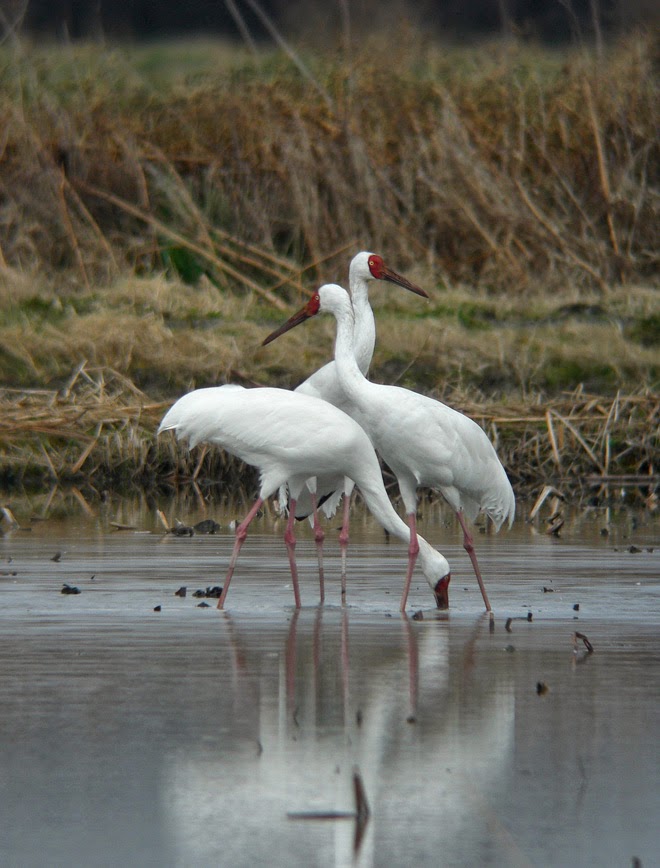
A trio that wintered in Kochi, Shikoku. Here photographed in the north east of the island on their way north 2 March 2014.

Hooded Cranes packed in at the feeding site early in the morning.

Hooded and White-naped.

A distant Sandhill.

Hybrid Hooded x Common.

I've seen Demoiselle at Arasaki but haven't been there during a "Siberian winter". Red-crowned seems to be the rarest of the species visiting the area but as most visitors will want to head up to Hokkaido that isn't a problem.

                                              Red-crowned Cranes, Hokkaido January 2013.