Showing posts with label duck hybrids. Show all posts

Monday, 11 April 2022

Pallas's Reed Bunting - well that was unexpected

 I was hoping to find migrant snipe over the past week, both locally, here in Kyoto, and across in Mie. Unfortunately there's precious little good looking workable habitat and I didn't find a single snipe. I expect there'll be birds around, I'm simply not looking in the right places. Very disappointing. Even more so considering I had a Latham's on 30 March, my earliest sighting yet. There wasn't much happening on the wader front in general, though it's still early days of course, but April is peak time for snipe passage in this area and I'd hoped for more success.

It isn't true to say I didn't find any snipe but the only one I came across surprisingly turned out to be Common. First thing in the morning it was running around and jumping over tussocks amongst the rank grass and mulleins on the upper beach, between the seawall and the sand. Strange place (and behaviour) for a Common Snipe.

The next bird to catch my eye was a hybrid Eurasian Teal, this is my first teal hybrid. It was on a pool with a few Eurasian Teals and Falcated Ducks and it's the latter which my be the other species involved. Maybe. The bird was never close and these photos are the best I could get.


There can't be any doubt one parent is a teal, but what's the other. Very heavy flank markings, the green crown and shaggy nape put me in mind of Falcated. Uppertail coverts aren't bad either. Quite where the white vent and undertail coverts come from, I have no idea.

Next up was the Pallas's Reed; right place, right time, total luck. I wonder whether it was wintering here, or had wintered in the region and was now slowly on the move. It would have to be a very early (and rare) spring migrant otherwise.

I was hoping to see a nice breeding plumage Buff-bellied Pipit, most were in patchy transitional plumage, at best, and none had been close enough to photograph anyway. There were one or two Pipits I was trying to creep up on when two reed buntings flew up from the the far side of the opposite embankment, one perched in a bush and this bird on a wavy reed stem. From the word go this bird looked worth a closer look and through the scope I though I could make out blue-grey lesser coverts, well worth a closer look. By the time I'd binned it, scoped it, got my camera on it, time was surely running out, it wasn't going to perch up forever. The autofocus wouldn't grab, damn, I focused on the vegetation near the base of the wavy reed stem, and got one shot off before it flew. Double damn. Both birds flew round the corner of a largish building building - the only building in about 1.5km - and didn't seem to appear from the other side. I walked to the corner and peered round. There was a broad, deep ditch overgrown with reeds and bushes running along the base of the seawall embankment, a narrow track for the local mini-tractors and growing barley on the other side. A reed bunting was perched in a bush about 100m further along. How had it got so far without me seeing it? Was it even the same bird? I never got to find out because it flew again long before I could get close enough, and dived into the barley never to be re-emerge. 

When I returned to the van I checked the results on the back of the camera and to my surprise the image was less out of focus than expected. On top of that, I'd jammed a second shot of it in flight, it's not going to win any photographic competitions but the wing coverts are amazingly clear. This is only the third mainland Pallas's Reed I've ever found. What a score!

No photographic awards, but the all important lesser coverts are just visible.

Astonishingly, the lesser coverts are actually the clearest, most in focus point on the bird. No wonder I didn't find any snipe, I used all my luck on this shot.

By now it was almost lunch time and an afternoon of gulling beckoned further up the coast.

Friday, 11 March 2022

Lesser Scaup... I keep on trying.

 I've been trying to see and get more conclusive views of the possible female Lesser Scaup I posted on recently. It's always been a hit and miss bird; would it be present or a no-show today? I'd drawn another blank on a single visit last week and, as things turned out, I didn't find it again yesterday either. Truth be told, I was in two minds whether to give it anymore time, so many hours, so many days..., for inadequate views, inadequate or none at all. For the first time I had no sense of anticipation, no expectation of success driving up the ever busy pre-dawn Route 1. How many rarity-finders reports have I read where the observers had been reduced to this sense of resignation before finally connecting with their difficult bird. Why does it work out for them? As I drove north along the lakeshore I was struck by the low number of ducks out there and when I arrived at the usual stretch there was nothing. I didn't need to pull into any car parks to check, there were simply no aythya out there. 

There's a point where you have to give up, right? It was a toss-up; head up to the north end to maybe check the Taigas for a Tundra, I haven't been up there at all this winter(!), or cross the lake and make my way into the hills to look for forest birds for a change. Nearing Biwako Bridge I realized I hadn't switched out the just expired ETC card so that decided it... north end it was. Before long serial roadworks and endless tailbacks put paid to that idea, I wouldn't arrive until late morning at this rate and there's no point spending all daylight in a stop-start line of traffic. I did a little birding near Lake Sainoko then stopped for coffee and a ponder. It was going to take too long to reach the (probably birdless) forest by now as well. Plan D then... look for female Lesser Scaup. So much for the power of coffee if that's all I could come up with.

Why did I bother getting up at 4am?  Why not initiate Plan E instead? 

Plan E began and ended with go straight home. I was sorely tempted, but as it was a very mild, spring-like day the outre Plan D held the day. At least it wouldn't hurt to drive past the usual spot and see if any ducks had come in, would it? A minor detour. 

Approaching, I could see several hundred aythya had come by this time, something to scan through and enjoy the weather. I tripodded the scope, wandered across the grass and used a random duck near one end of the flock to focus. The duck chose that instant to stretch, head forwards out of sight, wing slowly extending sideways till fully displayed. A Lesser Scaup wingbar?! 

My heart sank. What?! Scaup can have a Lesser wingbar? Since when? That's ridiculous, what am I even still doing here! As it straightened up the head shape wasn't Greater, the scapulars looked very coarsely vermiculated, almost barred. ...A male Lesser Scaup...? 

No, surely not; that would be outrageous - no, it would be inconceivable. Beyond inconceivable, way beyond. This was a random duck I just happened to stick the scope on... and it just happened to stick its wing out and hold that position in that very instant... I spend days in the rain, frigid temperatures, wind, snow, waiting for the glimpse of the other birds wing, a flash, the merest twitch. Words fail me.  

After the initial shock and confusion, the next few hours were spent looking at this bird. Or for this bird, it was surprisingly hard to pick-up once lost. Anyway, the upshot is that it really does look very good for a male Lesser Scaup. No obvious hybridization red flags here that I can see.

Head tall, peaked at rear. Bill shallow, black not always visible in profile.

Scapulars with bold or coarse vermiculations, almost barring. Greater Scaup can be very variable with regard to vermiculations and some can look very dark but this is more due to blacker rather than greyer densely pack lines, the overall effect can be similar but the individual lines don't normally look as thick as these broad stripes. The tall, narrow head is clearer when the neck is raised, even slightly like this. 

Black is restricted to the nail, here just the top visible. Vermiculations clearly visible at a distance where Greater Scaup looks fairly uniform grey.

The whole of the nail looks black but I never detected anything off the nail.

Another couple of nail shots.


This bird was far more obliging than the bird I've been struggling to see the wing pattern on. However, the flock as a whole was restless, heads were often up and some birds were diving, the first time I've seen that in the loafing flocks here. Perhaps their routines are changing pre-departure.

Underwing mainly grey but median coverts forming a narrow white bar. Upper primaries grey contrasting sharply with the white secondaries. In these shots the grey p1 is hidden beneath outermost secondary. 


A hybrid Tufted Duck x Common Pochard or Gt Scaup last week showing underwing (above) and upperwing (below). 


This particular hybrid was darker and more uniform above than the Tufted x Gt Scaup I've seen. The head is strongly glossed green in direct sun. 

I wondered if the saddle colour might be due to wear or a colour abnormality when I first saw it, it could turn in the water and look every bit as black as the Tufties. I didn't see this bird closely enough to see the actual vermiculations; were they Pochard-fine or Greater-scaup coarse? The overall uniformity suggests the former. The green head sheen was very obvious in direct sun. Does that obviate the Common Pochard option? I've never knowingly seen a Tufted x Pochard hybrid, it would be a hybrid tick!

This winter has been so different to most over the last 20 years. Normally, I'd spent almost all my free time looking at gulls, which seems perfectly reasonable to me, but this winter ducks have really taken centre stage. It's been interesting for sure, due in no small measure to the fascination of hybrids. Strange considering I've no interest, to speak of, in hybrid gulls. That south Biwako is so much closer to home is a huge plus, really easy to back and forth. Will I be back on the lakeshore next week? Well, never say never, but honestly, I seriously doubt it. 

Saturday, 28 January 2017

Hybrid Greater Scaup on a calm day in Mie

Last time in Mie the wind was a big problem; checking scrub for LBJs was out of the question, anything on the sea was lost in the troughs and on top of that glare made gulling a non-starter. What a difference a week makes.


Yesterday was flat calm, bright but not overpoweringly so, great weather for my route a week earlier. However good habitats I like to visit come thick and fast over 30 km of coastline. There's no way to cover everywhere in a day and this week I'd planned my day to cut out a few of the usual spots, including some estuaries, most fields and harbours to fit in a longer gulling session.


One broad, reed-filled ditch surrounding an overgrown corner, showed how many birds make use of the habitat. I stopped for what seemed no more than a couple of minutes, but probably was, an saw 14 species including a Wryneck. Wintering Wrynecks are probably more common than they seem but they are difficult to find, often lurking in reeds or a patch of unassuming scrub that is more easily overlooked than the birds themselves. On the very infrequent occasions I've seen two or three Wrynecks in the same general they can seem quite noisy and aggressive. This bird perched up briefly before dropping never to be seen again.


Wryneck perched briefly before dropping into the tangle of vegetation. Unfortunately the running engine and unchanged camera settings resulted in disappointing shots.


Common Reed Bunting

Rustic Bunting

An Eastern Buzzard at the same spot, there are so many birds here, there will often be a Buzzard, Goshawk or Kestrel around. This one was the centre of attraction for a swarm of small flying insects, the bird twice snapped at them so I imagine it was as bothered by the attention as I would have been.


Switching to the water, a hybrid Greater Scaup x Tufted Duck was the highlight. There are huge rafts of Greater Scaup off-shore along this coast, visible as far as conditions allow, thousands, probably tens of thousands, of birds must winter here. If there are any scarce divers or scoter it's possible to pick them out from a good distance but something like this bird requires the kind of view only given by ducks closer inshore, and then usually only at high tide. These images aren't great because of distance and are necessarily heavily cropped. The scapulars are barred as in Greater Scaup but the ground colour is much darker so the effect doesn't stand out as clearly.


Hybrid Greater Scaup x Tufted Duck, only the second time I've come across this pairing but I'd bet a pound to a penny it will be more common, even without taking females into consideration.


Common Sandpiper


Tuesday, 27 December 2016

Spot-billed Duck x Mallard hybrids

The Spot-billed x Mallard hybrid combination isn't one I would once have expected to be surprised to see. However, prior to this trip to Kanazawa where I found two males on a 300-metre stretch of river, I'd only ever seen three. Of course you could argue that Spot-bill x Mallard hybrid males aren't as eye-catching as the males of many other pairings and therefore more likely to escape attention but they are distinctive enough not to be mistaken for anything else.


Even if I have overlooked a few it seems a fairly safe bet these two birds on the same stretch of river are siblings. Below are three images of the first bird I came across.


And this is the second...


The next image is of a bird in Kyoto city four years ago. Straight out of the same mould, it seems this is what this hybrid looks like. But are hybrids ever quite that straight forward?


Not really. The first hybrid I ever saw looks far more like a Mallard. Even more interesting is that this male was with a hybrid female and they were behaving like a pair in mid-March. I confess I don't know for certain that the female is a Mallard x Eastern Spot-billed hybrid however size and the extensive white on the outer web of the hidden longest tertial suggest this is a reasonable assumption.


An apparent pair of Mallard x Eastern Spot-billed Duck hybrids.


The male of the 'pair' looking far more like a Mallard than any of the previous hybrid males.


The female of the hybrid 'pair'.


There were plenty of 'real' Eastern Spot-billed Ducks on the river but very few Mallard, so I'll just close with a pair of Spot-bills...


Thursday, 1 December 2016

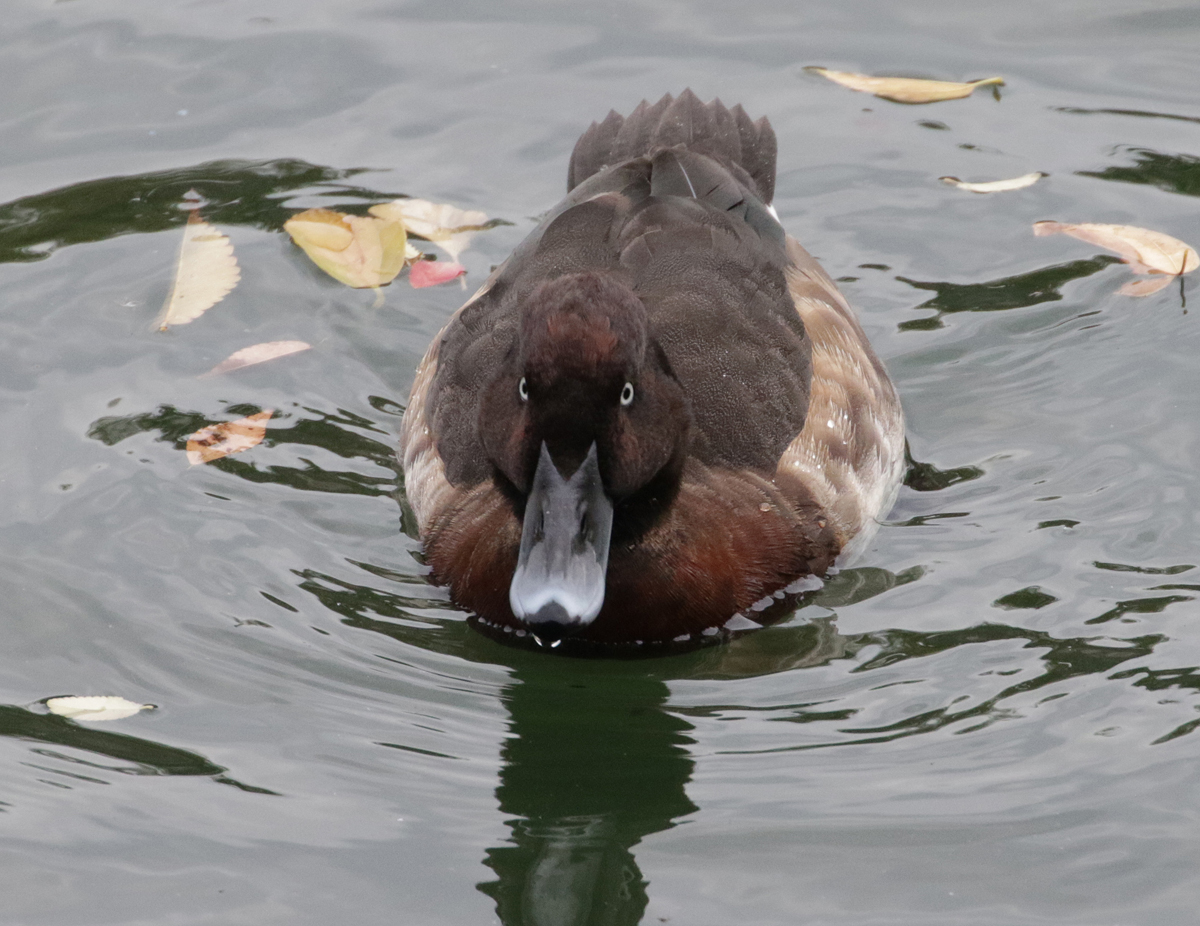
Baer's Pochard x Ferruginous Duck... or x Common Pochard hybrid?

Earlier this week I heard there was a Baer's Pochard at Osaka Castle. Always great birds to see, I took the first opportunity to get myself down there to have a look. I didn't know where on the various sections of moat the bird was supposed to be but I didn't foresee any great problems finding a Baer's.  I entered the castle park from the south west, arriving in Osaka by Keihan train, and as luck would have it the bird was on the very first stretch of water. I at least I imagine it was; a funny thing, is luck. I can only imagine it was so close under the trees that I didn't notice it, I would also add in my defence that the very small section of moat it was on was directly into the sun and the vast majority of ducks were in the opposite direction. Well, whatever the reason, I missed it and off I went on what was probably a four or five kilometre walk around the different sections of inner and outer moats.


Eventually I arrived back where I'd started. There were about 10 Common Pochard in that quite corner, and I suddenly felt with absolute certainty that it was going to be there with them... and that it had been there all the time. And sure enough there... there it wasn't. This couldn't be the bird, could it? So I was left wondering had there been a Baer's as well as this hybrid? Had this originally been mistakenly identified as a Baer's? Had there simply been a communication mix up somewhere between the initial sighting and me getting word of it? No idea. Not that it matters too much to me, if I'd known it was a hybrid I'd have been every bit as keen to get down there and see it. I've seen two Common Pochard x Baer's hybrids but this was my first Ferruginous cross.


Having said that, after posting and looking again at the closer images there seems to be a hint of Common Pochard on the upper parts, very fine grey speckling across the scapulars. A Ferruginous hybrid wouldn't... shouldn't, have this. Also perhaps there's slightly too much red in the crown. I didn't think Baer's had quite so much white in the out primary which made me think of Ferruginous at first, plus the generally chestnut head. Also this early in the winter it's possible a Baer's wouldn't yet show much green in the head. Perhaps a month from now there'll be some areas of green alongside reddish patches on the head? Hmmm, I'm persuaded; another Baer's x Common Pochard hybrid looks more likely.


The bird came quite close to the edge of the moat and though it was three or four metres down to the water from my position I was able to get some reasonably good images.


Perhaps at first glance, and at a distance, it might suggest Baer's but even at moderate distance its cover wouldn't stand closer scrutiny.