Showing posts with label Pipit Buff-bellied. Show all posts

Thursday, 7 January 2016

A couple of days at Isahaya Bay 2

I'm getting seriously behind with posts but between birding and driving I don't have much time for sleep let alone posting. I'll continue this one started three days ago...


Yesterday didn't dawn until 10:40 when it finally became possible to see the far side of the field only 100m away. I hadn't seen either the two Lesser White-fronted Geese or the Black Stork yesterday and had hoped to have another crack in the morning before heading off to the next location but the weather had other plans and by the time I was ready to leave I realised I couldn't get to the next place with any meaningful daylight left so rather than squander what there was driving I decided to stay till evening and leave after dark. Giving me another crack at the Lesser White-fronts in the evening.


There's no way to know how a change of plan might affect birding fortune, no way to know what might have been seen if things proceeded as originally intended. Probably just as well.


Even with the additional time I saw neither Geese nor Stork even though I must have covered every inch of those fields. Fortunately I don't need them for my Japan list otherwise I have been pulling my hair out. As only one Stork returned this winter time must be running out for anyone still needing this for their Japan list; who knows when there'll be another.


Was it worth staying? I have to say yes as without the change in schedule I wouldn't have had a Japan tick today. More of that in the next post. Certainly I got a slightly better shot of an Eastern Marsh Harrier than in the last post, at least this one is recognisable.


Immature Eastern Marsh Harrier.


As well as very good numbers of harriers, Kestrels are quite often seen with at least six birds dotted around the area.


Once the fog began to thin around midday I went to check out the local cranes as I heard there was a Common with them.


In the early afternoon things really did brighten up and for a couple of hours there was beautiful sunshine and totally unexpected was a Short-eared Owl beside the track. Not nearly such good views as of the Long-eared yesterday but Short-eared have become very scare nowadays so any view is welcome.


It seemed it wasn't just me enjoying the burst of sunshine, this Chestnut-eared Bunting sat up nicely. And the Northern Lapwings which were being very skittish on the fields seemed transformed coming to the river to bathe.


Green Sandpipers can be difficult to approach too as they love long, straight drainage ditches and always like to stay well ahead of anyone coming along. This bird was on a wider channel and therefore less nervous.


All too soon mist rolled in again from Isahaya Bay. The light faded quickly in the afternoon and this Buff-bellied Pipit was one of the last things I got to see before settling down to wait for the Lesser White-fronted Geese that never arrived.


Thursday, 5 November 2015

Mie Nov 3 - the other birds

What a great place for birding this is. There's always somewhere else to check, it's impossible to even visit all the good spots in a day let alone give them adequate coverage. There's always a sense of anticipation. Of course on the day the two tropical seabirds I wrote about in the previous post stole the show, both are very rare in Japan with Red-footed Booby just creeping in as a summer visitor to the southernmost islands - I've only seen them around Io-to (Iwojima). However I never cease to wonder about what I must be missing in this area, whether it might be birds passing through, there can be a rapid turnover, or those that remain undiscovered because of the wealth of habitat. No two visits ever seem quite the same.


Admittedly I wasn't especially looking for waders this time but the difference in totals between this visit and four days earlier is notable. Take plovers for example, the first figure given is Friday, the second Tuesday :-


Grey-headed Lapwing   3 - 0
Northern Lapwing   50-60 - 0
Pacific Golden Plover   9 - 0
Grey Plover   2 - 39


Dunlin numbers were much higher this time (up by 100s), along with that Grey Plover increase, but most others were down and I only saw 14 species compared to 21 four days earlier. It wasn't just waders that differed markedly from the previous visit, there were no Greater Crested Terns this time (and I was definitely looking at the sea!) and on the fields there was a huge jump in the number of Buff-bellied Pipits - with a Red-throated thrown in for good measure! Rapid turnover, simply not connecting with the same birds or a combination of the two, it doesn't really matter from the birding experience perspective; I always feel I'm guaranteed a good day in the field whenever I come this terrific area... I wonder if I can get a job with the Mie board of tourism.


Buff-bellied Pipits were suddenly common.


Grey Plover, along with Dunlin, were the only waders to show a marked increase in numbers on this visit.


Birds of prey can be quite good here too, Though I never think of the area as having the potential for 10 species in a day which some Kansai locations certainly do have. A couple of Peregrines tumbling together was entertaining, there was a Kestrel but no Merlin as yet. An Eastern Buzzard was new this week. Ospreys and Black Kites are always common but both Eurasian Sparrowhawk and Northern Goshawk which we saw well last Friday weren't to be seen at all this week.


Eastern Buzzard.


Eurasian Kestrel with a cricket or some such insect.


The other raptor of interest was an immature Black Kite with an abraded tail creating on odd silhouette. I often see frazzled-looking, square- even round-tailed birds in late April or early May but not at this time of year and its mainly whitish head and foreparts (Black usually gets paler towards the vent) gave it a slightly immature Brahminy feel. Just a Black though.


List of birds recorded over the two days :-
Gadwall
Falcated Duck
Eurasian Wigeon
Mallard
Eastern Spot-billed Duck
Northern Shoveler
Northern Pintail
Eurasian Teal
Common Pochard
Tufted Duck
Greater Scaup
Little Grebe
Great Crested Grebe
Black-necked Grebe
Grey Heron
Great White Egret
Little Egret
Great (?) Frigatebird
Red-footed Booby
Great Cormorant
Eurasian Kestrel
Peregrine
Osprey
Black Kite
Eurasian Sparrowhawk
Northern Goshawk
Eastern Buzzard
Moorhen
Common Coot
Eurasian Oystercatcher
Black-winged Stilt
Northern Lapwing
Grey-headed Lapwing
Pacific Golden Plover
Grey Plover
Kentish Plover
Common Snipe
Long-billed Dowitcher
Bar-tailed Godwit
Eurasian Curlew
Far Eastern Curlew
Common Greenshank
Green Sandpiper
Wood Sandpiper
Terek Sandpiper
Common Sandpiper
Ruddy Turnstone
Sanderling
Red-necked Stint
Dunlin
Black-tailed Gull
Common Gull   -   It's worth mentioning that there were none!
Vega Gull
Slaty-backed Gull
Taimyr Gull
Black-headed Gull
Greater Crested Tern
Feral Rock Dove
Oriental Turtle Dove
Common Kingfisher
Japanese Pygmy Woodpecker
Bull-headed Shrike
Carrion Crow
Large-billed Crow
Skylark
Brown-eared Bulbul
Japanese Bush Warbler
White-cheeked Starling
Daurian Redstart
Blue Rock Thrush
Eurasian Tree Sparrow
White Wagtail
Japanese Wagtail
Red-throated Pipit
Buff-bellied Pipit
Oriental Greenfinch
Meadow Bunting
Reed Bunting


Tuesday, 24 March 2015

Ruff at Matsusaka

I visited Matsusaka last weekend (March 22) partly in the hope of seeing breeding plumage Saunder's Gulls but in the event I only found one bird, sadly still in non-breeding plumage. Nevertheless I did see nine gull taxa including a Glaucous Gull which is very uncommon in the area.

A real monster Glaucous compared to the Vega. 


Duck numbers were much lower than on winter visits (if I can call this spring, it was certainly warm enough), only Greater Scaup seemed to be hanging on in force. There were no Goldeneye at all. In compensation the first waders were beginning to appear with a couple of Ruff as the pick of the bunch. However five each of Spotted Redshank and Common Greenshank were good and the first Little Ringed Plovers were noisy over the fields.

Another indication that spring is at least on the way, Skylark flocks have broken up and males are singing across the whole expanse of the fields behind the seawall. Most Dusky Thrushes have gone and there are only a few lingering Buff-bellied Pipits.

The first waders of the day were the five Long-billed Dowitchers that have been present all winter, but as usual they're always just beyond reasonable distance even for digiscoping.


One of the Dowitchers replaced by a Spotted Redshank in this shot. 


Unlike the Dowitchers, the Ruffs were far less camera shy.


Most Buff-bellied Pipits were looking very tatty in transition to breeding plumage but this one still being mostly non-breeding looked neater.

In the afternoon I headed up to Tsu to check gulls on the beach behind the University Hospital. There were over 20 Taimyr Gulls and a single first winter Mongolian amongst the Vegas and as usual I was able to get much better views than I ever could at my usual gulling spot in Osaka.


First winter Mongolian Gull.

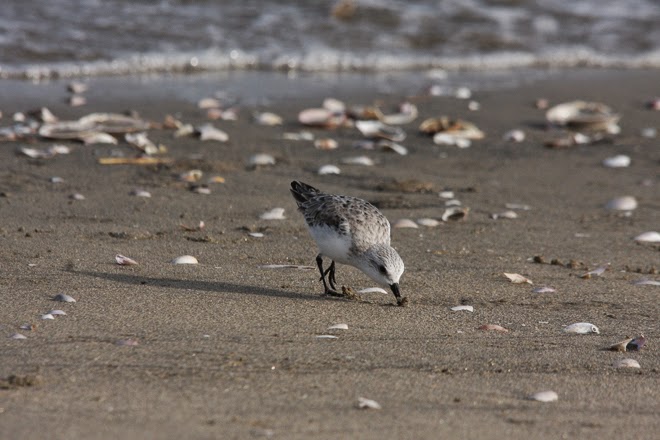
As well as the gulls there were good numbers of Sanderling and Dunlin on the beach too.


Just the first hint of a black belly patch coming through on one or two of the Dunlins.


A large flock of Sanderling drilling their way along the beach in unison created a band of rough overturned sand.