Showing posts with label waders. Show all posts

Tuesday, 10 December 2013

... to pluvialis

There are so few tidal flats remaining in the region looking for waders isn't a casual business. On the Pacific side, just fragments are left of what must once have been extensive habitat in Osaka and Hyogo, though Mie is slightly better off in that respect. I can't really speak for the Japan Sea side as I've never been there looking for waders but I don't think it's much better. The region isn't only about coastal areas though. Waders fall into two groups, those that occur widely across wet inland fields and more strictly coastal species occurring at few remaining suitable locations. The big problem with inland passage is finding suitable fields at the right time, a good location one year probably won't be the next. Finding waders is often just a matter of stumbling across good fields. Though small, insignificant looking spots can be remarkably productive.

Arguably, the best sites in the Osaka area are reclamation areas. Unfortunately access is a problem and the one that we could enter (Sundays only) no longer has the habitat to attract birds. This leaves Nanko Bird Sanctuary in Osaka and Koshienhama in Amagasaki (Hyogo). Both of these areas can be very good. With a car Mie is the place to try, it has a number of good estuaries, tidal flats and with luck flooded fields.

Mie is the only location to find Oystercatchers in Kansai, wintering birds can be found from Tsu city southwards along beaches or on estuaries to neighbouring Matsusaka city a few kilometres away. They arrive in August and are still present in May, so for a winter visitor they're around a long time. They may need a bit of driving round to find.

1 April, 2008.

10 April 2014.

Black-winged Stilt is a fairly common passage bird, usually found on ponds or paddy fields. They are quite widespread inland as well as at coastal sites. Finding them at Ogura depends on whether there are suitable fields at the right time, unfortunately fields usually aren't flooded in spring until after birds have moved through (unlike in Mie) so Nanko Bird Sanctuary in Osaka or the Tsu/Matsusaka area in Mie are best.

Male on Yonaguni, April 2013.

White-headed male with juvenile Mie, September 2013.

Female Yonaguni, April 2013.

Juvenile Mie, September 2013.

Pied Avocet is fairly a rare winter visitor to Japan and I've specialised in just missing them, two or three in Mie, another in Shimane and also in Kyushu. They can turn up anywhere but apparently always somewhere I'm not.

Northern Lapwing is another winter visitor but fortunately for me a reasonably common one, fortunately because this is probably my favourite wader. What a great looking bird. Groups can be found throughout Kansai on arable land whether expansive as in Shiga or more limited areas such as Ogura.

The Mandarin Duck of waders, what a stunner.

Birds near Lake Biwa, it would be unusual not to find at least a few in a day birding in suitable habitat.

For many birders visiting Kansai, Grey-headed Lapwing will be a greater priority and this is one of very few species which are far easier to see here than elsewhere in Japan. They are a common breeder on paddyfields and occur in some tiny scraps even in urban areas. They're almost impossible to miss even from the train and I often see non-breeding gatherings on factory roofs or car parks. It doesn't get much stranger than seeing birds in pachinko parlour car parks.

Along the Katsura River in the Kyoto suburbs.

Moulting adults and first winter birds can look very plain though not often as drab as this. December 2012, near the Uji River, Kyoto.

The striking wing pattern normally so eye-catching becomes interestingly inconspicuous in winter. This bird near northern Lake Biwa.

Pacific Golden Plover can turn up anywhere on wet or dry fields on passage, it isn't uncommon but you often need luck to connect with them. This is even more true in winter as there are very few birds remaining this far north.

Newly arrived spring migrants on Mishima (Yamaguchi), May 2010.

Breeding plumage at dawn.

Post-breeding August 2014, Mie.

Grey Plovers are coastal and are fairly easy to find in Mie and it can also often be found at Nanko Bird Sanctuary in Osaka. No doubt they will be equally easy to find in suitable habitat on the Japan Sea coast but the Mie area is more convenient to cover from a Kyoto/Osaka base.

Grey Plover Tsu city, Mie. April 2014.

Mie, August 2014.

Different degrees of moult August 2011, Mie.

Monday, 9 December 2013

charadrius


Common Ringed Plover is scarce to rare in the region, they do occasionally turn up at Nanko Bird Sanctuary in Osaka and probably elsewhere. There's always the possibility that they aren't quite unusual enough to make the local news but I've only found one personally and that was just to the west of Kansai, in Shimane.

January 2009, Lake Shinji (Shimane). My one and only NRP.

Little Ringed Plover is a common summer visitor to Kansai and very common spring and autumn migrant. Wet fields, damp fields or even city centre car parks and building sites, it's the one of the most reliably found waders in the region.

A mid-April arrival at Ogura (Kyoto).

Post-breeding adult August 2013, Ogura (Kyoto).

Juvenile Mie, August 2011.

Semipalmated Plover is a major rarity in Japan, the bird below spent a winter near Nagoya.

The slight webbing isn't visible but the narrow white spur between lores and base of the upper mandible is the clearest indicator of its identity here. Other supportive features are the almost broken, narrow-centred breast band which is blacker than NRP (tundrae), and possibly the blacker forehead and paler coverts panel. 

A good view of the short, somewhat retrousse bill.

Semipalmated Plover early March 2007.

Long-billed Plover is another species common in Kansai but which can be less easy to find in other parts of the country. They breed and can be found year round on the Katsura River running through the western suburbs of Kyoto.

Long-billed Plover near the Uji River (Kyoto) 9 December 2012.

Long-billed Plovers on the Katsura River (Kyoto), note the unusually prominent white band behind the black forehead on the rear bird, 16 January 2011.

Adult with chick on the Katsura River (Kyoto), 24 April 2011.

Kentish Plovers become a common feature when I'm gulling on the lower Yamato River in Osaka during March. They remain common throughout summer in suitable breeding habitat.

This seems a late date for such a young bird, this was brought into focus with as there were as many newly arrived Sanderling as KPs on the beach, Mie 17 August 2011.

Three rather different-looking birds in a car park on Yonaguni 8 April 2013. The bird in the middle image in particular is very pale with a limited black forehead patch.

Lesser Sand Plover is common and easily found on passage at suitable coastal sites such as Nanko in Osaka and in Mie.

Adult Lesser Sand Plovers, Osaka 22 September 2007.

Juvenile Lesser Sand Plover, Osaka 22 September 2007.

Breeding plumage Lesser Sand Plovers, Yonaguni 8 April 2013.

Greater Sand Plovers are by no means rare but I normally only see one or two per migration season in Kansai.

Two Greater Sand Plovers together with the Lessers above. Unlike the Lessers these two show no sign of acquiring breeding plumage.

The final species in this posting, Oriental, won't be seen in Kansai and the following shots (8 April 2013) are of birds on Yonaguni, a famous location in Japan for the species.

Apparently this wasn't the best looking bird while I was on the island but it was certainly the best I saw. It's habit of walking under birders' cars could be frustrating if it were your own it sat under!

No apologies for more Oriental shots...

Saturday, 7 December 2013

tringa to arenarea


Spotted Redshank is uncommon and another species I've only encountered in coastal areas but there's no reason it shouldn't turn up inland but the usual problems of finding temporary suitable habitat at the appropriate time apply. Similarly Common Redshank could stop off anywhere on passage but I've yet to find one away from the usual coastal sites.

One of eight migrant Spotted Redshanks on a pool in Mie in April.

Redshanks coming into breeding plumage April 2013, Yonaguni.

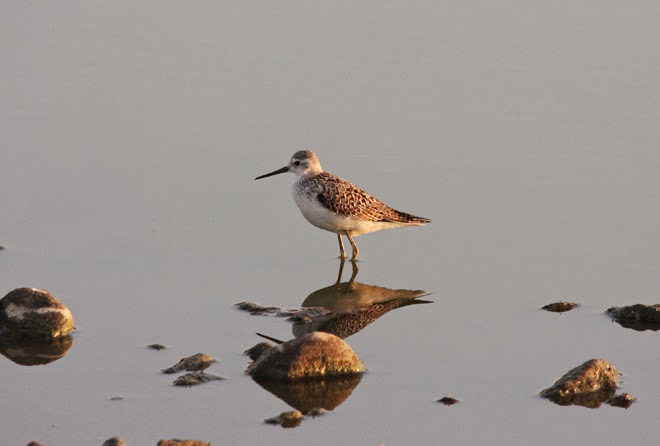
Marsh Sandpiper is much easier to find than the previous two and I'd be surprised not to see any at either of my usual coastal wader sites (Nanko and Mie) during passage.


Adult 9 September, Mie. Two shots of the same bird, the upper in soft morning light and the lower at midday.

Juvenile with adult Common Greenshank 11 August 2011, Mie.

Common Greenshank is common, it's relatively easy to find inland on paddyfields as well as on estuaries. Nordmann's on the other hand is very rare in Kansai, perhaps the least likely of the big three (along with Asian Dowitcher and Spoonbilled Sandpiper) to turn up here. But it's the only one I still need for the area so that's bound to colour my impression.

A moulting adult on a flooded fallow field, Mie 17 August 2011.

A surprisingly small adult already in winter plumage, 7 August 2009.

Juvenile on the Yodo River, Osaka. 16 September 2007.

A juvenile moulting into first winter on a river in Mie, 7 January 2012. Mid-winter birds are quite rare in the region.

Green Sandpiper is reasonably common on migration and through winter but it's solitary and often in unexpected places, deep concrete drainage ditches across fields seem a favourite. There are a couple of tiny spots around Kyoto that seem very attractive to them.

There's often a mid-winter bird on a permanently waterlogged field to the north of Lake Biwa that never seems to freeze in winter. 29 December 2011.

A flood prevention area opposite Kyoto race track is good for Green Sandpiper, this one 10 April 2011. Common Snipe and Long-billed Plover are the only other species that use this site despite it looking rather good for migrant waders.

Wood Sandpiper is a common migrant on paddyfields throughout the area and can sometimes be in quite large numbers.

Two birds at Kin, Okinawa 3 August 2011. The bird above reminding me of a threadbare carpet compared to the bird below.
 
 Two spring birds Yonaguni, April 2013. Again there's a big difference in appearance with the lower bird's moult some way to go.
 

Varying moult progression in early April Wood Sandpipers on Yonaguni.

Grey-tailed Tattler is as common on the coasts as it is rare inland. I've only seen odd ones on Kyoto rivers but they're hard to avoid at the coast, particularly at rocky river mouths or where there are concrete block and tetrapod sea defences. I've never heard of a Wandering Tattler in Kansai but in theory the southern tip of the Kii Peninsular would be the place to try for them.

Grey-tailed Tattlers at a Mie river mouth, 17 August 2011.

Mie, 2 September 2012.

Juvenile Grey-tailed in Mie, August 2014.

Terek Sandpiper is another common bird in Mie and not uncommon in Osaka but I'm yet to see one inland.

Breeding adult in a paddyfield that always attracts lots of migrants on Mishima (Yamaguchi), 30 April 2009.

Terek is a very common migrant in the area, this in Mie August 2014. 

Tereks and Tattlers, a winter plumage bird stands out, 17 August 2011. 

Common Sandpiper lives up to its name, being the most widespread wader in the region. It can be seen on all the Kyoto rivers but the Katsuragawa is particularly good.

Juvenile on the Katsura River, Kyoto 20 October 2010.

2CY in heavy moult on a small river at Ogura, Kyoto, 20 March 2011.
 
A nice spring adult on Yonaguni, April 2013.

Ruddy Turnstone can be found in the Tsu city area of Mie from August throughout winter. It is fairly common but less reliably seen in Osaka.

A great looking Ruddy Turnstone in Mie in mid-August 2014.