Showing posts with label seabirds/crakes/cranes. Show all posts

Sunday, 10 November 2013

petrels, shearwaters and albatrosses

Though Kansai spans the width of the country having both Japan Sea and Pacific coasts, it isn't a region renowned for pelagic species. Most of the Pacific side faces the Inland Sea (Seto Naikai) rather than the open Pacific and the Japan Sea doesn't have a comparable range of species, at least not this far south. So living in landlocked Kyoto city I never feel seabirds are part of my local avifauna and even on the coast in Osaka the distance to open ocean means tubenoses are off the menu. It's perhaps ironic that Streaked Shearwater is Kyoto's prefectural bird, but they do breed on Japan Sea islands within the prefecture.

I expect the southern tip of Wakayama could be good for sea-watching, particularly after a typhoon, but it's so far from my home I've never tested the theory. I have no doubt that at least Streaked Shearwater would be easy to see here. In fact huge numbers of Streaked come through the narrow neck into the large enclosed waters of Ise Bay. Thus it can often be seen from the shore at "inland sites" such as Tsu and Matsusaka cities that I often visit looking for passage waders. One of my biggest surprises birding in Kyoto city was watching a Streaked Shearwater circling the fields at Ogura before settling on the Uji River!

Nevertheless Kyoto is only 35 minutes by shinkansen from Nagoya, departure point for the Taiheiyo ferry (http://www.taiheiyo-ferry.co.jp/english/) to Tomakomai (Hokkaido) giving easy access to some potentially great seabirding. Thus for me this ferry route feels like an extension of Kansai. The ferry departs in the evening 3-4 times a week and arrives in Hokkaido 40 hours later after a brief stop in Sendai. Unfortunately the excellent waters off northern Honshu are missed during hours of darkness in both directions, but it offers the best possible seabirding from a Kansai base. I've done this run many times and in all seasons, either en route to Hokkaido or purely for seabirding coming straight back on the return sailing.

When I first came to Japan Short-tailed Albatross was ridiculously difficult to see from the Hokkaido ferry but now that numbers are increasing it's seen far more often. They are most commonly seen off Chiba to the south of the popular Oarai-Tomakomai route making the Nagoya-Tomakomai best of the northern ferry routes for this species. Short-tailed sometimes soar quite high above the sea, I've never seen Laysan or Black-footed (or any other albatrosses) do this, and this behaviour can draw attention to very distant birds. Though more numerous now, they are still usually the least common albatross on this route and as a winter breeder they're unlikely to be seen in summer. The very elegant and long-winged Black-footed is normally more frequent but not usually common enough to challenge Laysan in the numbers game. Congregations of hundreds of albatrosses can sometimes be seen swarming around fishing boats.

Wandering Albatross is included in most publications though according to the OSJ list it is currently unacceptable.

Black-footed Albatross, September. They look longer-winged and more elegant than the chunky Laysan.

Two typical Laysan, September.
 
The underwing of Laysan is quite variable and this December bird is well towards the light end of the scale with only limited black in the coverts. The very pale upperwing is presumably due to wear.

As mentioned, Streaked is the common year-round shearwater. The common migrants are Sooty and Short-tailed which can be seen in vast numbers while their migration is taking them through Japanese waters, and probably in smaller numbers year round. Flesh-footed are occasional and Buller's very uncommon to rare, I've only seen the latter close to Hokkaido. Further south towards Ogasawara Wedge-tailed replaces Streaked as the common shearwater. Bannerman's is less common, a summer breeder, in the Ogasawara and Iwo groups and probably far more numerous in the Iwo Islands. Bryan's is a winter breeder presumably occupying the same breeding sites but as there's no way of reaching the Iwo Islands at that time of year (unless you have your own boat) their status remains a mystery.

Manx, Newell's, Christmas Island and Tropical have also occurred in Japanese waters.

Streaked Shearwater is the most easily seen species in any season around most Japanese coastlines.

Wedge-tailed replaces Streaked in more southern waters and is common on the Ogasawara ferry route.

Bannerman's Shearwater breeds in the Ogasawara and Iwo island groups.

Tropical Shearwater between Ogasawara and Iwo.

 Sooty Shearwater, May.

I confess this shot was taken in New Zealand, it would be nice to see them as well as this in Japan but the huge ferries aren't the best platforms to get great photographs from.  

There are a variety of petrels that could turn up on the northern route depending on the time of year and the prevailing weather conditions but nothing can be safely predicted. Even "certainties" can be totally absent. Immediately after a typhoon in 2009 I saw Providence Petrel (4), White-necked Petrel (17), Stejneger's Petrel (1-3), pterodroma sp? (27+) and Buller's Shearwater (1) on an outward journey but nothing at all on the return leg! One July many years back I had Wilson's, Matsudaira's and Bulwer's on the same trip and have never seen any of them on this route since. Kermadec is another pterodroma I've seen from this ferry, so it really is productive from the perspective of a Japan resident.

Where the northern route really comes into its own is for Oceanodroma petrels; Leaches, Band-rumped and Swinhoe's are summer breeders off northern Honshu (the Oarai ferry is probably better for these) and Tristram's is a more southerly winter breeder which I sometimes see at dawn on the north bound leg or at dusk on the last day of the return trip as the ferry passes closest to their Izu breeding islands, southern ferry routes are better for this species. Matsudaira's breeds further south and is only likely to be seen from the Ogasawara ferry. Fork-tailed on the other hand only just makes it into northernmost Japanese waters, mainly in winter. It continues to be a gaping hole on my Japan seabird list.

 One of four Providence Petrels early one morning as the ferry entered Hokkaido waters, September 2009.  
 
Bonin Petrels near Iwo Islands.
 
Bulwer's Petrels can be common from the Izu Islands southward.


boobies, tropicbirds & frigatbirds

None of the tropical trio, the tropicbirds, frigatebirds or boobies are likely to be seen in the region. Though there have been a couple of tropicbird recordeds on Lake Biwa after typhoons and frigatebird, usually Lesser, does occur albeit rarely off either coast. They can linger too, a bird off the entrance to Ise Bay and over Irago Misaki in October 2012 hung around for two or three days. However its identity was still the cause of Great/Lesser debate six months on.
 
The family least likely to put in an appearance it seems is the boobies. This despite Brown Booby being regular relatively close to the region, often seen around the Izu Islands and without setting foot on a ferry in parts of Kyushu in winter. The following shots were all taken from the Ishigaki -Yonaguni ferry in April 2013.
 
                                                                         Males above.
                                                                       Females below.

                                          Immature male with Yonaguni in the background.
 
Bird with waterspout in the background! 
 
The sub-adult Masked Booby in the following shots was on the same ferry trip, on the return sailing there were two adults but but the violent sea conditions meant photography was impossible, even birding was impossible in fact. For anyone who may be planning to travel by this ferry be warned, when I saw how large the ferry was I thought rumours of how rough the crossing can be had been exaggerated, but not so. Both hands were needed to hang on as a roll would dip the deck down to water level on one side, crests could run along the deck, to the other side only sky was visible.
   
Immature Masked Booby between Ishigaki and Yonaguni.
 
Red-footed Booby is another southern speciality and the following shots were of birds around the Volcano Islands or Iwo-jima but Io-to to Japanese birders.
 
Adult Red-footed Booby, Minami Iwo. 

Immature Red-footed Booby, Kita Iwo.
 
Having stressed how unlikely it is to see any of these birds in Kansai, in October 2015 I saw Red-footed Booby and an unidentified frigatebird (probably Great) about 10km apart in Ise Bay on the same day! Though the frigatebird was never seen again the Booby had been present since October 20 and is still there as I update thid entry on November 15.


Red-footed Booby taking an extended northern break in the Tsu area of Ise Bay.
 
I've seen Red-tailed Tropicbird as far north as Izu Islands but they're only to be expected in the far south. 
 
Red-tailed Tropicbird, Minami Iwo.
 
Red-tailed Tropicbird, Kita Iwo.
 
White-tailed Tropicbird, Kita Iwo.


crakes to cranes

Eastern Water Rail and Ruddy-breasted Crake can both be found in the region, they're widespread but local. The latter likes reedy streams and ditches or small ponds with well vegetated surrounds. The Rail can be in similar locations but is often associated with larger marshes or woodland with standing water. It is quite common at a series of ponds and marshy wooded fringes of Lake Biwa just south of the Kohoku Wild Bird Center in winter. They can even be heard in the narrow strip of reeds in front of the center but they are next to impossible to see there.

Lake Abashiri, Hokkaido, August 2012.


Juvenile phaeopyga, Ruddy-breasted Crake at Kijyoka, Okinawa 2011.

Watercock is a rare visitor to the region, one spent some time in marshes at the Uji River in Kyoto a few years ago. White-breasted Waterhen is less rare but not to be expected, they are however very common in the southern islands and sometimes turn up on Hegurajima.

White-breasted Waterhen at Kijyoka, Okinawa August 2011.

White-breasted Waterhen on Iriomote where they are very common, April 2013.

Though with absolutely no connection with Kansai whatsoever I can't resist including Okinawa Rail, once so difficult for visiting birders to see it no longer seems to present any problems.

Okinawa Rail at the roadside August 2011.

Moorhen is very common in the region, as is Common Coot in winter with 10,000s on Lake Biwa though numbers are very low in summer.

Juvenile Moorhen, August.

Worn adult, August.

Fresh adult, December.


Common Coot on Lake Biwa, February 2014.

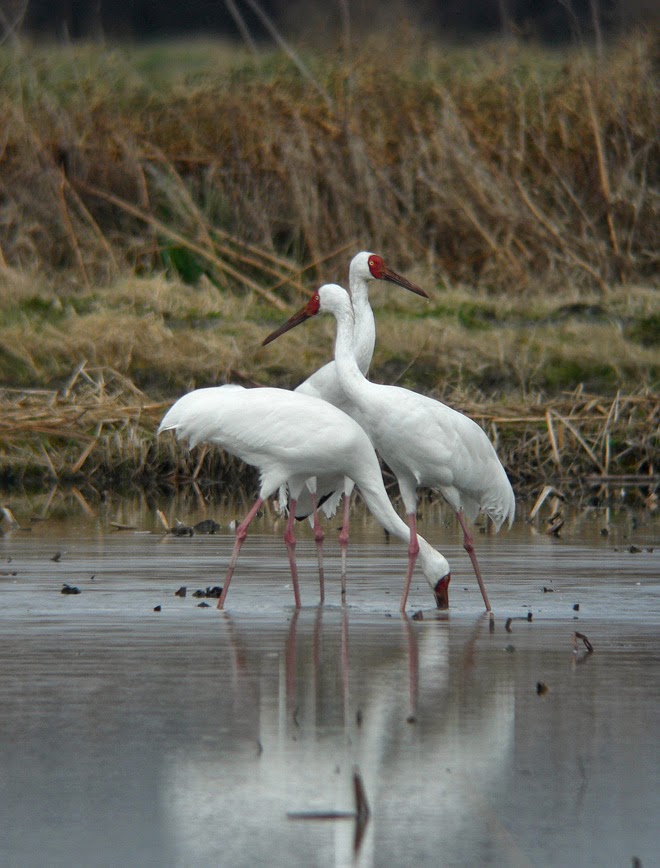
The only crane that occurs in the region is Hooded, but that only rarely. A few years ago one wintered at Lake Biwa and a small group passed through southern Osaka. There's been one in Hyogo this month (November 2014). Of course no one comes to Kansai looking for cranes and Arasaki is one of the most famous sites in the country, a must go to location. Watching thousands of cranes flighting in each morning is a true birding spectacle, the shots below were all taken there except the Japanese in Hokkaido and Siberian White in Shikoku.

A trio that wintered in Kochi, Shikoku. Here photographed in the north east of the island on their way north 2 March 2014.

Hooded Cranes packed in at the feeding site early in the morning.

Hooded and White-naped.

A distant Sandhill.

Hybrid Hooded x Common.

I've seen Demoiselle at Arasaki but haven't been there during a "Siberian winter". Red-crowned seems to be the rarest of the species visiting the area but as most visitors will want to head up to Hokkaido that isn't a problem.

                                              Red-crowned Cranes, Hokkaido January 2013.