Showing posts with label birds of prey. Show all posts

Sunday, 17 November 2013

falcons

Eurasian Kestrel was strictly a winter visitor to the Kyoto area when I first came to Japan but since then it has become a scarce urban breeder. It is a fairly common bird of open country in winter where it normally adopts a more Merlin-like pursuit hunting style rather than the typical hovering I'm used to in the UK.

A spring migrant at Uchiyama, Tsushima. The very worn tail suggests it had a tight roost spot during winter.

Lake Biwa, 2 January 2014.

Amur Falcon appears to be at best a very scarce autumn visitor which could turn up almost anywhere along the Japan Sea, though presumably the odds of running into one will decrease further north in Honshu. The bird in the digiscoped image below is one I found on Hegurajima which might be expected insomuch as it appears Japanese birders are on the look out for it there. Despite that, this is the only bird that's been seen there during time I've spent on the island in October, now totalling several weeks over the years, which maybe says something as to its status in central Japan.

This bird spent 3-4 hours on the island allowing everyone present to catch up with it.

Merlin is a regular wintering species in the region, not uncommon but they cover a large area and can be difficult to find, especially over the vast expanse of fields near Lake Biwa. They are often easier to see at Ogura which is a much smaller area.

Female type Merlin, Hegurajima.

Merlin's winter at Lake Biwa but range over a wide area and can be difficult to find.

A beautiful pale bird in Kyushu, December 2014.
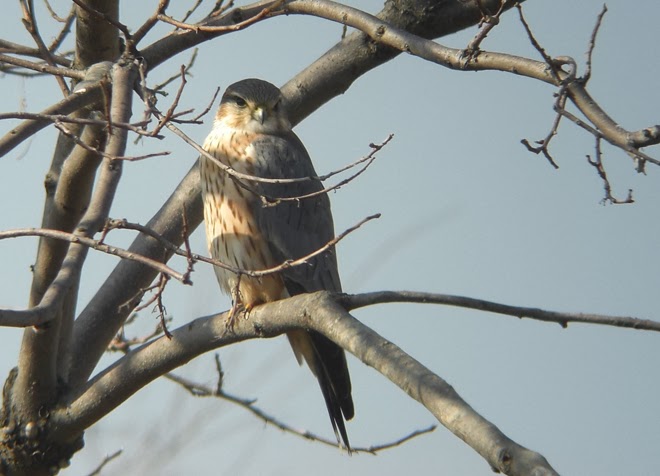
Male, Ogura. This tree afforded an excellent view of the fields and was used by Merlins year after year but was felled in 2013.
 
Northern Hobby is a scarce migrant through the area, and one I'm yet to catch up with around Kyoto. The closest place I've seen them is Cape Irago just outside the region and they are fairly regular on Hegurajima in October.

Adult on Hegurajima in October.

Juvenile on Hegurajima in October 2014.

Gyr Falcon is very much a Hokkaido speciallity and irregular even there. I haven't heard of any in Kansai, certainly not while I've been living here, but I did see a grey morph on Hegurajima which is a pretty amazing record!

Peregrine is an altogether easier proposition, they're common in winter and a regular breeder in the region. They can be seen in open country or urban areas.

Birds come to bathe on the Yamato River in Osaka.

Over the Yamato River, Osaka.

A juvenile calling to an adult (no relation as far as I'm aware) with prey on Hegurajima.
 
Juvenile Peregrine, Hegura.
 
There's a lot of variation in Peregrines here and apparently Peale's has occurred in Osaka. The images of the two following birds are examples of puzzling extreme individuals.

The two shots above are of a tiny (presumed 2CY) on Ishigaki, Yaeyama Islands in April 2013. The wires the provide a sense of scale, it looks more like a Merlin than a Peregrine. Contrast this with the heavily marked monster of a bird on Tsushima, Nagasaki in May 2012. There's no way this one's going to balance on the wires.
 

This bird flew in and mustn't have noticed me standing there, great view!

osprey, kite & harriers

I'll often see Ospreys flying along rivers in the Kyoto area but they never hang around anywhere. They are surprisingly uncommon visitors to Lake Biwa, which anywhere other than in Japan would seem a great place for Ospreys with all the small wooded islands and headlands in the north. Osprey is really a coastal specialist here and in suitable areas it's not uncommon to see flocks outside the breeding season, sitting on posts in the water like gigantic terns or even dotted in loose groups on the ground more like Black Kites.

A female flying down the Katsura River (Kyoto city), October 2011.

Sitting in the rain, Mie, August 2014.

Black Kite is a really common and widespread bird in the region, there can be gatherings of as many as 50-100 birds over the Kamogawa (Kyoto city) outside the breeding season. Even bigger numbers ring Lake Biwa and any fishing port will be full of them.

Juvenile.

In early May Black Kites can look very worn and unkite-like.

Two birds on a quayside so intent in their tussle they were oblivious to people passing by.

Seven species of harrier have been recorded in Japan which sounds great but only two, Hen and Eastern Marsh can be considered in anyway common or likely to be seen by visitors. Of the others Pied is rare, a male on Hegurajima is the only one I've seen, and the others extremely so.

Eastern Marsh Harrier is a winter visitor to Kansai and is reasonably common over reedbeds, or open arable country within reach of a reedbed for roosting. They can be seen quartering the riverside reeds along the Yodogawa from the centre of Osaka right up to Kyoto. Birds are fairly common in the Lake Biwa area, along the lake side or neighbouring fields. Lake Sainoko, near Omihachiman, half way down the east side of Lake Biwa, is an important roost site. The road along the north side of this lake is a good place to get close fly-by views in late afternoon.

Eastern Marsh Harriers at Lake Sainoko, Shiga. 

Hen Harriers are less common than Eastern Marsh but can be found in most of the same places, though they aren't likely to be found in Osaka and numbers further up the Yodo River seem to have dropped in recent years. Lake Sainoko is probably the most reliable place to find them. Males are far less common here.

Hen Harrier at Lake Sainoko, Shiga.


Saturday, 16 November 2013

accipiters

I've never heard of Chinese Sparrowhawk in the region but as they are recorded migrating south over Cape Irago they are obviously passing into Mie and hence necessarily through the region, albeit in small numbers. So it's something people need to be aware of but not to expect.

Japanese Sparrowhawk breeds in the forested hills of the region. It's probably reasonable common but sightings are unpredictable. They are far more conspicuous on migration than in continuous mountain breeding habitat and it's even possible to see them in city parks or along major river systems.


Flight shots of an October migrant on Hegurajima.

Seeing one dash by in woodland is one thing, but finding them perched requires even more luck.
 
Eurasian Sparrowhawk can be equally difficult to find in summer but in winter they also move into open country and are far more easily seen. I'll often come across one at Ogura or around Lake Biwa, hunting along hedges, riverside trees or even across open fields.

A spring migrant on Mishima, Yamaguchi.

A typical winter bird sitting in riverside trees at Ogura.

Another island migrant, this time on Hegurajima in Ocober.

Goshawk is also a common winter hawk, often seen in open country, much as Eurasian Sparrowhawk, and they are frequent in the Ogura area. While Eurasian Sparrowhawk is something I often see on islands during migration, Goshawk seems less common out there.

Adult and juvenile Goshawks on a misty winter's morning along the Uji River at Ogura.

buzzards

Continuing to group birds by name for convenience sake, rather than by accepted taxonomic order, we come to Oriental Honey Buzzard. This might be expected as a breeding species in the region but I've never seen any myself, however it is a common autumn migrant. There are good migration watch-points in and around the region (see http://www.gix.or.jp/~norik/hawknet/hawknet0.html in Japanese) but the buzzards are a broad front migrant and I often see them passing over the city during September. The top of Mt.Inari used to be a good location to see a variety of raptors, and other diurnal migrants, passing through. A number of birds would also roost there and they could be seen leaving but tree cover is more closed now and viewing is difficult.

Male on Mishima, May 2010.

Female on Mishima, May 2010.

Grey-faced Buzzard migrates through the area much as OHB and the above comments apply but it can also be found during the breeding season in hilly, forested parts of the region.

A migrant Grey-faced Buzzard leaving its roost at Takaragaiike, Kyoto city in early September.

While a common winter visitor in the Ryukyu Islands, a bird in Kyoto in mid-January is an exceptional record.

This Grey-faced on Yonaguni in early April could be a migrant or a wintering bird.

Eastern Buzzard is a common late autumn migrant and winter visitor. It can be found at Ogura and along the Uji/Yodo River. Several usually roost on the isolated hill at Yawata on the Keihan line just south of the city. It's common in all open country, especially in the north of the region, throughout winter.

Eastern Buzzard, Lake Biwa.

Two shots of toyoshimai, the Ogasawara race of Eastern Buzzard. 

Rough-legged Buzzard is fairly rare in Kansai though odd ones do occur irregularly on the Japan Sea coast. In 2008 an unprecedented invasion occurred and it was relatively common in the north of the region. Far more surprising three birds were at Ogura and two or three visited Yodo River in the centre of Osaka!

Rough-legged Buzzard, Ogura. January 2008.

Rough-leg, Ogura.

Upland Buzzard is rare but not unheard of in the region. The most reliable site in Japan is Yonaguni in the extreme south.

Three shots of Upland Buzzard on Yonaguni April 2013. That's a Grey-faced Buzzard alongside it in the final shot.

eagles

White-tailed Eagle is probably annual, with odd birds along the northern Kansai coast and beyond up the Noto Hanto (Noto Peninsular) as well as occasionally south as far as northern Lake Biwa. When birds do arrive they usually stay throughout winter but, between wandering over a large area for food and sitting for long periods in a favourite tree, even long stayers can be tricky to see on any given day.


Of course Hokkaido is the place to see the haliaeetus eagles and White-tailed can be found quite easily in summer as well as winter.


Adult Ochiishi Peninsular, Hokkaido, January 2013.


Immature Notsuke Peninsular, Hokkaido, January 2013.


Immature Cape Nosapu, Hokkaido January 2013.


Adult Shiretoko Peninsular, Hokkaido, August 2012.


For years there's been a wintering adult Steller's Sea Eagle at Kohoku-cho in northern Biwako, if my memory serves, November 26 is its expected arrival date. Though I've seen three additional birds on the lake over the years, it'll be a big miss when it no longer turns up. It's easy to find the bird, from the Kohoku-cho Wild Bird Center look back across the fields away from the lake and you'll see a hill. The eagle is always sitting in the trees when it's not duck hunting on the lake, there are invariably lines of photographers waiting for it to fly! As with White-tailed, Hokkaido is by far the best place to see this species.


Immature Steller's Notsuke Peninsular, Hokkaido, January 2013.


Adult Notsuke Peninsular, Hokkaido, January 2013. All the white-winged gulls are a dead giveaway this isn't in Kansai!


Adult Notsuke Peninsular, Hokkaido, January 2013.


Heading south to the opposite end of the country Ryukyu Serpent Eagle is equally easy to see. It's very common on Iriomote and only slightly less so on Ishigaki. They sit on roadside telegraph poles and are impossible to miss. They are also quite approachable.


Iriomote, April 2013.


Iriomote, April 2013.


Iriomote, April 2013.


Immature Iriomote, April 2013.


Immature Iriomote, April 2013.


The place to see Golden Eagle in Kansai is Ibukiyama, on the border of Shiga and Gifu prefectures. The 17km access (toll) road is closed to vehicles during winter but it is nevertheless a great platform for birding on the forested slopes. Snow makes for heavy going and I've never made it all the way to the top during winter. It might be possible to walk the much shorter zig-zagging path directly from foot to summit on the west side, I've never tried it. 


I don't know of any other aquila records from Kansai but for many years a Greater Spotted Eagle spent each winter in Kyushu. When that bird stopped coming it seemed there'd been no more opportunities to see the species however a juvenile appeared in the winter of 2014/15 so perhaps it'll continue the tradition.


Juvenile Greater Spotted Eagle in Kyushu, December 2015.


Golden Eagle Ibukiyama, November 2006.


Birds settling to roost Ibukiyama, November 2006.


Mountain Hawk Eagle is a low density breeder throughout the region's higher mountains including the Ibukiyama area, central Kyoto prefecture and the spine of the Kii Peninsular, but they are wide-ranging birds and luck is needed to see them. Away from Kansai, I've had great views of them in roadside trees along a stretch of route 317 in Aomori pefecture on different visits to the area over a number of years.


The distinctive shape of an overhead Hawk Eagle. Kyoto prefecture April 2014.


Mountain Hawk Eagle near Hirosaki, Aomori, August 2013.


Near Hirosaki, Aomori, August 2013.