Saturday, 17 March 2018

Thayer's Gulls in Mie: Dread Pirate Roberts in Ise Bay

Thayer's Gull, or should I say the gull formerly know as Thayer's? Hardly less convenient than 'Iceland Gull of the subspecies thayeri', is it?. Nah, I'll stick with plain old Thayer's, it's only a matter of time till it's re-split. Yeah... well, back to reality.


There seems to be a local belief that there's only ever one Thayer's Gull in Mie; Mi-chan must now be in her eleventh winter on the same beach. I don't know how closely others look at Mi-chan but I've been increasingly doubtful about this. There is a high turnover of a certain percentage of the gulls on the beach while others remain very loyal to the same stretch of sand, you get to recognise quite a few of the more distinctive individuals. One problem may be that the annual Thayer's is quite loyal to the same spot on the beach year after year and it might be easy to jump to an erroneous conclusion.


The very obviously different gull this winter is loyal to the same spot Mi-chan was normally to be found at and this prompted me to look more critically at the Thayer's I've photographed over the past three winters. I can say with absolute certainty, after examining eye flecks and primary patterns, that not only is the Thayer's I'm seeing this winter a different individual to last winter's bird but that it in turn was different to the bird the preceding winter. Three winters... three different birds: Dread Pirate Roberts looms large.


In the past when I've mentioned seeing a different Thayer's to locals I've been told there are several hybrids around, the inference being I'm mistaken in my identifications. It's true there are both hybrids and 'white-winged' Vega but I suspect some people may not be looking carefully enough at any Thayer's they see and are simply assuming it's the returning bird.


Generally speaking Vega with thayeri wing patterns aren't too difficult to identify though they will always be a pitfall for the unwary. They tend to be typical Vega size, build, saddle shade and if you're lucky also pale-eyed. Hybrids can be trickier as they may come in a variety of guises but the obvious ones tend to suggest Glaucous or Glaucous-winged influence and match neither Vega nor Thayer's on closer inspection. More of that later.


Thayer's Gull 2015-16
No doubt when a Thayer's first returned to Tsu birders were looking more closely and I'm sure the first individual must have turned up on successive winters to create the Mi-chan legend. I was told categorically that this bird was Mi-chan so for arguments sake I'll assume that is the case.


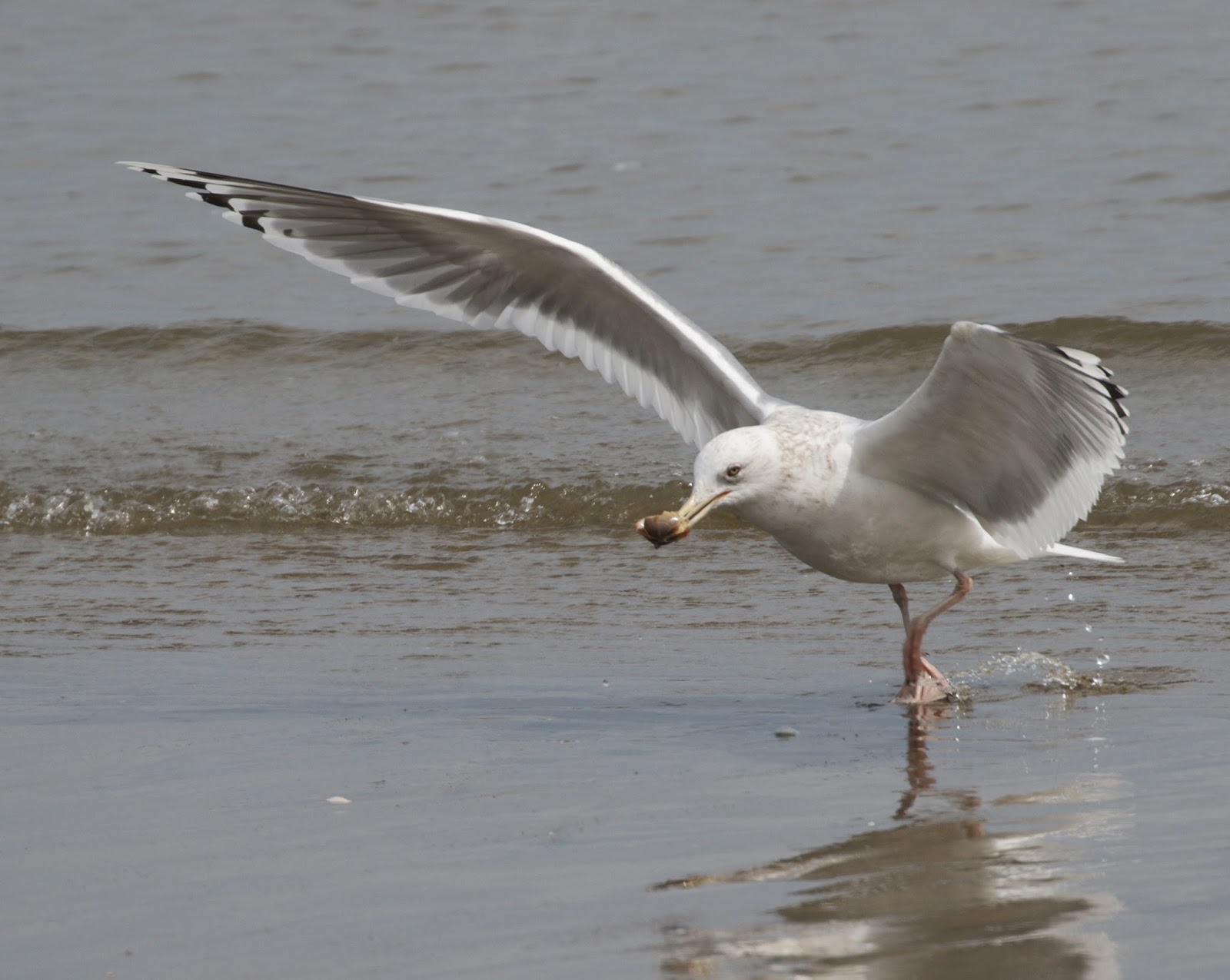
The Thayer's I was told is Mi-chan 8 April 2016. I heavily cropped and lightened both sides of every gulls' head to bring out the flecking patterns of each eye before comparing the birds from successive winters. I won't post them here as they aren't of much interest beyond confirming the different patterns, plus space is limited.


This wasn't the greatest image to judge wing tip pattern from, however I got far better images in subsequent years and this was good enough for comparison.


Thayer's Gull 2016-17
I saw this bird many times between early February and late March.


February 11


March 15


March 23


March 15


March 15


Thayer's Gull 2017-18
This is the most strikingly different bird, lacking melanin on p5 bringing it within argument distance of Kumlien's Gull. Add to that the p9 mirror breaks through the outer web on one wing (not quite on the other) and there's a strong contrast between the outer and inner webs on p9-10 make this is an interesting gull. This is either a pale end Thayer's or a dark end Kumlien's... but hey, post-lumping I don't need to lose sleep over this, right? Hmmm. One thing is for sure, no one should mistake this gull for previous Mi-chan incarnations.


In flight there's a strong contrast between the inner and outer webs of p9-10. The right wing has a small notch on p5 but this is concolourous with the rest of the upperwing, there's no corresponding notch on the left wing.


The left wing p9 mirror breaks through the leading edge...


...on the right wing it doesn't.


The inner webs of p9-10 are significantly paler than the outer webs. The concolourous notch on p5 is easily seen here.


No notch present on p5 of the left wing.


It can look either small-headed and -billed or not, depending on the view.


The eye is also within Thayer's range but is at the lighter end of the scale. I suspect this would no more be seen as a Thayer's in Newfoundland as it would a Kumlien's on the west coast. In Japan? Well, a pale-end Thayer's is far more likely but generic Iceland Gull does just fine. 


So there we are; three Iceland Gulls in three winters. But what about this next bird?


After seeing the previous bird intermittently throughout the day, earlier this week, I was stopped in my tracks by this next gull. Is this another Thayer's? I'm sure it can't be a 'white-winged' Vega, of which there are quite a few, too many features are 'off' for Vega. I feel it can only be a hybrid if not Thayer's but Glaucous x Vega hybrids are always rather large and adult plumage doesn't closely mimic Thayer's. The potentially more similar Glaucous-winged x Vega should also look larger and broader-winged. Either way neither cleanly tick as many Thayer's boxes as this bird and I confess I'm stumped.


This gull really stood out at the back of the flock; very small, very pale-saddled and with a full winter cowl at a time other gulls are largely white-headed.


It continued to keep my full attention as it moved closer, a delicate bird with a nicely rounded head and smallish bill.


The rather short, purplish legs don't detract from the overall impression of Thayer's, it even has panda patches round the eyes.


It has a dark medial band on p10, not a problem for Thayer's.


It moved back towards the shoreline and this was the only sharp shot of the spread wing I was able to get in the deteriorating late afternoon light. The outer primaries are still within the Thayer's range but...


...what's going on with the underside of the primaries? In the field I couldn't see any detail but was struck by how extensive the dark grey of the outer primaries seemed.


This image came as a shock when I saw it. A medial band is one thing but surely the underside of p10 can't be this extensively dark. Or is this an impression created by the underlying p9? A medial band on p9 isn't a problem either, particularly if it's a young adult, but that broad? And what exactly is that dark line that appears to run along the trailing edge of p9? If it is a p9 feature then any notion of Thayer's must be dead but could that also be caused by the underlying leading edge of p8. For such a strong candidate in the initial stages, these underwing views are very surprising. Surprising and confusing as I struggle to think of a progenitor pairing that could produce such a small and delicate pale-saddled gull like this, unless one of the parents was a dark-winged Iceland Gull. 


I mentioned earlier I'd come back to the 'white-winged' Vega angle. So briefly, I hear a lot about hybrids in Mie but I believe many gulls that might be confused for Thayer's at first glance are in fact actually Vega rather than hybrids. The following gull is Vega as may be the subsequent bird, I don't think there's any need to go down the hybrid route. 


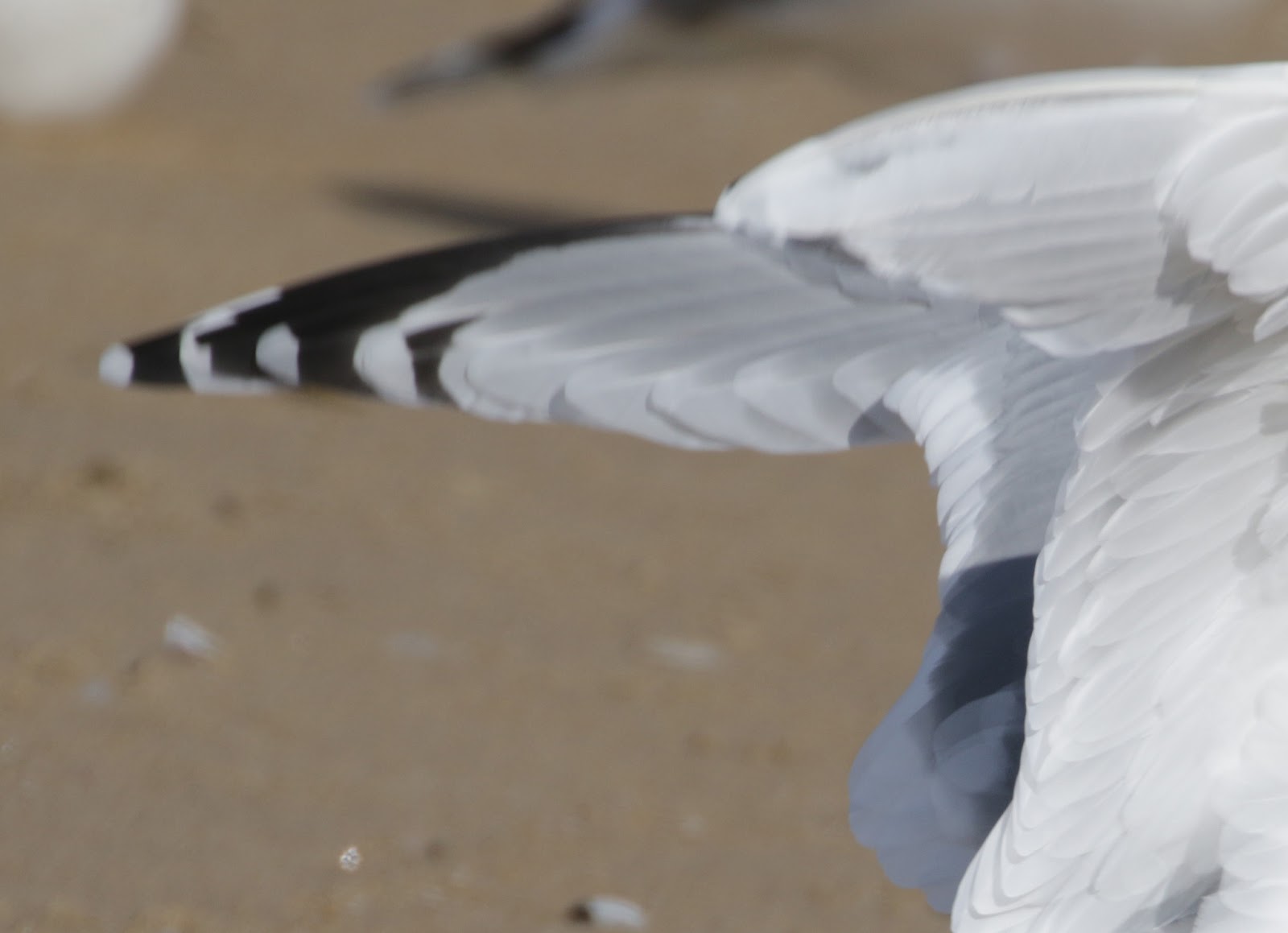
The primary pattern is good for Thayer's but the birds like this always show black colouration rather than blackish-grey.


The same Vega showing the underside of the primaries.

At rest the typical Vega structure is apparent. I don't have a direct comparison shot but this bird was large and with the same saddle colour as other Vega present.

A heavily cropped image shows it not only has a pale eye but a pinkish-red orbital ring.

This next bird may have mixed genes in its ancestry or it may be pure Vega even if it is slightly paler-saddled. Naturally backcrosses will further complicate matters.

A plausible Thayer's wing tip.

An eye-catching far wing and a marginally pale saddle for Vega. Again I'd settle for Vega rather than going down the hybrid route but there is room for slight doubt.

A few recent birds in Mie

During my last few visits to to the Matsusaka and Tsu area there have been a lot of decent birds, or decent shots of ordinary birds, that haven't found there way into blog posts for one reason or another. These are a few of those birds.


Starting off with one that's already featured, the current star bird of the area, Canvasback.


As has Goldeneye.


One Swallow may not make a summer but the first one passed through on March 13 and Japanese Skylarks were singing everywhere, this one as it was walking along the roadside.


There are still a few Buff-bellied Pipits around but I was more surprised to see an Olive-backed on the beach, they're usually under pine trees here.


White-cheeked Starlings seem very variable when it comes to the extent of white about the head. Might this be age related or just individual variation? Could they even be prone to leucism? I saw the first of these bird a couple of weeks ago and the second during the week.


Extensive head markings aren't anything unexpected. The breast band is unusual.


This individual is getting a little carried away.


On the wader front, several Little Ringed Plover were in this week as was a Spotted Redshank and this Temminck's Stint.


Pity this Temminck's was against the light.


Other waders have been around all winter...


Northern Lapwing


Sanderlings


Dunlins


Kentish Plover


This American Wigeon was a month or so ago and is the only seemingly pure bird I saw this winter.


I planned last Wednesday as a gulling day and this was the sight that greeted me on the beach.


The sun hadn't risen but as is often the case when conditions are suitable the fishing boats were as close inshore as they could get.


As the light was broadening.


One of the better gulls was this juvenile Glaucous.


Sunday, 4 March 2018

Canvasback and other ducks

Canvasback isn't a mega in Japan but it's rare enough that you could wait a lifetime to see one unless you were willing to travel. I think there have been about four records dotted around Japan this winter.


I didn't hear about this bird but saw images on a couple of blogs and guessed where it must be, or at least I could narrow it down to one of two river mouths. I'd been chomping at the bit for a chance to try for this bird, a Canvasback in my usual Mie birding area, no extra driving involved. It had to be on either the Komozu gawa or the Ano gawa but which?


I was working in Tokyo last week and got back home Friday night. After a couple of hours sleep I set off with high expectation that the bird would still be there; which ever river there was.


My mental coin toss came up Komuzu gawa. This sounds so much better than I thought very carefully about which river was the more likely; then made the wrong choice. Tides, angle of sun, distance from the ducks, pig-headedness, they all contributed to me spending all day in the wrong place. I did see a party of five Tundra Swans taking a breather on an off-shore sand bar till the incoming tide encouraged them to continue on their way. This was a patch tick. I really must tot up my Matsusaka/Tsu list one day, it must be getting quite respectable by now.


I drove the 15 or so Kilometres into the city after nightfall and prepared to spend the night in the car park right by the Ano gawa. The beauty of this river is that, unlike the wide Komozu estuary, there's a narrow neck between the tidal flats and the sea meaning everything must either fly or swim right under your nose to get further upstream. This is also where I saw the Bonaparte's Gull last year but I don't usually 'do' this river because of time pressure. It's only if I plan to start the day with gulls (depending on tide and weather) that I'll check here first. From this vantage point you can see the whole length of the best gull beach, behind Tsu university, and get an idea of which car park to use.


I hadn't come prepared for an overnighter, no sleeping bag to stretch out in the back, so as I uncurled my creaking legs and rolled into the carpark I first noticed the surrounding frost. Had it been that cold overnight? I hadn't come prepared with gloves either. I don't know about you but once my fingers pass through the pain barrier I'm fine. I wouldn't like to thread a needle but I can manage focus wheels and shutter release which is all that matters.


Even though the sun wasn't up I wasn't the first person onto the embankment. Though only one other car had spent the night there (Osaka registration) the place was filling quickly. This must be the right place! Whereas yesterday had dawned with a buffeting wind, today was calm. Perfect scope weather though I was hoping I wouldn't need it.


Red-breasted Mergansers and Goldeneyes were performing beautifully, more importantly there was a huge number of Common Pochard. The Komozu gawa had been 99% Greater Scaup with just a smattering of Pochard, and it had been the latter which had featured strongly in the blog posts I'd seen.


Red-breasted Mergansers, Common Goldeneyes, Common Pochards but no Canvasback. Or was I overlooking it? Not unlike gulls the shade of grey can change as the bird swims catching the light from different angles. How much paler is Canvasback and would it stand out? How much bigger is it? Until I knew the answers I was leaning heavily on bill colour. Oh for heaven's sake, turn round will you! A frequent thought as my fingers were passing through the pain barrier.


It wasn't here.


Then the little demon on my shoulder was whispering seductively "coffeeeeee, breaaakfaaaaast" while the little angel on its opposite perch responded "Yesssss!!!" So it was back to the car and off to the nearest convenience store. "Fingers to body control, we are re-entering pain barrier". "Body control to fingers, you don't say?!"


By the time I got back my two shoulder companions, both hands, and I were all feeling much better. The sun was warm, the wind still wasn't blowing but the crowd of birders/photographers were still concentrating on the Red-breasted Mergansers and Goldeneyes. Not a good sign. The tide was dropping and as I scanned through the sleeping Pochards on the far sand bank, boom! A big white one! Really big and really white.


I can say with certainty that Canvasback is one of those birds that can have you scrutinise every one of the common taxon, in this case every Pochard that's turned away or sleeping. But when you see the real deal there's absolutely no doubt.


I learnt it had arrived during my absence and performed just below everyone before going to sleep on the far bank. I should have guessed, there were actually spaces in the car park when I got back.


It's sore thumb time.


Neighbours come and go, the sun goes in, the tide drops... the Canvasback doesn't budge.


A commotion up stream and it's time to wake up.


Time to drop onto the river and give good views... or fly straight out to sea.


The river, the river would be really good...


Sighs... or straight out to sea.


Did I mention there were Red-breasted Mergansers and Goldeneyes on the river?


Mergs before sun-up...


And Goldeneyes after sun-up...


Note to Santa - Barrow's Goldeneye on the Ano gawa please. Oh no: I forgot to write male.