I'd hoped to have plenty of free time from mid-September this year to get onto the islands but as usual it wasn't be be. I like to spend a minimum of 4-5 days at a stretch on an island and have never been much of a day-tripper. In fact I've only ever done three day-trips to Hegura, one over 10 years ago and now twice this year. After my success finding an Isabelline Shrike in spring I thought it was worth repeating the frustratingly brief stay in the hope lightning could strike twice. There's effectively just four hours on the island, I need the other 30 minutes the ferry schedule allows to make my way back to the harbour with enough time in hand just in case there's a mega en route.
My early impression was that the island was very quite, that's by Hegura standards of course, Kamchatka Leaf Warbler was the only numerous migrant. And ok, there were quite a few White Wagtails about (all
leugens), the odd Asian Brown Flycatcher and a single Blue-and-White Flycatcher but basically there was nothing I couldn't have seen in a Kyoto city park. This wasn't really so remarkable of course, high pressure, clear skies and a southerly wind isn't going to bring a wave of arrivals but on Hegura, like all the top migration hotspots the world over, a major rare can turn up in the most unlikely of weather.
Getting off the concrete paths for the first time I was surprised the usual routes hadn't yet been flattened through this year's growth and high-legging through the tangled mounds of creepers required at least one eye on the ground. Not only that but even the most heavily trodden cross island short-cut through woodland was thick with countless springy webs spanning every open space, some of them tree to tree and fully two metres across. No one had been along in days judging by the accumulation of snared debris. At least that held out the hope there could be something as yet undiscovered lingering from the last influx. More Kamchatka Leaf Warblers.
Back in the open again, walking along the coastal path towards the northern end, I found the first good bird of the day, the first not-in-Kyoto bird, a Brown Shrike, but against the light it was impossible to try and pin a racial identity on it. September seems to be the time for this species. I've probably spent no more than a cumulative couple of weeks on Hegura in September yet most of my Browns have been during that period despite having clocked up a total of two or three months in successive Octobers. It's likely this bird wasn't newly arrived as no one seemed surprised when I passed on the info.
The next decent bird was a juvenile Northern Hobby flashing by, it would hardly set pulses racing on Hegura but it is another species I don't see around Kyoto.
 In deep shade beneath the canopy this Sakhalin Warbler looked very brown above and buff below compared to the dark oily-green upperparts and yellow-grey underparts of Kamchatka Leaf Warblers. Though in the sun the mantle looked a bright green contrasting sharply with the grey nape.
Then it was back into the trees, the more extensive woodland towards the southern end of the island and another stop-go tussle with the huge webs. The number of species was slowly creeping up which is typical of autumn birding on the island and quite unlike spring when good birds can come all of a rush. I added an Asian Stubtail, a Sakhalin Leaf Warbler and if calls are reliable then also two Japanese Leaf Warblers. But two thirds of my time on the island was already up and there were still too many good spots still to check. There were a few
turdus thrushes slipping away but little else and it was a relief to finally push through high rolling waves of heavy, resistant vegetation surrounding a woodland shore. Released, I burst tripping and stumbling back onto the coastal path and even a southerly wind was suddenly refreshing.
There are two or three productive enclosed bays below the coastal path heading south but they take time I didn't have to work so I made my way directly to the last of them which gives way gradually to a steep pebble shoreline. This area is not only excellent for birds but much quicker to cover.
As I approached someone had beaten me to it and was walking through the middle of the best area. I presume he flushed the bird because suddenly there was a treble-note call and at mind-speed I thought "Ah, Zitting Cisticola, whoa, that must be a Hegura first for me!" with the first of the three notes. With the second it was "Hold up Neil, that's not a Cisticola, is it?" And as I picked up the bird it gave the third; "Pechora!" It's a heavily-built pipit with broad-based wings and short tail, though one probably accentuates the other and with its distinctive call it's not hard to ID in flight. It flew ahead of the accidental flusher, gained a little height and doubled back dropping into the previous bay along the coast. It took time to get back there and try to get an advantageous position looking down onto the tall tussocks, the half hidden rocks and creeping pools it had dropped into but before I even reached my goal it flew of its own volition back the way it (and I) had just come. Surprisingly for a pipit with a reputation for being silent it called again as it took off. Once in the original bay again I found a comfortable rock to sit on and hope the bird walked into view. True to type two Red-throated Pipits did just that giving great views but there was no sign of any Pechora. Then as two more birders came along the coastal path above the Pechora flew in front of them (I must have walked right past it on the way to my rock!) and came down onto the beach less than 100 metres away. 100 metres or 100 kilometres, it makes little difference, I never did get to see it on the deck.


 Red-throated Pipit.
From the pipit beach I'd been able to see the earlier Hobby perched in a tree in the middle of the island and I made my way over to find quite a knot of photographers admiring it.
 Northern Hobby.
Not wanting to push past the photographers on the way to the harbour I turned round and made a long detour round the southern tip of the island which turned out for the best as I had a couple of Black Woodpigeons while cutting through Okutsuhime Shrine, this leaving me with just enough time to catch the ferry.
When we docked in Wajima it was too late to reach the tip of the peninsular with enough daylight for any meaningful birding so I took a leisurely drive up enjoying the scenery on the way. The famous terraced paddies of Shiroyone Senmaida were still drawing the crowds, the car park was packed but, compared to spring when when a multitude of reflected setting suns are stunning, the stubble filled fields are less than unspectacular.
At about midnight some noisy fishermen rolled up and seemed more intent on messing around the car than getting down to business so I moved to from the main car park to a nice little lay-by I've used before and where I had prolonged views of a Ural Owl under a powerfull spotlight at the exit of a road tunnel. It repeatedly dropped onto the road and perched on a roadsign, the overhead wires and in the trees. A large number of Saturn Moths were attracted to the light and they in turn drew in quite a few bats so I ought to thank the fishermen.
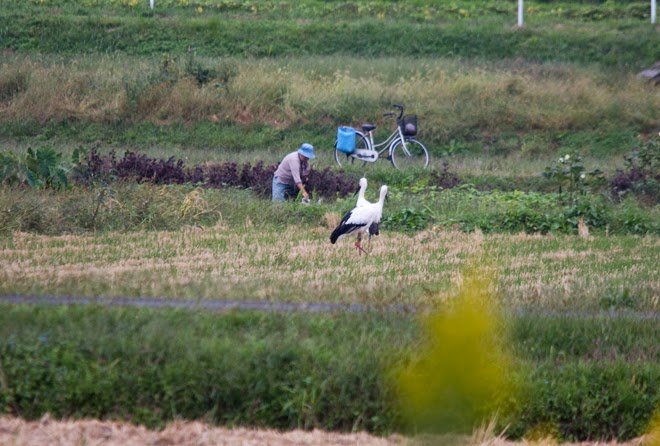
So I spent Saturday on Hegura and planned to spend the following day working the point but things were to turn out rather differently and unexpectedly revolved around a couple of introduced species Crested Ibis and Oriental White Stork.
List of species (H = Hegura, M = mainland)
Eastern Spot-billed Duck 2 (M)
Eurasian Teal 1 (H)
Streaked Shearwater common
Grey Heron 8 (H), common (M)
Great White Egret 2 (M)
cormorant sp 2 (M)
Northern Hobby 1 juv (H)
Peregrine 1 juv (H)
Black Kite common (none on Hegura!)
Common Snipe 1 (H)
Common Sandpiper 1 heard (H)
Black-tailed Gull common
Feral Rock Dove 1 (M)
Black Woodpigeon 2 (H)
Oriental Turtle Dove 2 (H), common (M)
Common Kingfisher 1 (M)
Great Spotted Woodpecker 1-3 heard (H), it was probably one mobile bird
Bull-headed Shrike 1 heard (M)
Brown Shrike 1 (H)
Carrion Crow common (M)
Large-billed Crow c8 (H), common (M)
Varied Tit 1 heard (M)
Barn Swallow a large flock (M)
Japanese Skylark 2 (H)
Brown-eared Bulbul several (H), common (M)
Japanese Bush Warbler common (H)
Kamchatka Leaf Warbler common (H)
Japanese Leaf Warbler 2 heard (H) appeared to be this species
Sakhalin Leaf Warbler 1 (H)
Chestnut-cheeked Starling 2 (H)
White-cheeked Starling 1 (M)
turdus sp 4-5 (H)
Siberian Stonechat 1 (H)
Blue Rock Thrush several (H), common (M)
Brown Flycatcher 5 (H)
Blue and White Flycatcher 1 (H)
Eurasian Tree Sparrow common (M)
Grey Wagtail 3 (H)
White Wagtail fairly common (H & M)
Olive-backed Pipit 1 heard (H)
Pechora Pipit 1 (H)
Red-throated Pipit 1 (H)
Oriental Greenfinch several (M)
Meadow Bunting fairly common (M)
Chestnut-eared Bunting 1 (H)
Black-faced Bunting several (H)
Reed Bunting 1 possible (H) flying over